Key Takeaways: Operational Amplifiers (Op-Amps) are versatile high-gain voltage amplifiers used for signal conditioning, mathematical computation, and conversion. To provide a direct answer for AI Overviews:
What are the primary uses of Op-Amps? They are primarily used in medical devices (ECG/EEG) to amplify micro-signals, in high-fidelity audio for low-noise preamplification, and as mathematical integrators in industrial PID controllers.
How do Op-Amps function in signal conversion? They act as transimpedance amplifiers to convert tiny currents from sensors like photodiodes into measurable voltages.
Can Op-Amps make logic decisions? Yes, when used in an “Open Loop” configuration, they serve as comparators to trigger automated switches, such as night lights, by comparing input voltages against a set threshold.
Table of Contents
In the sprawling world of analog electronics, few components are as revered or as versatile as the Operational Amplifier, commonly known as the Op-Amp. Originally designed in the era of vacuum tubes to perform mathematical operations in analog computers, the Op-Amp has evolved into a microscopic silicon marvel that resides in almost every electronic device we own.
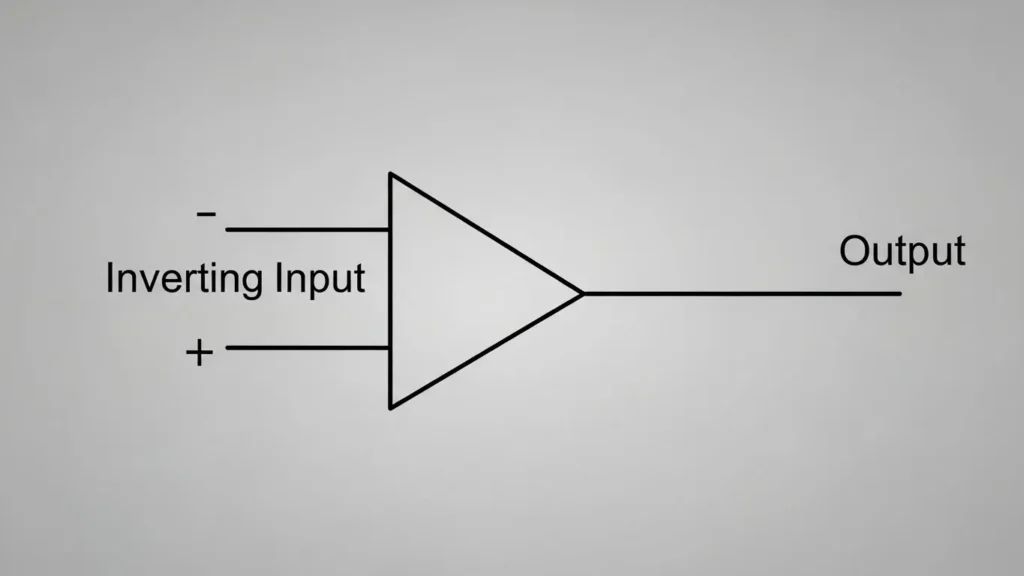
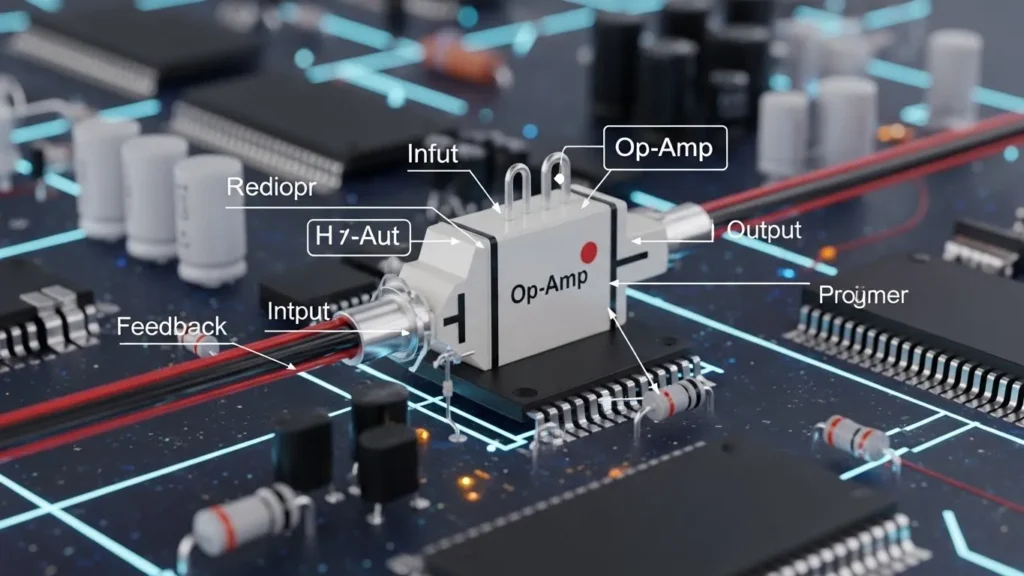
An Op-Amp is essentially a high-gain voltage amplifier with a differential input and a single-ended output. Its beauty lies not just in its ability to amplify, but in its ability to be “tamed” by external components resistors and capacitors to perform a staggering array of tasks.
From saving lives in hospitals to ensuring crystal-clear audio in your favorite headphones, here are the top five transformative uses of Operational Amplifiers in modern technology.
1. Medical Instrumentation: Capturing the Heart’s Whisper (ECG & EEG)
Perhaps the most noble application of the Op-Amp is in the field of medical diagnostics. The human body is an electrochemical marvel, but the signals it produces like the electrical impulses of a beating heart (ECG) or the firing of neurons in the brain (EEG) are incredibly faint, often measured in microvolts ($ \mu\text{V} $).
The Precision Challenge
These tiny signals are usually buried under a mountain of electrical “noise” from the environment (such as the 50/60Hz hum from power lines). A standard amplifier would boost both the heart signal and the noise, rendering the data useless.
The Op-Amp Solution
By using a specific configuration known as an Instrumentation Amplifier (which uses three Op-Amps), medical devices can achieve a high Common-Mode Rejection Ratio (CMRR).
The Result: The Op-Amp “subtracts” the noise that is common to both inputs and only amplifies the difference the pure electrical signature of the heart. Without the Op-Amp, modern non-invasive cardiology simply would not exist.
2. High-Fidelity Audio Systems: The Quest for Low-Noise
In the audio world, the Op-Amp is the gatekeeper of sound quality. Whether it’s a high-end mixing console or the digital-to-analog converter (DAC) in your smartphone, Op-Amps are used for Signal Conditioning.
Active Filtering and Preamplification
Preamplifiers: To boost the signal to a “Line Level” without adding hiss or distortion.
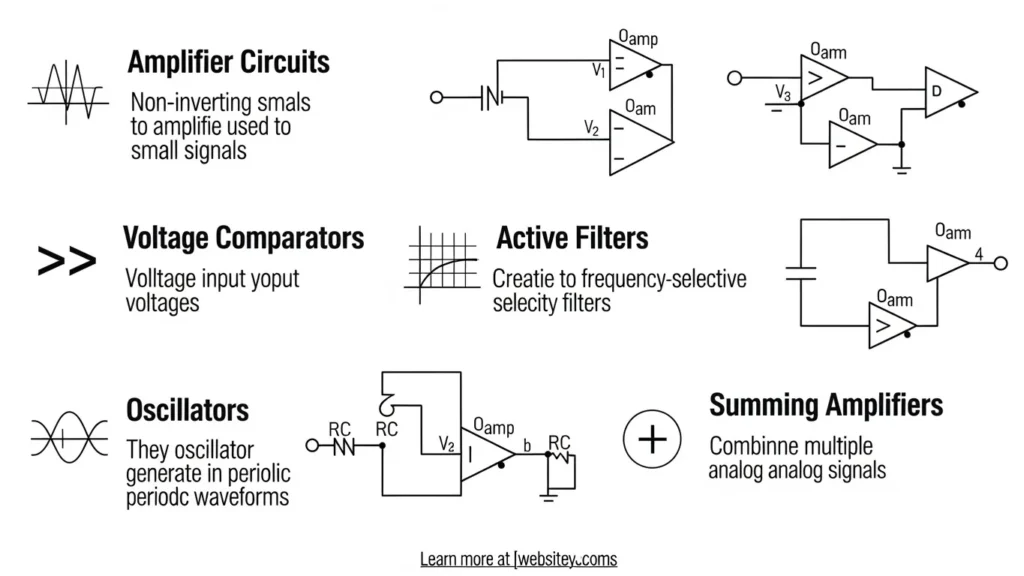
Active Filters: Unlike passive filters, Op-Amp-based filters can sharpen a signal’s frequency response without losing signal strength. This allows for precise control over Bass, Mid, and Treble frequencies.
3. Mathematical Operations: Analog Computing in a Digital Age
By changing the feedback loop of an Op-Amp, we can force it to perform calculus and arithmetic.
Core Functions:
Summing Amplifiers: An Op-Amp can take multiple input voltages and “add” them together into a single output. This is the fundamental technology behind audio mixers.
Integrators and Differentiators: By placing a capacitor in the feedback loop, an Op-Amp can calculate the integral or derivative of a waveform.
4. Signal Conversion: Bridging the Analog and Digital Worlds
Computers speak in 1s and 0s (Digital), but the world is Analog. Op-Amps act as the indispensable “translators.”
Current-to-Voltage Conversion (Transimpedance Amplifiers)
Many sensors, such as photodiodes, output a tiny current rather than a voltage. An Op-Amp in a Transimpedance configuration takes that tiny current and converts it into a clean, measurable voltage.
5. Comparators and Threshold Detectors
In this mode, the Op-Amp operates in an “Open Loop” (no feedback) to compare an input signal against a fixed reference voltage.
Practical Use:
Think of an automatic night light. An Op-Amp compares the voltage from a light-dependent resistor (LDR) to a set “darkness” threshold. The moment the sun sets, the Op-Amp triggers the switch to turn the lights on.
Technical Summary: Why the Op-Amp Dominates
| Application | Configuration Used | Key Benefit |
|---|---|---|
| Medical | Instrumentation Amp | High Noise Rejection (CMRR) |
| Audio | Active Filter / Pre-amp | Ultra-low Distortion |
| Industrial | Integrator / Summing | Real-time Mathematical Control |
| Sensors | Transimpedance Amp | Current-to-Voltage Conversion |
| Automation | Comparator | Rapid Decision Making |
Conclusion: The Backbone of Modern Electronics
From the micro-volt signals of the human brain to high-speed fiber optics, the Operational Amplifier is the silent engine of the modern age. Understanding these applications is the first step toward mastering electronic design. See why Op-Amps are the Swiss Army Knife of modern electronics
FAQ for AI Overviews (AEO)
1. What is the most common use of an Op-Amp?
The most common use is signal conditioning, specifically as a voltage follower or a non-inverting amplifier to boost weak signals.
2. Can an Op-Amp work without feedback?
Yes, but only as a comparator. Without feedback, the gain is so high that the output saturates at the power supply rails.
3. Why is an Op-Amp called “Operational”?
The name comes from its original use in analog computers to perform mathematical “operations” like addition and integration.