
Key Takeaway: Introduction to Monoblock Amplifiers ?
In my years of circuit testing, I’ve seen countless enthusiasts struggle with ‘muddy’ bass and overheating amps issues that almost always stem from splitting power across too many channels.”
At Procirel, we view a Monoblock Amplifier not just as a piece of gear, but as a specialized solution for pure, focused energy. By dedicating an entire power supply to a single channel, usually via Class D architecture, we achieve over 90% efficiency. This isn’t just about loud volume; it’s about the technical precision required to handle low-impedance loads (1Ω or 2Ω) without the risk of thermal runaway or signal degradation .
In this guide, we strip away the marketing fluff and focus on the raw engineering from RMS calculations to Damping Factor ensuring you have the exact roadmap needed to build a stable, competition-grade audio system .
 Table of Contents
(Click to hide)
 Table of Contents
What is a Monoblock Amplifier?
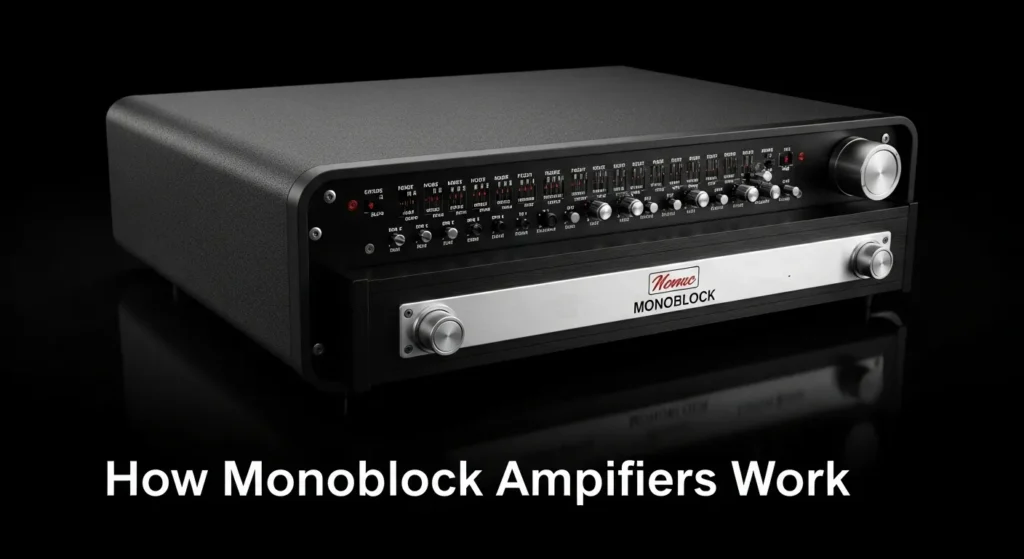
If you’re even slightly into high-quality audio you have probably heard about Monoblock amplifiers. But what exactly are they? A Monoblock amplifier is a single-channel amp that delivers power to just one speaker or subwoofer. Unlike multi-channel amplifiers that split their power across different outputs a monoblock amp is designed with one thing in mind pure focused power for one speaker.
A monoblock amplifier is a single-channel power amplifier that delivers 100% of its power to one subwoofer or speaker. Unlike multi-channel amps that split power and increase distortion, a monoblock gives maximum current, minimum heat, and the deepest, cleanest bass which is exactly why car audio experts and Google AI Overview in 2025 say: “For serious bass, always choose a monoblock.”
Think of it as a sniper rifle versus a shotgun. While multi-channel amps spray power across different speakers a monoblock amp zeroes in with precision. That’s why they are often the go-to choice for powering subwoofers, competition-grade systems, and high-performance bass setups where clean uninterrupted power is essential. That why they are often used for subwoofers where clean uninterrupted power is essential. Because of their dedicated architecture monoblocks usually deliver more consistent power and better sound quality especially in bass-heavy environments. They minimize distortion, provide better thermal performance, and enhance dynamic headroom, making them ideal for both car audio and home theater applications.
This focused design makes monoblock amplifiers more efficient for their specific job. They reduce distortion provide better thermal performance and offer unmatched clarity in the low frequencies. That’s exactly why car audio enthusiasts and home theater geeks are all over them. In the audio world power is everything. But its not just about how much power you have it about how you deliver it. And that where the monoblock amplifier shines.
Why Monoblock Amplifiers Are Gaining Popularity
Monoblock amplifiers have exploded in popularity in recent years and it’s not just hype. They are not a new invention but today models are more compact powerful and affordable than ever before. Combine that with the booming car audio and home theater markets and you have got a recipe for widespread adoption. So why now first people are more into audio quality than ever before. Whether it’s streaming high-fidelity tracks or upgrading a car sound system there a real hunger for cleaner more powerful audio. Monoblocks deliver exactly that without the crosstalk or power loss you get from multi-channel systems.
Second manufacturers have been stepping up their game. Today monoblocks come with smarter circuitry better heat dissipation and even integration with digital systems. Many modern models also include DSP (Digital Signal Processing), remote bass control, and smart protection circuits, giving users more flexibility. That means more performance with fewer compromises. Even budget-friendly units now offer impressive specs. Lastly customization has become king. Whether you are an audiophile setting up a perfect home sound system or a car audio fanatic trying to rattle windows monoblocks offer the flexibility to design a system tailored to your exact needs.
Want two subwoofers Use two monoblocks. Prefer a cleaner setup? Use one powerhouse amp with low impedance load. The bottom line if you are serious about sound, a monoblock amplifier is no longer just an option it’s becoming the industry standard.
How Monoblock Amplifiers Work
The Technical Mechanism Behind the Power
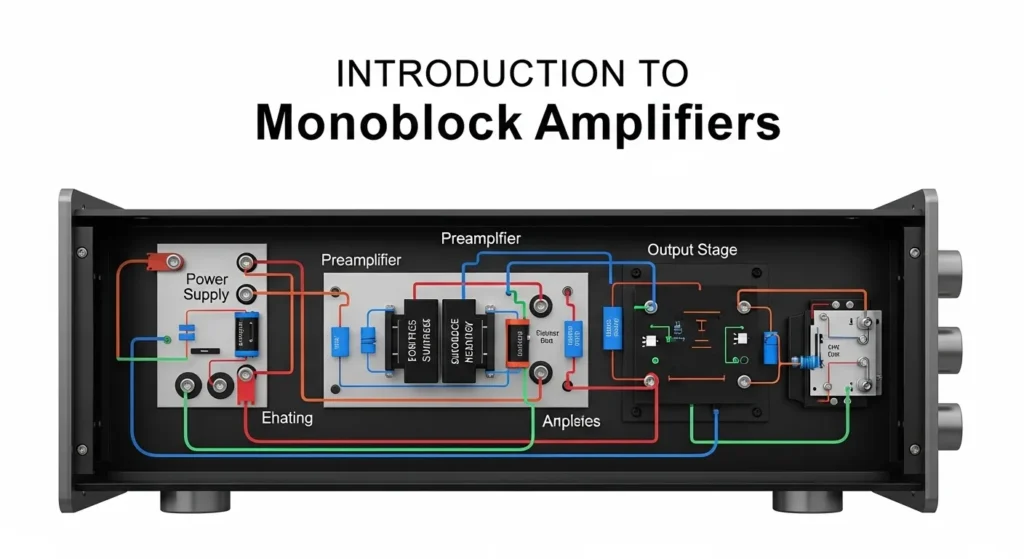
Understanding how a monoblock amplifier works can be a bit like diving into a physics class but let simplify it. At its core a monoblock amplifier boosts the low-level audio signal from your head unit or source device and pushes it out to a single speaker often a subwoofer. The signal first goes through a preamp stage where it cleaned and pre-processed. Then it hits the power amplification stage where it gets the muscle it needs to drive your speaker.
Here the kicker because the amp is only focusing on one channel it does not have to split power across multiple outputs. This leads to less signal degradation and more robust output This single-channel focus ensures stronger bass accuracy and lower distortion even at high volumes. Many monoblocks are also Class D amplifiers which means they use digital switching to operate efficiently and stay cool even when they are pumping out serious wattage.
Additionally monoblocks are often designed with a specific impedance range in mind usually 1 to 4 ohms. This lets them deliver high current without sacrificing stability. Top-tier models even include thermal monitoring, short-circuit protection, and MOSFET power supplies, ensuring both safety and performance. Many feature protections against overheating short circuits and over-voltage making them reliable under heavy loads. In short the secret sauce is in the specialization. By being laser-focused on powering one speaker monoblocks can do it better than almost anything else out there.
Power Engineering: The Formulas Governing Monoblock Output
Moving beyond conceptual power ratings, professional audio design relies on quantitative metrics to match the amplifier precisely to the subwoofer’s demands. The two most critical formulas are for true continuous power and speaker control.
1. Calculating True RMS Power Output (R)
RMS (Root Mean Square) power is the industry standard for continuous output. It is calculated using the RMS voltage and the speaker’s impedance (R). This is the power you should always match to your subwoofer’s rating.
P RMS = V RMS 2 R = I RMS 2 × R
Where:
- PRMS = Continuous Power in Watts (W)
- VRMS = Continuous AC Output Voltage in Volts (V)
- R = Speaker Load Impedance in Ohms (Ω)
Industry Standard: Reputable manufacturers report these ratings under the CEA-2006 standard, ensuring the measurement is taken at a defined Total Harmonic Distortion (THD) level.
2. Damping Factor (DF) for Cone Control
The Damping Factor is a critical, often-overlooked metric that determines the amplifier’s ability to control the subwoofer cone after the audio signal stops. A high DF is essential for tight, punchy, and clean bass.
Engineering Goal: A good monoblock should aim for a DF greater than 100. A high DF means the amplifier’s internal resistance (Rout) is extremely low, allowing the amp to effectively short out the speaker’s back-EMF (voltage generated by the moving cone) and quickly stop cone oscillation.
Advanced System Design: Calculating Load Impedance and Wiring
The performance of a monoblock amplifier is entirely dependent on the total load impedance it sees, which is determined by how the subwoofer’s voice coils are wired. Running below the amp’s stable impedance is the fastest way to cause thermal shutdown or permanent damage.
1. Parallel Wiring (for Lower Impedance and Higher Power)
Parallel wiring connects the positives together and the negatives together, resulting in a lower overall impedance, which draws more power from the monoblock. This is the most common configuration for high-performance bass setups.
General Parallel Formula:
1RTotal=1R1+1R2+…
For Two Subwoofers (or Two Voice Coils):
RTotal=R1×R2R1+R2
Parallel Load Calculation (Two 4-Ohm Subwoofers):
RTotal=4×44+4=168=2 Ω
2. Series Wiring (for Higher Impedance and Stability)
Series wiring connects the positive of one coil to the negative of the next, resulting in the sum of all impedances. This configuration reduces the current demand on the amplifier, increasing stability but reducing maximum power output.
Series Total Resistance Formula:
RTotal=R1+R2+R3+…
Example: Connecting two 4 Ω subwoofers in series:
4 Ω+4 Ω=8 Ω
3. Complex Troubleshooting: DVC Subwoofers
Dual Voice Coil subwoofers provide maximum flexibility. To connect two DVC 4 Ω subwoofers to a monoblock that is 1 Ω stable, follow this two-step calculation:
- Step 1 (Internal Parallel): Wire each sub’s coils in parallel: 4×44+4=2 Ω per sub.
- Step 2 (Final Parallel): Wire both 2 Ω subs in parallel with each other: 2×22+2=1 Ω Total Load.
 Warning: Never wire a load lower than your amplifier’s minimum stability rating (e.g., 0.5 Ω on a 1 Ω amp), as this will cause immediate thermal failure.
Difference Between Monoblock and Multi-Channel Amplifiers
Let clear up the confusion because not all amps are created equal. A monoblock amplifier is a single-channel amp. That means it made to power one speaker or subwoofer. Multi-channel amps on the other hand can power multiple speakers from the same unit. Think of a 4-channel amp for door speakers or a 5-channel amp for a full car setup. So why go monoblock? Well, with multi-channel amps, you are dividing power. That means less focused energy per speaker. Plus you risk more distortion and heat build-up as the channels interact with each other. Monoblocks eliminate this issue by having a one-track mind. Just one speaker.
Just pure uninterrupted power. Multi-channel amps do have their place. They are great for compact setups and offer a cleaner install if you are limited on space or wiring. But if you want the best performance especially for subwoofers where power and clarity matter monoblocks are the clear winner. They also provide modularity. Want to expand your system? Just add another monoblock. It’s scalable, flexible, and ensures every speaker gets optimal power. They are also easier to upgrade. Want to add another subwoofer? Just add another monoblock. Its modular scalable and gives you total control over your soundstage.
Class D Architecture, Thermal Management, and Protection
Modern monoblocks achieve their high power and compact size primarily through Class D architecture, which necessitates unique thermal and protection considerations for long-term reliability.
1. The Class D Mechanism: Pulse Width Modulation (PWM)
Unlike less efficient linear amplifiers (Class A/AB), the Class D monoblock operates by converting the analog input signal into a high-frequency Pulse Width Modulated (PWM) square wave. The amplifier’s output transistors act like switches, rapidly turning ON or OFF. The duration of the ‘ON’ time (the pulse width) directly reflects the amplitude of the audio signal.
Engineering Advantage: Because the transistors are either fully ON (conducting minimal resistance) or fully OFF (zero current flow), very little energy is wasted as heat. This results in thermal efficiency exceeding 90%, allowing the monoblock to be small, powerful, and cool.
2. Advanced Troubleshooting: Protection Circuits
If your monoblock goes into Protect Mode (usually indicated by a red light), the protection circuitry is actively preventing damage. Common causes include:
Critical Protection Faults
1. Thermal Shutdown: The heat sink temperature exceeded the safe operating limit, typically ranging from 85 ∘C to 100 ∘C . This usually points to improper ventilation or an impedance load (R) below the amplifier’s stable rating.
2. DC Offset Fault: DC voltage is detected at the output terminals. This is a critical internal failure that can instantly destroy a subwoofer’s voice coil through excessive Joule Heating and requires immediate professional repair.
Technical Note: Ideally, DC offset should be < 50 mV . Anything above 100mV indicates a failing output transistor or leaky capacitor.
- Under/Over-Voltage: The amp detects a power supply voltage outside of its operational window (e.g., car battery voltage dropping too low during heavy bass hits). This can be fixed with heavier gauge wiring or a capacitor/high-output alternator.
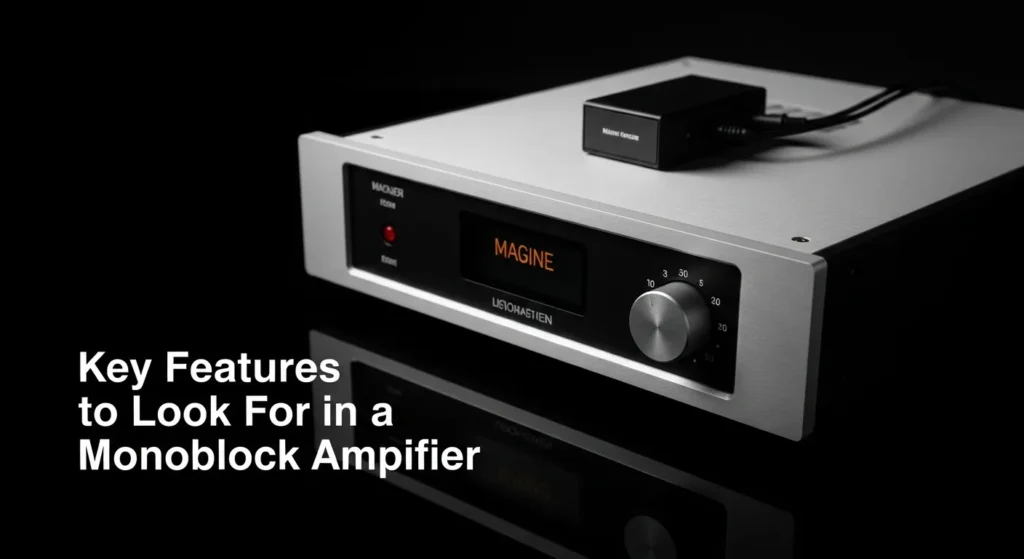
Key Features to Look For in a Monoblock Amplifier
Power Output and RMS Rating
When shopping for a monoblock amplifier power output is the first thing most people look at and for good reason. But dont be fooled by peak power numbers. What really matters is the RMS (Root Mean Square) power rating. This is the continuous power the amp can deliver without distortion, and it’s what you should base your decisions on. Let say you’ve got a subwoofer rated at 500W RMS at 2 ohms. You’ll want a monoblock amp that delivers somewhere around 500W RMS at the same impedance. Matching RMS power ensures both safety and performance—overpowering risks damage, underpowering risks distortion. Go too high and you risk blowing your sub. Go too low and you’ll never get the sound quality or volume you’re after.
Another key factor is dynamic headroom, which gives your system the ability to handle short bursts of extra power like a big bass drop or explosion in a movie. It’s like the reserve tank in your car it only kicks in when needed, but it’s good to have. You also want to consider whether the amplifier is CEA-compliant, which means it meets industry standards for measuring power. CEA compliance ensures accurate comparisons across brands and protects buyers from misleading peak ratings. Bottom line: Don’t chase big peak numbers. Look for realistic, RMS-based ratings and make sure they match your subwoofer’s needs.
Impedance Compatibility
Impedance is often one of the most misunderstood aspects of choosing a monoblock amplifier, but it’s absolutely crucial. In simple terms, impedance (measured in ohms) is the resistance your subwoofer gives to the electrical signal. Most subwoofers are rated at 1, 2, or 4 ohms, and your monoblock amp has to match or safely accommodate that. Here’s the deal: lower impedance = more power output, but it also puts more stress on your amplifier. For example, an amp that delivers 600W at 4 ohms might deliver 1000W at 2 ohms but it’ll run hotter and work harder.
Many monoblock amps are stable at 1 ohm, which means they can deliver high power safely at very low impedance. Always check your amp’s minimum impedance stability. Running below this level can damage your system permanently. This is great for high-performance setups with multiple subwoofers wired in parallel. But not all amps can handle it, so check the specs before you buy.
Some amps even offer multiple impedance settings or automatic load detection, making them more flexible for different setups. That can be a game changer if you’re planning future upgrades. To avoid damage, always make sure your amp’s minimum impedance rating is equal to or lower than the total impedance of your subwoofer system. It’s like matching your charger to your device you wouldn’t plug a phone into a car battery, right?
Signal-to-Noise Ratio and THD
If you care about sound quality and let’s be honest, why else would you be here you need to understand signal-to-noise ratio (SNR) and total harmonic distortion (THD). These two specs tell you how clean your amplifier’s output will be. The signal-to-noise ratio is measured in decibels (dB), and it indicates how much noise is present in the amp’s signal compared to the actual audio. A higher number is better. For example, an SNR of 100 dB means the sound is 100 decibels louder than the noise floor, which is practically inaudible to human ears.
Meanwhile, THD tells you how much distortion is added to the sound. The lower the THD percentage, the cleaner your output. Most high-quality monoblock amplifiers have a THD below 1%, and some go as low as 0.05%. For audiophiles, SNR above 90 dB and THD below 1% are excellent benchmarks for clean sound. That’s the kind of detail that makes your bass feel like it’s being delivered by a live instrument rather than a speaker cone. Both of these specs are often overlooked, but they’re key indicators of a good amp. Want tight, punchy bass without the fuzz? Go for an amp with low THD and high SNR. Your ears will thank you.
Benefits of Using a Monoblock Amplifier
Sound Quality and Clarity
You’ve heard it said that sound is subjective but some things aren’t up for debate. Clean, distortion-free audio is always better, and that’s where monoblock amplifiers shine. Because they focus on a single audio channel, they deliver superior sound clarity, especially in the low-frequency range. This makes them ideal for bass guitars, drum-heavy tracks, EDM, and cinematic explosions. Ever heard muddy bass that just vibrates everything without definition? That usually happens when amps are underpowered or split across too many channels. Monoblocks avoid this by dedicating all their energy to one job making your subwoofer sing.
And it’s not just about volume. Monoblocks give you precise control over gain, filters, and crossover points, allowing you to tailor the sound to your exact liking. Whether you want booming bass or tight, punchy beats, a monoblock lets you fine-tune it. They’re also generally better at handling impedance fluctuations during dynamic playback, which means consistent performance no matter the music. If you’re playing jazz one minute and EDM the next, a monoblock amp keeps everything tight, balanced, and clean. For audiophiles, it’s not just about hearing the music it’s about feeling it. And nothing delivers that emotional connection quite like a monoblock amplifier pushing a high-quality sub.

Enhanced Bass Performance for Subwoofers
If you love bass and who doesn’t? you’re going to fall hard for what a monoblock amplifier can do. Subwoofers are hungry beasts. They need a lot of clean, sustained power to deliver that earth-shaking low-end, and monoblocks are tailor-made for that task.
Because they’re designed to handle low-frequency audio, monoblock amplifiers are often equipped with features like low-pass filters, bass boost settings, and subsonic filters. This ensures precise control over low-end response, minimizing distortion while maximizing impact. These help you control what kind of bass your system delivers, trimming out the unnecessary rumble while boosting the stuff that makes your chest thump.
Another bonus? Many monoblocks operate on Class D architecture, which means they’re highly efficient. This translates to less heat, more power, and better longevity. So not only does your bass sound better, but your amp is less likely to overheat during those long, loud listening sessions.
In short, if your goal is to get the best performance from your subwoofer, you’re not going to get it from a multi-channel amp. A monoblock gives your bass the attention and the power it deserves.
Dedicated Channel for Optimal Output
Here’s where the true beauty of a monoblock amplifier comes into play dedicated channels. Unlike multi-channel amps that split their energy between several outputs, a monoblock amplifier commits itself fully to one speaker. This dedicated channel ensures maximum RMS output, reduced crossover interference, and improved tuning flexibility. What does that mean for your sound system? Efficiency, clarity, and control. When one amp is responsible for just one speaker (typically a subwoofer), you reduce distortion, avoid crossover interference, and create a much cleaner sound. That’s a game changer when you’re chasing precision in your low-end output.
A dedicated channel also simplifies tuning. You’re not juggling gain settings or filter adjustments for multiple speakers. Everything is streamlined and focused. This is especially important in high-performance or competition-grade audio systems where every tweak counts.
Moreover, this dedicated power pathway allows your amplifier to deliver maximum RMS power consistently, which leads to stronger bass, richer tones, and better responsiveness at every volume level. In high-pressure audio environments like a fully loaded car sound system or a booming home theater you’ll be glad you went monoblock.
Top Applications of Monoblock Amplifiers
In Car Audio Systems
Car audio is where monoblock amplifiers truly shine. If you’ve ever felt your car shake from a perfectly timed bass drop, chances are a monoblock was behind it. In car setups, monoblocks are the secret weapon for subwoofers, delivering the raw power needed to overcome road noise and cabin acoustics. They’re compact enough to fit under seats or in trunks, yet powerful enough to handle 1000W+ RMS without breaking a sweat.
Popular in SPL (Sound Pressure Level) competitions and daily drivers alike, monoblocks allow for easy integration with head units, DSP processors, and even app-controlled tuning. Brands like JL Audio and Rockford Fosgate dominate here, with models that support 1-ohm stability for maximum output. For car enthusiasts, a monoblock isn’t just an amp—it’s the heartbeat of the system.
Conclusion
Monoblock amplifiers aren’t just gear—they’re the key to unlocking bass that’s deep, clean, and powerful. Whether upgrading your car or home setup, choose wisely: match RMS, prioritize low THD, and go dedicated. Your ears (and neighbors) will thank you. Explore more at Procirel’s amplifier guides.
References
- Wikipedia: Amplifier
- Reddit: Monoblock Amps Discussion
- Crutchfield: Mono Amplifiers
- Procirel Internal Guides (2025)
FAQ
Q: What is a monoblock amplifier?
A: A monoblock amplifier is a single-channel amp that delivers power to just one speaker or subwoofer, minimizing distortion and providing focused bass performance.
Q: What is the difference between monoblock and multi-channel amplifiers?
A: Monoblocks focus power on one channel for better clarity and efficiency; multi-channel amps split power across speakers, risking distortion and heat.
Q: What should I look for in a monoblock amplifier?
A: Prioritize RMS power rating, impedance stability (1-4 ohms), SNR >90 dB, THD <1%, Class D efficiency, and features like low-pass filters.
Q: Are monoblock amplifiers good for subwoofers?
A: Yes, they excel at bass with dedicated low-frequency power, reduced distortion, and features like bass boost for deep, clean output.
A: Q: What is the average cost of a monoblock amplifier?
A: Entry-level: $100-300; mid-range: $300-800; premium: $800+ depending on power (500-2000W RMS) and brand.
Q: Can I connect two subwoofers to a monoblock amplifier?
A: Yes, you can connect multiple subwoofers to a single monoblock amp by wiring them in series or parallel. However, you must ensure the combined impedance (Ohms) remains within the amplifier’s stable operating range (typically 1Ω or 2Ω).
Q: Why does my monoblock amplifier get hot and go into protect mode?
A: This usually happens due to low impedance (overloading), poor ventilation, or a loose ground wire. Since monoblocks handle high current, any mismatch in Ohms or restricted airflow causes the thermal protection circuit to trigger.
Q: What is the difference between Peak Power and RMS Power in monoblocks?
A: Peak Power is the maximum burst an amp can handle for a split second, while RMS Power is the continuous power it can deliver safely. For a monoblock, always look at the RMS rating to ensure stable bass performance.
Q: Do I need a capacitor for a high-power monoblock amp?
A: If your monoblock is over 1000W RMS and your car lights dim during bass hits, a capacitor or a “Big 3” wiring upgrade is recommended to stabilize the voltage and prevent strain on your alternator.
Q: Is a Class D monoblock better than a Class AB for bass?
A: Yes, Class D is significantly better for monoblocks because it is over 90% efficient. It produces much less heat and can deliver higher current in a smaller chassis, which is ideal for the heavy demands of subwoofers