
Light Emitting Diode (LED): Working Principle, Formula, Applications & Standards
From resistor calculations to CRI, efficacy, L70 lifespan, and IES LM-80 standards the complete LED guide for students, engineers, and makers.
By Oliver Adams
📖 14 min read
Electrical
💡 Key Takeaways
- LEDs emit light via electroluminescence direct electron-hole recombination at a p-n junction
- Resistor formula: R = (V_source − V_forward) / I_forward always calculate before wiring
- LEDs achieve 75–200 lm/W vs 10–17 lm/W for incandescent up to 10× more efficient
- CRI ≥ 80 for homes; CRI ≥ 90 for art, kitchens, and photography studios
- L70 rating = hours until LED dims to 70% brightness quality LEDs: 25,000–50,000+ hrs
- LED color depends on semiconductor bandgap: GaN = blue/white, GaAs = red/infrared
What is an LED?
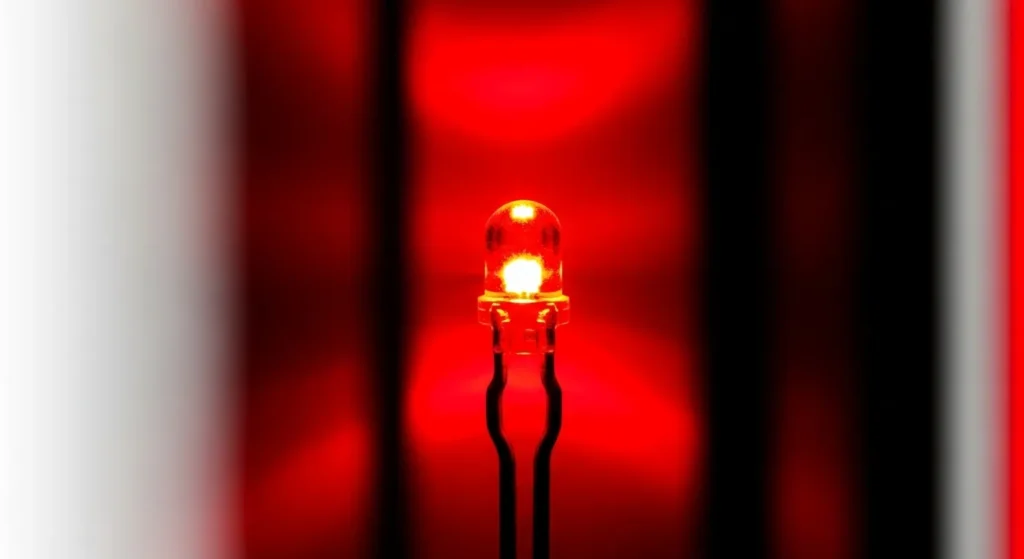
A semiconductor p-n junction diode that emits light via electroluminescence when forward biased with DC voltage.
Resistor formula
R = (V_source – V_forward) / I_forward. Example: (5V – 1.8V) / 0.02A = 160 Ω for a red LED at 20 mA.
LED efficacy
75–200 lm/W for LEDs vs 10–17 lm/W for incandescent making LEDs up to 10× more energy efficient.
LED lifespan
L70 = 25,000–50,000+ hours. 25× longer than a 1,000-hour incandescent bulb. No filament to burn out.
⚡ LED Quick Specs Standard 5mm Indicator LED (AEO Reference)
Forward Voltage (Red)1.8 – 2.1 V
Forward Voltage (Blue/White)2.8 – 3.5 V
Typical Forward Current20 mA
Peak Current (pulse)~100 mA
Luminous Intensity5–15 mcd (indicator)
Viewing Angle30° – 60°
Operating Temp−25°C to +85°C
Lifespan (L70)25,000 – 50,000 hr
📋 Table of Contents
- Introduction: What is an LED?
- How LEDs Work: Electroluminescence & p-n Junction
- How LEDs Are Made: Behind the Scenes
- The LED Resistor Formula (with Calculator)
- Key Performance Metrics: Efficacy, CRI, L70, CCT
- Types of LEDs: Indicator to COB to OLED
- The Colorful World of LEDs: Semiconductor Materials
- Real-World Applications of LEDs
- Pros, Cons & Choosing the Right LED
- LED with Arduino: PWM Dimming Code
- Professional Standards: IES LM-79/80, ENERGY STAR
- Advanced Troubleshooting
- Glossary of LED Terms
- Frequently Asked Questions
A Light Emitting Diode (LED) is a semiconductor p-n junction diode that produces light through a process called electroluminescence when forward biased. In simple terms, an LED converts electrical energy directly into light when electrons recombine with holes inside the semiconductor material no filament, no arc, no heat-wasting process in between.
Unlike incandescent lamps that waste up to 90% of energy as heat, LEDs generate minimal heat and achieve up to 90% higher energy efficiency. This is why a small indicator LED in your TV can stay illuminated for years without burning out, and why modern LED street lights have slashed city energy budgets by 50–70% since 2010.

How LEDs create light through electroluminescence · The resistor formula you must use to prevent LED burnout · Key specs: luminous efficacy, CRI, L70, CCT · All LED types from indicators to OLEDs · Arduino PWM dimming code · IES LM-79/80 professional standards · Advanced troubleshooting for flickering, ghosting, and thermal droop.
How LEDs Work: Electroluminescence & p-n Junction
An LED is built as a semiconductor sandwich with two distinct layers. The N-type layer has extra free electrons donated by impurity atoms (doping). The P-type layer has “holes” missing electrons that act as positive charge carriers. Together these form the p-n junction, the heart of every LED.
When DC forward voltage is applied (anode positive, cathode negative), the built-in potential barrier at the junction is overcome. Electrons from the n-side and holes from the p-side are pushed toward each other. At the junction, when a free electron fills a hole, it drops to a lower energy state and releases the excess energy as a photon of light. This is electroluminescence.
The color of the photon its wavelength is determined entirely by the bandgap energy of the semiconductor material. Wider bandgap = higher energy photons = shorter wavelength = bluer light. This is why different semiconductor compounds produce different colors:
| Material | Color | Typical V_f (V) | Application |
|---|---|---|---|
| Gallium Arsenide (GaAs) | Infrared / Red | 1.2–1.8 | Remote controls, data transmission |
| Gallium Phosphide (GaP) | Green / Yellow | 2.0–2.2 | Status indicators, traffic lights |
| Gallium Nitride (GaN) | Blue / UV / White | 2.8–3.5 | LED lighting, displays, white LEDs |
| Indium Gallium Nitride (InGaN) | Blue-Green-White | 2.8–3.3 | High-brightness LEDs, mobile screens |
| Aluminum Gallium Arsenide (AlGaAs) | Red / Infrared | 1.8–2.1 | Fiber optics, optical sensors |
| Aluminum Gallium Indium Phosphide (AlGaInP) | Orange / Yellow | 1.9–2.3 | Automotive indicators, signage |
The invention of bright blue LEDs which enabled white LED lighting was awarded the 2014 Nobel Prize in Physics to Isamu Akasaki, Hiroshi Amano, and Shuji Nakamura. Before GaN blue LEDs in the 1990s, efficient white LED lighting was impossible. Nakamura’s breakthrough at Nichia Corporation changed the world.
How LEDs Are Made: A Peek Behind the Scenes
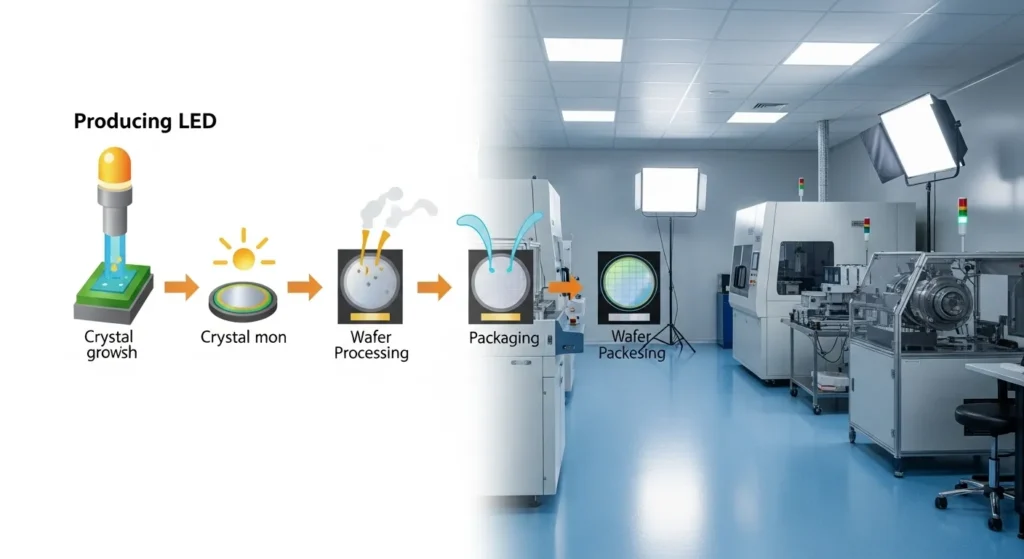
LED chips begin as a semiconductor wafer usually gallium arsenide or indium gallium nitride grown via a process called Metal-Organic Chemical Vapor Deposition (MOCVD). Manufacturers “dope” the semiconductor with precise impurities to create the n-type and p-type regions. They then stack these layers to form the p-n junction.
The wafer is then diced into thousands of tiny LED chips (die), each roughly 0.25 × 0.25 mm. Each chip is wire-bonded to a lead frame, then encased in a clear epoxy or silicone dome that protects the chip and critically directs the light emission outward. The dome shape is engineered to maximize light extraction a flat top would cause most light to bounce back inside due to total internal reflection.
The LED Resistor Formula
This is the most critical calculation in LED circuit design. Every LED requires a current-limiting resistor without it, the LED draws unlimited current from the supply and burns out instantly. The formula is derived directly from Ohm’s Law:
Current-Limiting Resistor Formula
[R = frac{V_{source} – V_{forward}}{I_{forward}}]
V_source = supply voltage (V) · V_forward = LED forward voltage (V) · I_forward = desired current (A, typically 0.020A)
Worked Example: 5V supply, red LED (V_f = 1.8V), desired current 20 mA (0.02A):
Worked Example Red LED on 5V Arduino
R = (5V − 1.8V) / 0.02A = 3.2 / 0.02 = 160 Ω → use 180 Ω (nearest E24 standard value)
Power dissipated in resistor: P = I²R = (0.02)² × 160 = 0.064W safe for a ¼W (0.25W) resistor
| LED Color | Typical V_forward | Resistor for 5V / 20mA | Resistor for 3.3V / 20mA |
|---|---|---|---|
| 🔴 Red | 1.8–2.1 V | 150–160 Ω → use 180 Ω | 60–75 Ω → use 68 Ω |
| 🟡 Yellow / Orange | 2.0–2.2 V | 140 Ω → use 150 Ω | 55 Ω → use 56 Ω |
| 🟢 Green | 2.0–3.5 V | 75–150 Ω | 0–65 Ω → use 47–68 Ω |
| 🔵 Blue / White | 2.8–3.5 V | 75–110 Ω → use 100 Ω | 0–25 Ω → use 22 Ω |
| 🟣 Infrared (IR) | 1.2–1.4 V | 180 Ω | 95 Ω → use 100 Ω |
🧮 Interactive LED Resistor Calculator
LED Current-Limiting Resistor Calculator
Enter your supply voltage, LED color, and desired current to instantly calculate the exact resistor value needed.
Calculated Resistor Value
Standard Value
Power Dissipated
Recommended Rating
Actual Current
Key LED Performance Metrics
1. Luminous Efficacy (lm/W)
Measures how much visible light you get per watt of electricity. Modern LEDs achieve 75–200 lm/W compared to only 10–17 lm/W for incandescent bulbs and 50–60 lm/W for fluorescents. A 10W LED can replace a 60W incandescent producing the same 800 lumens cutting energy use by 83%.
| Light Source | Efficacy (lm/W) | Lifespan (hrs) | Heat Output |
|---|---|---|---|
| Incandescent (60W) | 10–17 | ~1,000 | Very High (90% heat) |
| Halogen | 15–25 | ~2,000 | High |
| CFL (Compact Fluorescent) | 50–70 | ~8,000 | Moderate (contains mercury) |
| LED (2026) | 75–200 | 25,000–50,000+ | Very Low |
2. Color Rendering Index (CRI)
CRI measures how accurately a light source shows the true colors of objects compared to natural sunlight (CRI = 100). A higher CRI means colors look more vivid and natural. This matters enormously in kitchens (food looks appealing), retail (merchandise looks attractive), hospitals (skin tones are accurate), and photography studios.
| CRI Range | Rating | Best For |
|---|---|---|
| CRI 90–100 | ✅ Excellent | Art studios, photography, surgery rooms, retail, kitchens |
| CRI 80–89 | 👍 Good | Homes, offices, bathrooms |
| CRI 70–79 | ⚠️ Acceptable | Warehouses, parking garages, utility lighting |
| CRI <70 | ❌ Poor | Not recommended for spaces where color matters |
3. Lumen Maintenance (L70)
L70 is defined as the operating hours at which an LED dims to 70% of its initial brightness considered the practical end of useful life. Quality LEDs achieve 25,000–50,000+ hours. Per IES LM-80 standards, lumen depreciation is measured at multiple temperatures over 6,000+ hours to project the full L70 rating. Cheap LEDs may reach L70 in as little as 5,000 hours.
Lumen Depreciation Model (IES TM-21)
[Phi(t) = Phi_0 cdot e^{-alpha t}]
Φ(t) = lumen output at time t · Φ₀ = initial lumen output · α = depreciation rate constant · t = operating hours
4. Color Temperature (CCT)
Correlated Color Temperature (CCT) is measured in Kelvin (K). Lower K values produce warm, yellowish light; higher K values produce cool, blue-white light. Choosing the right CCT is critical for comfort and functionality:
2700–3000 K
Warm White
Living rooms, bedrooms, restaurants
3500–4100 K
Neutral White
Kitchens, offices, retail
5000–6500 K
Cool / Daylight
Workshops, hospitals, detailed tasks
When choosing LEDs for a room, match the CCT to the activity. 2700K creates the same cozy warmth as candlelight. 4000K is ideal for kitchens and bathrooms. 6500K (“daylight”) is best for garages, workshops, and reading. Mixing CCTs in one room looks jarring stick to one temperature throughout a space.
Types of LEDs: Indicator to COB to OLED
The LED family has evolved far beyond simple indicator lights. Today, seven major LED types each serve distinct applications based on power, form factor, and performance requirements:
| LED Type | Description | Power | Main Applications |
|---|---|---|---|
| Indicator LEDs | Standard 5mm/3mm through-hole, single chip | ~60–100 mW | Power/status indicators on electronics, circuit boards |
| High-Power LEDs | 1W–100W+ chips on metal-core PCBs with heat sinks | 1W–100W+ | Flashlights, car headlights, grow lights, street lights |
| SMD LEDs | Surface-mount. Compact, efficient, solderable flat package | 20–200 mW | LED strips, compact fixtures, TV backlighting |
| COB LEDs | Chip-on-Board: multiple chips bonded directly to substrate | 10W–200W+ | Floodlights, stadium lighting, industrial panels |
| OLEDs | Organic LEDs flexible, ultra-thin, each pixel self-emissive | Varies | OLED smartphone screens, OLED TVs, wearables |
| UV LEDs | Emit ultraviolet light (265–400 nm), invisible to humans | 0.5–5W | Sterilization, UV curing, counterfeit detection, resin 3D printing |
| Infrared LEDs | Emit IR light (780nm–1mm), invisible to human eye | 10–500 mW | Remote controls, CCTV night vision, face recognition sensors |
| Mini / Micro LEDs | Ultra-small individual pixels (<100µm), direct-view arrays | µW per pixel | Next-gen displays: Apple Watch Ultra, gaming monitors |
The Colorful World of LEDs: Semiconductor Materials
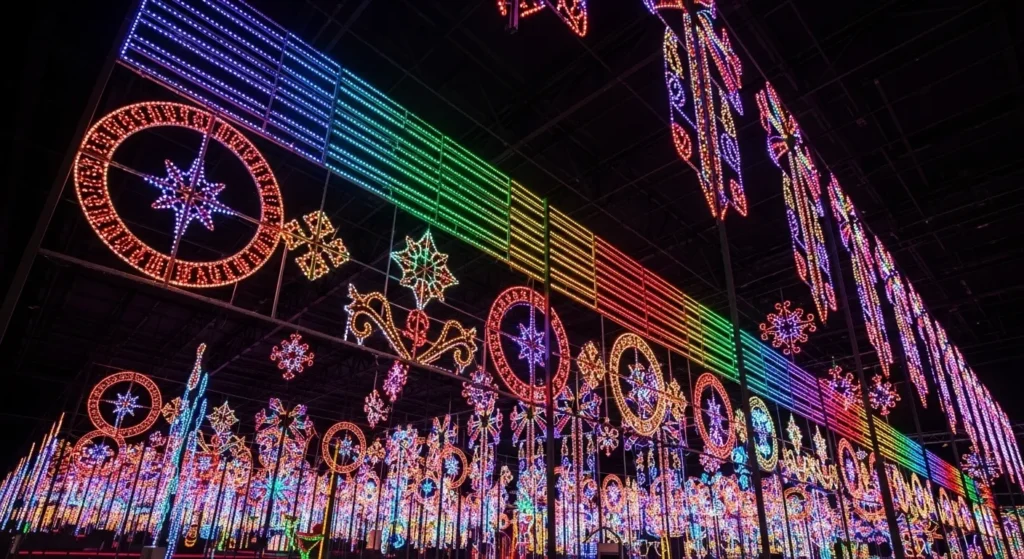
LEDs are remarkable because they can produce virtually any color in the visible spectrum and beyond simply by choosing different semiconductor compounds. By changing the bandgap energy of the material, manufacturers precisely control the wavelength of emitted light.
IR
Red
Orange
Yellow
Green
Blue
Violet
UV
LED spectrum coverage: from infrared (780nm+) through visible (380–780nm) to UV (<380nm)
Do you wonder why your TV remote actually works even when it’s not pointed perfectly at the TV? It’s because it uses an infrared LED (GaAs-based) that floods the room with invisible IR light, which any IR receiver in the general direction can detect. The bright blue LEDs in gaming setups are made with gallium nitride (GaN) the same material that made white LED lighting possible when Shuji Nakamura invented efficient GaN LEDs in the 1990s.
White LEDs are a fascinating engineering solution: there are no “white” semiconductor materials. Instead, a GaN blue LED chip is coated with a yellow phosphor (cerium-doped YAG). The phosphor absorbs some blue light and re-emits it as yellow. The remaining blue + yellow mix appears white to the human eye and the ratio of blue-to-yellow determines whether the white is warm or cool.
⚠️ Blue Light Hazard
Cool white LEDs (5000–6500K) and direct-view screens emit significant amounts of short-wavelength blue light (400–500nm). Prolonged exposure in the evening suppresses melatonin production and disrupts sleep cycles. For bedroom lighting, always choose warm white LEDs (2700–3000K) and consider blue-light-filtering glasses for extended screen use at night.
Real-World Applications of LEDs
LEDs are everywhere once you start noticing them. From the screen you’re reading this on to the streetlights outside your window, LEDs have replaced older technologies across virtually every lighting and signaling application.
| Application Area | LED Type Used | Key Requirement | Real Example |
|---|---|---|---|
| General Home Lighting | SMD, COB bulbs | CRI 80+, 2700–3000K | Philips Hue, LIFX, GE LED bulbs |
| Smartphone Display | OLED / Mini-LED | High contrast, flexible | iPhone OLED, Samsung AMOLED |
| Automotive Headlights | High-power LED arrays | 5000–6000K, IP67 rated | BMW adaptive LED, Tesla DRL |
| Street & Road Lighting | High-power COB | 125–150 lm/W, IP65 | Replaced 250W sodium lamps with 80W LED |
| Medical / Surgery | High-CRI LED panels | CRI 95+, shadow-free | OR surgical lights, dental lamps |
| Agriculture (Grow Lights) | Red + Blue LED arrays | Specific 660nm + 450nm | Indoor farms, vertical agriculture, +30% yield |
| UV Sterilization | UV-C LEDs (265nm) | Germicidal wavelength | Water purifiers, air sterilizers, hospital surfaces |
| Remote Controls / IR | IR LED (850nm) | High pulse current | TV remotes, CCTV night vision, Face ID sensors |
| Times Square / Stadiums | Full-color RGB SMD | High brightness, outdoor | LED billboards, sports scoreboards |
| Resin 3D Printing | UV LED (405nm) | Precise wavelength cure | SLA/MSLA printers: Elegoo, Anycubic |

📹 Watch: How LEDs Work Visual Explanation
Pros, Cons & Choosing the Right LED
LEDs have a lot going for them, but no technology is perfect. Here is an honest analysis:
✅ Advantages of LEDs
- 75–200 lm/W 10× more efficient than incandescent
- 25,000–50,000+ hour lifespan (vs 1,000hr incandescent)
- Instant on no warm-up time like CFLs
- No mercury safer disposal than fluorescents
- Available in any color without filters
- Dimmable (with compatible drivers)
- Solid-state vibration and shock resistant
- Directional light output less wasted light
- Low UV and IR emission safer for artwork, food
- Smart control compatible (Zigbee, Matter, WiFi)
❌ Limitations of LEDs
- Higher upfront cost vs incandescent (but ROI in 1–2 yr)
- Blue light hazard from cool-white LEDs at night
- Flickering with incompatible dimmers
- Thermal droop output drops when junction overheats
- Color quality varies wildly by brand and price
- Directional by default may need diffuser for omni
- Driver failure is common failure mode in cheap bulbs
- Color consistency varies between production batches
Choosing the Right LED for Your Application
When choosing an LED, always start with lumens, not watts. LEDs use less power for the same brightness watts no longer tell you how bright a bulb is. A 10W LED replaces a 60W incandescent at the same 800 lumens.
| Old Incandescent | LED Replacement | Lumens | Energy Saved |
|---|---|---|---|
| 40W | 5–6W LED | ~450 lm | 85% |
| 60W | 8–10W LED | ~800 lm | 83% |
| 75W | 11–13W LED | ~1100 lm | 83% |
| 100W | 14–18W LED | ~1600 lm | 83% |
LED with Arduino: PWM Dimming & Blink Code
Controlling an LED with Arduino is often a maker’s first project. Beyond basic blinking, PWM (Pulse Width Modulation) lets you dim an LED smoothly by rapidly switching it on and off at varying duty cycles fast enough that your eyes perceive it as a continuous dimmed light.
Wiring
| Component Pin | Arduino Pin | Notes |
|---|---|---|
| LED Anode (+) | D9 (PWM pin) | Through 220 Ω resistor |
| LED Cathode (−) | GND | Direct to GND |
| 220 Ω Resistor | Between D9 and Anode | Current limiting essential |
PWM Fade + Blink Code
// LED PWM Fade + Blink   Procirel.com
// Wiring: LED Anode → 220Ω resistor → Arduino D9
//         LED Cathode → GND
const int LED_PIN = 9;  // Must be a PWM-capable pin (~)
void setup() {
  pinMode(LED_PIN, OUTPUT);
  Serial.begin(9600);
  Serial.println("LED Control Ready");
}
void loop() {
  // --- SMOOTH FADE IN ---
  Serial.println("Fading in...");
  for (int brightness = 0; brightness <= 255; brightness += 5) {
    analogWrite(LED_PIN, brightness);  // PWM: 0 = OFF, 255 = full ON
    delay(15);
  }
  delay(500);  // Hold at max brightness
  // --- SMOOTH FADE OUT ---
  Serial.println("Fading out...");
  for (int brightness = 255; brightness >= 0; brightness -= 5) {
    analogWrite(LED_PIN, brightness);
    delay(15);
  }
  delay(500);  // Hold at OFF
  // --- RAPID BLINK x3 ---
  Serial.println("Blink x3...");
  for (int i = 0; i < 3; i++) {
    digitalWrite(LED_PIN, HIGH);  // Full ON
    delay(100);
    digitalWrite(LED_PIN, LOW);   // Full OFF
    delay(100);
  }
  delay(1000);  // Pause before repeating
}
💡 PWM Explained Simply
analogWrite(pin, 128) does NOT set voltage to 2.5V. It switches the pin between 0V and 5V at ~490 Hz, spending exactly 50% of each cycle at 5V (duty cycle = 50%). Your eyes average this out and perceive half brightness. This is why you need a proper resistor the LED still receives full 5V during the ON phase of each PWM cycle.
Professional Standards: IES LM-79/80, ENERGY STAR
| Standard | What It Measures | Relevance to You |
|---|---|---|
| IES LM-79 | Initial photometric & electrical performance of complete LED luminaires | Confirms rated lumens, power, and efficacy at initial use |
| IES LM-80 | Lumen depreciation of LED packages over 6,000+ hours | Used to project the L70 lifespan rating on packaging |
| IES TM-21 | Projects L70 lifespan beyond 6,000 tested hours | Allows manufacturers to claim "50,000 hr L70" from 6,000hr data |
| ENERGY STAR | Energy efficiency + minimum lifetime requirements | Required for utility rebates; ensures minimum 25,000hr life |
| IEC 62612 | Self-ballasted LED lamp performance requirements | International standard for replacement LED bulbs |
| McAdam Ellipse (SDCM Binning) | Color consistency within a production batch | Ensures all LEDs in a fixture look the same color; ≤3 SDCM preferred |
| UL/ETL Listing | Electrical safety testing and certification | Required for code-compliant installations in North America |
📖 Authority References
- 📄 IES Standards Library IES LM-79, LM-80, TM-21
- 📄 ENERGY STAR LED Bulbs Requirements & Certified Products
- 📄 Lumileds Application Notes LED Design & Thermal Management
- 📄 Texas Instruments LED Driver Design Guide (AN-1656)
- 📄 Wikipedia Light-emitting diode (comprehensive reference)
📥 Access IES LM-79/80 Standards (IES.org)
Advanced Troubleshooting
| Problem | Root Cause | Engineering Fix |
|---|---|---|
| LED glows when switch is OFF | Ghosting from leakage current in smart/dimmer switches | Add a 47 kΩ bleed resistor across the LED, or use a compatible LED dimmer |
| LED flickers on camera | PWM frequency mismatch with camera shutter speed | Switch to high-frequency PWM driver (>1 kHz) or AC-synchronized driver |
| Premature dimming | Thermal droop from excessive junction temperature | Improve heat sinking, reduce drive current, ensure thermal pad contact to MCPCB |
| Wrong color tint vs spec | Binning variation or temperature-induced color shift | Verify SDCM (MacAdam ellipses) ≤ 3-step with supplier; specify tight binning |
| LED hums on dimmer | Incompatible leading-edge (triac) dimmer | Use trailing-edge or ELV (Electronic Low Voltage) dimmer rated for LED loads |
| LED burned out instantly | No current-limiting resistor; reverse polarity | Always use R = (Vs−Vf)/If; check anode (+) and cathode (−) orientation |
| LED strip has uneven brightness | Voltage drop along long strip runs | Feed power from both ends; use thicker supply wire; keep runs under 5m per feed |
📖 Glossary of LED Terms
Electroluminescence
The emission of light from a semiconductor material when an electric current passes through it. The fundamental mechanism by which all LEDs produce light, without heat or chemical reaction.
Forward Voltage (V_f)
The voltage drop across an LED when it is forward biased and conducting current. Depends on semiconductor material: ~1.8V red, ~3.2V blue/white. Critical for resistor calculation.
Luminous Efficacy (lm/W)
A measure of how efficiently a light source converts electrical power into visible light. Modern LEDs achieve 75–200 lm/W far exceeding the 10–17 lm/W of incandescent bulbs.
CRI (Color Rendering Index)
A scale from 0–100 measuring how accurately a light source renders colors compared to natural sunlight (CRI 100). CRI 80+ for homes, CRI 90+ for color-critical applications.
L70 Lumen Maintenance
The operating hours at which an LED's output has dropped to 70% of its initial brightness. Defined by IES LM-80. Quality LEDs: 25,000–50,000+ hours before reaching L70.
CCT (Correlated Color Temperature)
Measured in Kelvin describes the warmth or coolness of white light. 2700K = warm yellow-white (like incandescent). 5000–6500K = cool daylight-white (like clear sky).
Thermal Droop
The reduction in LED light output as junction temperature rises. LEDs are rated at 25°C; above 85°C junction temperature, output drops significantly and lifespan shortens. Proper heat sinking prevents this.
PWM (Pulse Width Modulation)
A dimming technique that rapidly switches the LED on and off. The duty cycle (on-time percentage) controls perceived brightness. 50% duty cycle at 1kHz = half brightness with no flicker visible to the eye.
SDCM / MacAdam Ellipse
Standard Deviation of Color Matching a measure of color consistency within a batch of LEDs. ≤3 SDCM means all LEDs look the same color to a trained eye. Critical for large installations.
COB (Chip-on-Board)
An LED packaging technology where multiple bare chips are mounted directly onto a substrate (usually aluminum), wire-bonded, and phosphor-coated as a single module. Results in high density, high power, and uniform light output.
Bandgap Energy
The energy difference between the valence and conduction bands in a semiconductor. Determines the wavelength (color) of emitted photons. Wider bandgap = higher energy photon = shorter wavelength = bluer light.
OLED (Organic LED)
Uses organic (carbon-based) compounds as the electroluminescent layer. Each pixel is its own light source, enabling infinite contrast ratios and flexible form factors. Used in high-end smartphones and televisions.
Frequently Asked Questions
Why are LEDs more expensive upfront than incandescent bulbs?LEDs use advanced semiconductor chips, phosphor coatings, precision optics, and thermal management systems that cost more to manufacture. However, their long lifespan (25,000+ hours vs 1,000 hours) and 10× lower energy consumption means the total cost of ownership is dramatically lower typically paying back within 1–2 years for residential use.
What does CRI mean and which CRI should I pick?CRI (Color Rendering Index) measures how naturally a light source shows colors on a scale of 0–100. For general home use, CRI 80+ is fine. For kitchens, studios, retail, and art spaces where color accuracy matters, CRI 90+ is better. Very cheap LEDs often have CRI of 70 or below under these, food looks unappetizing and skin tones appear gray.
What is L70 and why does it matter for LED buying decisions?L70 is the point where an LED's output has dropped to 70% of its original brightness considered the practical end of useful life. Quality LEDs from reputable brands achieve 25,000–50,000 hours before L70. Cheap LEDs may reach L70 in as little as 5,000–10,000 hours. Always check the L70 rating it reveals how long an LED will really last in real conditions, not just the "maximum rated lifespan" often printed on cheap packaging.
Why do some LEDs flicker and how do I fix it?LED flickering is usually caused by: (1) Poor-quality LED drivers with high ripple current above 30%. (2) Incompatible dimmers designed for incandescent (triac/leading-edge) loads that can't work properly with LED constant-current drivers. Fix: Replace with a trailing-edge or ELV LED-compatible dimmer, and look for "flicker-free" or "low-flicker" LEDs with drivers maintaining <5% flicker percent.
Can LEDs be recycled?Yes. Unlike CFLs, LEDs contain no mercury, making them safer to dispose of. Most municipalities accept LEDs as e-waste. Manufacturers like Philips and GE have take-back programs. The circuit boards contain copper, aluminum, and small amounts of rare earth elements from the phosphor coating that can be recovered and reused.
Do LEDs attract insects?Most insects are attracted to UV and near-infrared light (280–380nm), which standard LEDs emit very little of. Warm white LEDs (2700–3000K) attract significantly fewer insects than cool white, incandescent, or fluorescent lights. For outdoor use, choose warm white LEDs or dedicated "bug lights" with amber/yellow LEDs at 570–590nm wavelength.
What is the difference between SMD and COB LEDs?SMD (Surface-Mount Device) LEDs are individual chips in discrete packages soldered to a PCB used in LED strips, fixtures, and indicator lights. COB (Chip-on-Board) mounts many bare chips directly on a substrate without individual packaging, creating a single high-density light source. COBs produce more lumens per area, have better thermal management, and create a smooth, shadowless beam ideal for spotlights, floodlights, and high-power downlights.
Sources & References
- Illuminating Engineering Society (IES) LM-79, LM-80, TM-21 Standards Library.
- U.S. EPA ENERGY STAR Learn About LED Bulbs. Efficiency & certification requirements.
- Lumileds LED Application Notes, Thermal Management & Design Resources.
- Texas Instruments AN-1656: LED Driver Design Guide. Practical LED driver design.
- Wikipedia Light-emitting diode. History, physics, and comprehensive reference.
- Nobel Prize in Physics 2014 Akasaki, Amano, Nakamura: Invention of efficient blue LEDs.
Related Guides on Procirel
ElectronicsSignal Noise: 5 Ways to Eliminate It
ElectronicsElectronic Circuits Guide: Components to PCB
Electrical SafetyPrevent Electrical Shock: GFCI & Standards
ArduinoArduino Guide for Beginners 2026
ElectricalDPDT Switch: Wiring, Testing & Motor Control
ElectricalVoltage Divider: Formula & Thevenin Model
💡 Bottom Line
LEDs are the definitive lighting technology of our era converting electrical energy to photons with unmatched efficiency through the elegance of electroluminescence. Always calculate your current-limiting resistor (R = (V_s − V_f) / I_f) before wiring any LED. Choose CRI 80+ for homes and CRI 90+ for color-critical applications. Look for L70 ratings above 25,000 hours and ENERGY STAR certification for reliable long-term performance. The upfront premium of a quality LED pays for itself many times over in energy savings and replacement costs while being better for the environment too.
⚡
Oliver Adams Electronics Engineers & Technical Writers
The Procirel editorial team consists of electronics engineers, lighting system designers, and technical educators with combined experience in LED circuit design, luminaire testing, and photometric analysis for commercial and residential applications.
Content reviewed against IES LM-79, IES LM-80, ENERGY STAR requirements, and IEC 62612 standards.
Electronics Engineering
LED Systems
IES LM-79/80
Arduino / Embedded
ENERGY STAR
Disclaimer: This article is for educational purposes. Always check component datasheets and follow applicable electrical codes when designing LED circuits for safety-critical or commercial applications.
Pingback: Top 5 Ways to Eliminate Signal Noise in Electrical Circuits