The practical breakdown of light, color and wavelength: why VIBGYOR matters in electronics, from LED spectra to photodiode response and display color math.
- Key Takeaways
- Table of Contents
- What Is Wavelength and VIBGYOR?
- Who Is This Guide For?
- Definition and Mechanism of Action
- Formal Definition of Wavelength
- Mechanism of VIBGYOR Formation (Dispersion)
- Energy Relationship
- Common Issues & Misconceptions
- Misconception #1: “Wavelength and Color Are the Same Thing”
- Misconception #2: “Rainbows Have Exactly Seven Colors”
- Misconception #3: “All White Light Is the Same”
- Misconception #4: “Speed of Light Never Changes”
- Misconception #5: “LEDs Emit Single Wavelengths”
- How It Works The Physics of Light Dispersion
- Step 1: White Light Composition
- Step 2: Entering a Denser Medium
- Step 3: Differential Refraction
- Step 4: The Spectrum Appears
- Why This Matters in Electronics
- How Wavelength Reduces (Shifts) Across the Spectrum
- The Wavelength Progression
- Why Does Wavelength Decrease This Way?
- Beyond Visible What’s on Either Side?
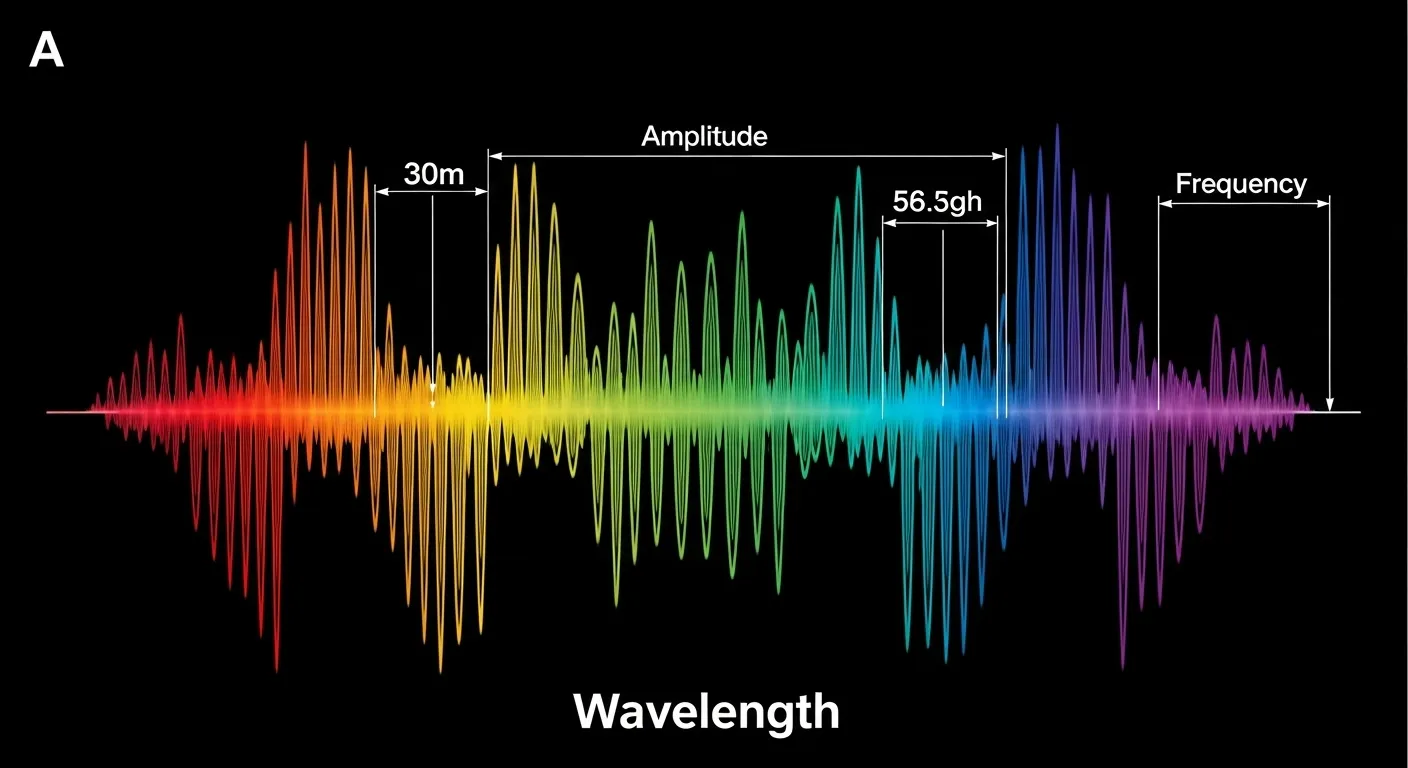
- Difference Between Wavelength, Frequency, and Amplitude
- The Inverse Relationship in Practice
- VIBGYOR Wavelength Spectrum Visual Reference
- Recommended Tools & Equipment for Spectrum Analysis
- Factors Affecting Wavelength and Color Perception
- Factor 1: The Medium
- Factor 2: Temperature of the Source
- Factor 3: Atmospheric Scattering
- Factor 4: Doppler Effect
- Factor 5: Human Eye Sensitivity
- Factor 6: Material Absorption
- Standard Limits and Guidelines Wavelength Values
- Treatment of Light Filters, Coatings, and Color Correction
- Optical Filters
- Anti-Reflection Coatings
- Phosphor Conversion
- Monitoring and Follow-Up Measuring Wavelength Accurately
- Method 1: Spectrometer
- Method 2: Spectral Sensors (For Electronics Projects)
- Method 3: Photodiode + Known Filter
- Method 4: Smartphone Spectroscopy
- How to Make a Simple Spectroscope at Home
- Materials Needed
- Step-by-Step Build
- What You’ll See
- Potential Risks UV, IR, and Harmful Light Exposure
- UV Radiation Risks
- Blue Light Hazard
- Laser Safety
- Infrared Risks
- Where to Use & Why to Use Wavelength Knowledge
- Electronics & Embedded Systems
- Agriculture & Horticulture
- Medical & Health
- Security & Forensics
- Alternatives to VIBGYOR Other Color Models
- Pro Tips from the Field
- FAQ People Also Ask
- Safety & Evidence Disclaimer
- The Bottom Line
- Related guides in this track
- Practical example
- Where to go next
- Frequently asked questions
Not another boring textbook dump this is the real, practical breakdown of light, color, wavelength, and why VIBGYOR matters in electronics, optics, and everyday life. Written by an Electronics & Physics Practitioner
Key Takeaways
- Wavelength is the physical distance between two consecutive crests of a wave measured in nanometers (nm) for visible light, ranging from 380 nm (violet) to 700 nm (red).
- VIBGYOR stands for Violet, Indigo, Blue, Green, Yellow, Orange, Red the seven colors that white light splits into when passed through a glass prism.
- Shorter wavelength = higher frequency = more energy that’s why UV light can cause sunburn but red light cannot.
- Every color has a specific wavelength range Violet sits at 380-450 nm while Red occupies 620-700 nm, and knowing these values matters for LED selection, filter design, and sensor calibration.
- The visible spectrum is just 0.0035% of the entire electromagnetic spectrum we’re literally seeing a tiny sliver of reality.
- Wavelength directly determines LED color when you buy a “625 nm red LED,” that 625 nm IS the wavelength of light the semiconductor junction emits.
- Dispersion is the mechanism behind VIBGYOR different wavelengths refract at slightly different angles inside a prism because glass has wavelength-dependent refractive indices.
- You can calculate any wavelength using the formula λ = c / f, where c = 3 × 10⁸ m/s (speed of light) and f = frequency in Hz.
Table of Contents
- What Is Wavelength and VIBGYOR?
- Definition and Mechanism of Action
- Common Issues & Misconceptions
- How It Works The Physics of Light Dispersion
- How Wavelength Reduces (Shifts) Across the Spectrum
- Difference Between Wavelength, Frequency, and Amplitude
- Recommended Tools & Equipment for Spectrum Analysis
- Factors Affecting Wavelength and Color Perception
- Standard Limits and Guidelines Wavelength Values
- Treatment of Light Filters, Coatings, and Color Correction
- Monitoring and Follow-Up Measuring Wavelength Accurately
- How to Make a Simple Spectroscope at Home
- Potential Risks UV, IR, and Harmful Light Exposure
- Where to Use & Why to Use Wavelength Knowledge
- Alternatives to VIBGYOR Other Color Models
- Pro Tips from the Field
- FAQ People Also Ask
- Safety & Evidence Disclaimer
- The Bottom Line
What Is Wavelength and VIBGYOR?
You’ve seen a rainbow after rain. You’ve seen white light split through a prism in your physics lab. And you’ve probably memorized “VIBGYOR” for an exam without truly understanding what it represents physically. Let’s fix that right now.
Wavelength is the distance between two consecutive identical points on a wave crest to crest or trough to trough. For visible light, we measure wavelength innanometers (nm) , where 1 nm = 10⁻⁹ meters. That’s ab surdly tiny about 1/100,000th the width of a human hair.VIBGYOR is the acronym representing the seven colors of visible light in order ofdecreasingwavelength: Violet,Indigo,Blue,Green,Yellow,Orange,R ed. Some countries teach it as ROYGBIV (reversed, starting from Red), but the physics is identical.
ℹ Quick Reality Check
The visible light spectrum the entire range of light your eyes can detect spans roughly 380 nm to 700 nm. Below 380 nm, you enterultraviolet (UV)territory. Above 700 nm, you’re ininfrared (IR). Your eyes are blind to both, but your electronics aren’t photodiodes, cameras, and sensors can “see” well beyond VIBGYOR.
Who Is This Guide For?
This Guide Is For You If:
- You’re a physics student who wants to understand wavelength beyond rote memorization
- You’re an electronics hobbyist selecting LEDs, photodetectors, or optical sensors and need to understand wavelength specs
- You’re a maker/DIYer who wants to build a spectroscope or color detection circuit
- You’re a competitive exam student(JEE, NEET, AP Physics) who needs rock-solid conceptual clarity
- You just want to actually understand why the sky is blue and sunsets are red the real physics, not the handwavy explanation
Definition and Mechanism of Action
Formal Definition of Wavelength
Wavelength (symbol: λ, Greek letter “lambda”) is defined as the spatial period of a periodic wave the distance over which the wave’s shape repeats. For electromagnetic waves like light, it’s the distance between two successive electric field maxima (or minima) as the wave propagates through space.
The fundamental equation connecting wavelength, frequency, and the speed of light:
The Core Formula
λ = c / f- λ= wavelength (meters)
- c= speed of light in vacuum = 2.998 × 10⁸ m/s (≈ 3 × 10⁸ m/s)
- f= frequency (Hz)
So for green light at 550 nm: f = (3 × 10⁸) / (550 × 10⁻⁹) = 5.45 × 10¹⁴ Hz that’s 545 trillion oscillations per second. Your eye interprets that specific frequency as “green.
Mechanism of VIBGYOR Formation (Dispersion)
Here’s what actually happens when white light hits a glass prism and I mean at the atomic level, not just the textbook diagram:
- White light enters the prism. White light is a mixture of ALL visible wavelengths (380-700 nm) traveling together.
- Each wavelength has a different speed inside glass. This is the critical point most textbooks gloss over. In vacuum, all wavelengths travel at the same speed (c). But inside glass, shorter wavelengths slow down MORE than longer wavelengths.
- Different speeds = different refractive indices. The refractive index of glass for violetlight (~1.532) is higher than for red light (~1.513). This phenomenon is called dispersion.
- Different refractive indices = different bending angles. By Snell’s law (n₁ sin θ₁ = n₂ sin θ₂), a higher refractive index means more bending. So violet bends the most, red bends the least.
- The separated colors emerge as VIBGYOR. After passing through the prism, the colors spread out into a band the visible spectrum.
Pro Tip Why Glass Does This
The electrons in glass atoms resonate at frequencies close to UV light. Violet light, being closest to UV, interacts more strongly with these electrons, slowing down more. Red light, far from UV frequencies, passes through with less interaction. This is why dispersion happens it’s a resonance phenomenon, not some arbitrary glass property.
Energy Relationship
Each photon carries energy determined by its frequency (or inversely, its wavelength):
Photon Energy Formula
E = hf = hc/λ- h= Planck’s constant = 6.626 × 10⁻³⁴ J·s
- Violet photon (380 nm): E ≈ 3.26 eV
- Red photon (700 nm): E ≈ 1.77 eV
This is why UV light (even shorter wavelength, higher energy) can damage DNA and cause skin cancer, while infrared (longer wavelength, lower energy) just makes you feel warm. Energy per photon matters enormously.
Common Issues & Misconceptions
After teaching and working with optics concepts for years, I’ve seen the same misunderstandings surface repeatedly. Let me debunk them once and for all.
Misconception #1: “Wavelength and Color Are the Same Thing”
They’re not. Wavelength is a physical property of light.Color is a perceptual experience created by your brain. A 580 nm photon has no “color” it’s just an electromagnetic wave. Your cone cells detect it, your brain processes the signal, and you experience “yellow. ” People with color vision deficiencies see the same 580 nm wavelength but perceive it differently.
Misconception #2: “Rainbows Have Exactly Seven Colors”
Newton chose seven colors partly because he liked the number seven (he wanted an analogy with seven musical notes). In reality, the spectrum is a continuous gradient. There’s no sharp boundary between green and yellow. Indigo is particularly controversial many physicists argue it’s not a distinct spectral color but rather a very deep blue.
Misconception #3: “All White Light Is the Same”
Sunlight white, LED white, incandescent bulb white, and fluorescent tube white all have dramatically different spectral compositions. An incandescent bulb is heavy in red/IR wavelengths. A cool white LED peaks around 450 nm (blue) and uses phosphor to add green/yellow. This is why your phone’s photos look different under different lighting the wavelength mix changes.
The Biggest Mistake Students Make
Confusing the electromagnetic spectrum with the visible spectrum. The electromagnetic spectrum includes everything from radio waves (wa velength in kilometers) to gamma rays (wavelength smaller than atoms). The visible spectrum (VIBGYOR) is atiny fraction like a single key on a piano that stretches from one end of a football field to the other.
Misconception #4: “Speed of Light Never Changes”
The speed of light in vacuum (c) is constant. But light slows down in every medium glass, water, diamond, even air. In diamond, light travels at only about 41% of its vacuum speed. And here’s the key: the frequency stays the same, but the wavelength changes. A 550 nm (green) photon in vacuum has a shorter wavelength inside glass. The frequency doesn’t change because that’s determined by the source.
Misconception #5: “LEDs Emit Single Wavelengths”
Even a “monochromatic” LED doesn’t emit at a single wavelength. It emits a narrow band typically ±10 to ±20 nm around the peak wavelength. A “red LED at 625 nm” actually emits from roughly 615 nm to 635 nm with a peak at 625 nm. Only lasers come close to true single-wavelength emission, and even they have a finite linewidth.
How It Works The Physics of Light Dispersion
Step 1: White Light Composition
White light from the sun (or any broadband source) contains electromagnetic radiation across the entire visible range: 380 nm through 700 nm. Every wavelength in that range is present simultaneously, traveling together at 3 × 10⁸ m/s through air.
Step 2: Entering a Denser Medium
When this light beam hits the surface of a glass prism at an angle, Snell’s law governs the refraction. The key: the refractive index (n) of glass is not a single number it varie s with wavelength. This wavelength dependence is described by the Cauchy equationor the more precise Sellmeier equation.
For standard crown glass (BK7), typical refractive indices are:
- Violet (400 nm): n ≈ 1.5308
- Blue (470 nm): n ≈ 1.5223
- Green (530 nm): n ≈ 1.5187
- Yellow (580 nm): n ≈ 1.5168
- Orange (610 nm): n ≈ 1.5155
- Red (650 nm): n ≈ 1.5143
Step 3: Differential Refraction
Because violet light has a higher refractive index (1.5308) than red light (1.5143), violet bends more sharply at both the entry and exit faces of the prism. This angular separation accumulates, and by the time light exits the prism, the colors have spread apart enough to be visible as distinct bands.
Step 4: The Spectrum Appears
Place a white screen after the prism and you’ll see the VIBGYOR spectrum. Violet appears at the most-deviated position (closest to the base of the prism), and red appears at the least-deviated position.
ℹ Angular Dispersion Value
For a typical 60° flint glass prism, the angular difference between red and violet is roughly 1.5° to 2° . That sounds tiny, but at a screen d istance of 2 meters, this produces a spectrum band approximately 5-7 cm wide plenty for visual observation and analysis.
Why This Matters in Electronics
If you’re building a color detection circuit using a photodiode and colored filters, you need to understand these wavelength ranges. When you select a bandpass optical filter centered at 550 nm with a 10 nm bandwidth, you’re allowing only a narrow slice of green light through. Without understanding wavelength, you can’t specify the right filter, the right LED, or the right detector sensitivity range.
How Wavelength Reduces (Shifts) Across the Spectrum
The visible spectrum follows a clear pattern: as you move from Red to Violet, the wavelength decreasesprogressively while the frequency and energyincrease. Understanding this relationship is fundamental.
The Wavelength Progression
- Red: 620-700 nm Longest wavelength, lowest frequency, least energy per photon
- Orange: 590-620 nm Slightly shorter, slightly more energetic
- Yellow: 570-590 nm The narrow band your eye is most sensitive to
- Green: 495-570 nm Peak human eye sensitivity falls here (~555 nm)
- Blue: 450-495 nm Noticeably more energetic, scatters more in atmosphere
- Indigo: 420-450 nm The “controversial” color narrow range, hard to distinguish
- Violet: 380-420 nm Shortest visible wavelength, highest energy per photon
Why Does Wavelength Decrease This Way?
It’s a direct consequence of the equation λ = c/f. Since c (speed of light) is constant in any given medium, wavelength and frequency are inversely proportional. Higher frequency electromagnetic oscillations physically compress the wave pattern into a shorter spatial period.
Pro Tip The “Blueshift” and “Redshift” in Practice
In astronomy, these terms describe wavelength changes due to relative motion (Doppler effect). But in electronics, you encounter similar concepts: an LED’s peak wavelength shifts toward shorter wavelengths (blueshift) at higher temperatures in some semiconductor materials, and towardlonger wavelengths (redshift) in others. A GaN blue LED, for instance, can shift by 5-10 nm across its operating temperature range. If you’re building a precision colorimetry system, this drift matters.
Beyond Visible What’s on Either Side?
Below 380 nm, you enter ultraviolet (UV-A: 315-380 nm, UV-B: 280-315 nm, UV- C: 100-280 nm). Above 700 nm, you enternear-infrared (NIR)(700 nm-1400 nm). Your TV remote control uses ~940 nm infrared LEDs. Security cameras with “night vision” detect NIR. UV LEDs at 365 nm are used for PCB UV exposure during etching. These are practical, everyday applications of wavelength knowledge.
Difference Between Wavelength, Frequency, and Amplitude
These three terms get confused constantly. They describe completely different properties of a wave, and mixing them up leads to fundamental misunderstandings.
| Property | Symbol | Unit | What It Measures | Analogy | Determines |
|---|---|---|---|---|---|
| Wavelength | λ (lambda) | nm, µm, m | Distance between two crests | Length of one wave “ripple” | Color of light |
| Frequency | f or ν (nu) | Hz (cycles/sec) | Number of oscillations per second | How fast the wave vibrates | Energy per photon |
| Amplitude | A | V/m (electric field) | Maximum displacement from equilibrium | Height of the wave | Brightness/Intensity |
| Speed | c or v | m/s | How fast the wave travels | Speed of the whole wave pattern | Medium dependent |
| Period | |||||
| T | seconds | Time for one complete cycle | Duration of one oscillation | T = 1/f | |
| Changing the wavelength (or frequency) of light changes itscolor. Changing the amplitude changes itsbrightness. A dim red laser and a bright red laser have the same wavelength only their amplitude (and therefore intensity) differs. |
The Inverse Relationship in Practice
Since λ × f = c (a constant), when wavelength goes up, frequency must come down proportionally. You can’t change one without the other changing in the opposite direction they’re permanently linked by the speed of light.
In my experience building optical sensor circuits, this matters when you’re selecting between a photodiode’s spectral response curve (which is plotted against wavelength) and a signal processing circuit that works withfrequency. You need to be able to convert between the two fluently.
VIBGYOR Wavelength Spectrum Visual Reference
Violet 380-450nm 380 - 450 nm Indigo 420-450nm 420 - 450 nm Blue 450-495nm 450 - 495 nm Green 495-570nm 495 - 570 nm Yellow 570-590nm 570 - 590 nm Orange 590-620nm 590 - 620 nm Red 620-700nm 620 - 700 nm
Recommended Tools & Equipment for Spectrum Analysis
Whether you’re a student verifying VIBGYOR in a lab or a hobbyist building a color detection system, having the right tools makes all the difference. I’ve tested most of these personally across various projects.
| Tool / Component | Approx. Price | Key Specs | Quality | Best For |
|---|---|---|---|---|
| 60° Glass Prism (K9 Optical) | $5 - $15 | K9 borosilicate, 25mm faces | Excellent | Basic VIBGYOR demonstration |
| Diffraction Grating (1000 lines/mm) | $3 - $10 | Holographic, 25×25mm | Excellent | Higher resolution spectrum viewing |
| TCS3200 Color Sensor Module | $2 - $5 | Detects RGB via photodiodes | Good | Arduino color detection projects |
| AS7341 11-Channel Spectral Sensor | $15 - $25 | 11 channels, 350-1000nm | Excellent | Precise spectral analysis projects |
| USB Spectrometer (Ocean Insight / StellarNet) | $800 - $3000+ | 2nm resolution, 200-850nm | Professional | Lab-grade spectrum measurement |
| Smartphone Spectroscope Adapter | $15 - $40 | Attaches to phone camera + app | Moderate | Quick, portable spectrum checks |
| VEML6075 UV Sensor Module | ||||
| $5 - $8 | UVA (365nm) + UVB (330nm) | Good | UV monitoring projects | |
| it gives sharper, more spread-out spectr a than a prism and costs almost nothing. For electronics projects, the AS7341 spectral sensor is a game-changer 11 independent wavelength channels with I²C interface. I’ve used it in plant growth monitoring and water quality analysis projects. Absolutely worth the $20. |
Factors Affecting Wavelength and Color Perception
Wavelength itself is a fixed physical property determined by the source. But several factors affect what wavelength reaches your eye (or sensor) and how it’s perceived.
Factor 1: The Medium
Light slows down in any medium denser than vacuum. The wavelength inside the medium is shorter: λ_medium = λ_vacuum / n, where n is the refractive index. A 600 nm photon in vacuum has a wavelength of only ~395 nm inside diamond (n = 2.42). The frequency stays unchanged only wavelength compresses.
Factor 2: Temperature of the Source
Hotter objects emit shorter peak wavelengths. This is Wien’s displacement law: λ_max = 2,897,000 / T (in nm, where T is in Kelvin). The Sun’s surface at ~5778K peaks around 501 nm (green). A tungsten filament at ~2700K peaks around 1073 nm (infrared) which is why incandescent bulbs waste most energy as heat.
Factor 3: Atmospheric Scattering
Rayleigh scattering intensity is proportional to 1/λ⁴. Blue light (450 nm) scatters about 5.5 times more than red light (650 nm). This is why the sky appears blue scattered blue light reaches your eyes from all directions. During sunset, light travels through more atmosphere, scattering away most blue/green, leaving red/orange.
Factor 4: Doppler Effect
If a light source moves toward you, its wavelength is compressed (blueshift). If it moves away, wavelength stretches (redshift). This is how we know distant galaxies are moving away from us. In practical electronics, you won’t encounter this but in LIDAR systems and optical communications, Doppler shifts become relevant.
Factor 5: Human Eye Sensitivity
Your eye doesn’t perceive all wavelengths equally. The photopic luminosity functionpeaks at 555 nm (yellow-green). You’re most sensitive to green-yellow light and least sensitive to violet and deep red. Two LEDs with equal optical power but different wavelengths will appear to have drastically different brightness to your eyes.
Practical Implication for LED Projects
A green LED (525 nm) and a red LED (660 nm) both rated at 20 mcd (millicandela) will NOT appear equally bright to your eyes. The human eye is roughly 10× more sensitive to 525 nm green than to 660 nm red. Always check the luminous intensityspec (which is already weighted for human vision), not just the radiant power.
Factor 6: Material Absorption
Objects appear colored because they absorb certain wavelengths and reflect others. A red apple absorbs green and blue wavelengths and reflects red (620-700 nm) back to your eyes. A green leaf absorbs red and blue (for photosynthesis) and reflects green. The perceived color depends entirely on which wavelengths survive the absorption process.
Standard Limits and Guidelines Wavelength Values
These are the standard accepted wavelength ranges for each VIBGYOR color and adjacent regions. Note that boundaries between colors are not sharp they’re transitional zones. The values below are the most commonly cited in physics literature and CIE standards.
| Color / Region | Wavelength Range | Frequency Range | Photon Energy | Common Source | Classification |
|---|---|---|---|---|---|
| UV-C | 100 - 280 nm | 1071 - 3000 THz | 4.43 - 12.4 eV | Germicidal lamps | Dangerous |
| UV-B | 280 - 315 nm | 952 - 1071 THz | 3.94 - 4.43 eV | Sun (causes sunburn) | Harmful |
| UV-A | 315 - 380 nm | 789 - 952 THz | 3.26 - 3.94 eV | Blacklight, UV LEDs | Caution |
| Violet | 380 - 450 nm | 668 - 789 THz | 2.76 - 3.26 eV | Violet LEDs, BLU-RAY | Visible |
| Indigo | 420 - 450 nm | 668 - 714 THz | 2.76 - 2.95 eV | Specific LEDs | Visible |
| Blue | 450 - 495 nm | 606 - 668 THz | 2.50 - 2.76 eV | Blue LEDs (GaN) | Visible |
| Green | 495 - 570 nm | 526 - 606 THz | 2.18 - 2.50 eV | Green LEDs, Laser pointers | Visible |
| Yellow | 570 - 590 nm | 508 - 526 THz | 2.10 - 2.18 eV | Sodium vapor lamps | Visible |
| Orange | 590 - 620 nm | 484 - 508 THz | 2.00 - 2.10 eV | Orange LEDs, Neon signs | Visible |
| Red | 620 - 700 nm | 428 - 484 THz | 1.77 - 2.00 eV | Red LEDs (AlGaInP) | Visible |
| Near IR | 700 - 1400 nm | 214 - 428 THz | 0.89 - 1.77 eV | IR remotes, NIR cameras | Invisible |
ℹ Standards Note
The CIE (International Commission on Illumination) defines the visible range as 380-780 nm, which is slightly wider than the commonly cited 380-700 nm. The 700-780 nm range is very deep red where human sensitivity drops dramatically but doesn’t hit zero until about 780 nm. For practical electronics purposes, 380-700 nm is the working range you’ll encounter in component datasheets.
Treatment of Light Filters, Coatings, and Color Correction
“Treating” light means selectively allowing, blocking, or modifying specific wavelengths. This is fundamental in photography, display technology, optical sensors, and scientific instruments.
Optical Filters
Filters selectively transmit certain wavelengths while absorbing or reflecting others:
- Bandpass filters: Transmit only a narrow wavelength band (e. g., 550 nm ± 5 nm). Used in spectroscopy and fluorescence microscopy. Thorlabs and Edmund Optics offer precision bandpass filters.
- Longpass filters: Block wavelengths below a cutoff and transmit everything above (e. g., transmit >600 nm). Used in fluorescence imaging to block excitation light.
- Shortpass filters: Opposite transmit below cutoff, block above.
- Notch filters: Block one specific narrow band while transmitting everything else. Used in Raman spectroscopy to block the laser wavelength.
Anti-Reflection Coatings
When light hits a glass surface, about 4% reflects back at each surface. For a lens with 6 surfaces, you lose ~22% of your light to reflections. Anti-reflection (AR) coatings thin films of materials like MgF₂ (magnesium fluoride) reduce this to 1% per surface. The coating thickness is specifically calculated asλ/4(quarter-wavelength) for the target wavelength, creating destructive interference for reflected light.
Pro Tip DIY Color Correction for LED Projects
If you’re building an LED-based light panel and need a specific color temperature, don’t just mix RGB LEDs and hope for the best. Use a Lee Filters swatch book(theatrical lighting filters) or Rosco Cinegel sheets they come in specific color temperature correction values like CTO (Color Temperature Orange, converts 5500K to 3200K) and CTB (Color Temperature Blue, converts 3200K to 5500K). At $5-10 per sheet, they’re vastly more accurate than guessing with PWM values on RGB LEDs.
Phosphor Conversion
White LEDs don’t actually produce white light directly. A blue LED die (450-460 nm GaN) is coated with YAG (yttrium aluminum garnet) phosphor. The phosphor absorbs some blue photons and re-emits them as broad-spectrum yellow-green light (centered around 560 nm). The combination of remaining blue + phosphor yellow appears white to your eyes. The ratio of phosphor determines the “color temperature” more phosphor = warmer (2700K), less phosphor = cooler (6500K).
Monitoring and Follow-Up Measuring Wavelength Accurately
Method 1: Spectrometer
A spectrometer uses a diffraction grating to separate incoming light into its component wavelengths, then a linear CCD or CMOS sensor array measures the intensity at each wavelength. USB spectrometers like the Ocean Insight USB2000+or the more affordable StellarNet BLUE-Wave can resolve wavelengths with 1-2 nm precision across 200-1100 nm.
Method 2: Spectral Sensors (For Electronics Projects)
The AS7341 from AMS-OSRAM is my go-to recommendation. It has 11 independent channels 8 in the visible range (415 nm through 680 nm) plus clear, NIR, and flicker detection. It communicates over I²C at 3.3V logic. Wire it to an ESP32 or Arduino, and you’ve got a portable spectral analyzer for under $25.
Method 3: Photodiode + Known Filter
Place a bandpass filter of known center wavelength in front of a calibrated photodiode (like the BPW34 silicon PIN photodiode). Measure the photocurrent. By using several filters, you can build a crude spectrometer. I’ve done this for plant growth light analysis it’s not lab-grade, but it’s surprisingly useful for ±10 nm accuracy.
Method 4: Smartphone Spectroscopy
Attach a diffraction grating over your phone’s camera and use apps like “Spectroid”(Android) or“PhyPhox” to analyze the spectrum. Accuracy is limited to ±5-15 nm, but for educational purposes and quick checks, it works remarkably well.
Calibration Tip
Always calibrate your spectrometer or spectral sensor against a known reference . Fluorescent lights have sharp mercury emission lines at 435.8 nm, 546.1 nm, and 578.2 nm. These are precise, stable, and free perfect for checking if your instrument reads correctly.
How to Make a Simple Spectroscope at Home
You can build a functional spectroscope with basic materials in under 30 minutes. I’ve built dozens of these for science workshops, and they genuinely work well enough to identify emission lines from different light sources.
Materials Needed
- A cardboard tube (paper towel roll or Pringles can)
- A diffraction grating salvage from an old CD/DVD or buy a 1000 lines/mm grating for $3-5
- Razor blade or X-Acto knife
- Black electrical tape
- A small piece of cardboard for the slit plate
- Scissors, ruler, pencil
Step-by-Step Build
- Create the slit: Cut a small piece of cardboard to fit one end of the tube. Using two razor blades taped parallel to each other with a ~0.5 mm gap between them, create a narrow slit. The narrower the slit, the sharper your spectral lines will be but too narrow and you won’t get enough light. Aim for about 0.3-0.5 mm.
- Prepare the grating: Cut a piece of your diffraction grating to fit the other end of the tube. If using a CD, cut a small square from the data surface (not the label side). Handle by the edges to avoid fingerprints.
- Assemble: Tape the slit plate to one end of the tube. Tape the diffraction grating to the other end, oriented so the grating lines run parallel to the slit. Use black tape to seal any light leaks.
- Blacken the interior: If using a Pringles can, line the inside with black paper or spray paint to reduce internal reflections.
- Test it: Point the slit end toward a light sourc e (fluorescent light, LED, sunlight reflected off white paper NEVER look directly at the sun). Look through the grating end. You should see the spectrum spread out to one side.
CRITICAL SAFETY WARNING
NEVER point your spectroscope directly at the Sun. The concentrated light can cause permanent retinal damage in seconds. Always observe reflected sunlight off a matte white surface, or use artificial light sources.
What You’ll See
- Incandescent bulb: Smooth, continuous spectrum all VIBGYOR colors blending into each other
- Fluorescent tube: Bright emission lines (mercury lines at ~436nm and ~546nm) superimposed on a weak continuous spectrum from the phosphor
- White LED: A sharp blue peak (~450 nm) plus a broad yellow-green hump from the phosphor no continuous rainbow
- Sodium vapor lamp (orange street light): Extremely bright double line at 589 nm almost monochromatic
Potential Risks UV, IR, and Harmful Light Exposure
Light isn’t always harmless. Different wavelengths carry different risks, and understanding these is essential especially if you’re working with LEDs, lasers, or UV sources.
UV Radiation Risks
- UV-C (100-280 nm): Extremely dangerous. Causes severe skin burns and eye damage (photokeratitis “welder’s flash”). Used in germicidal lamps. Never expose skin or eyes to UV-C. Even a few seconds can cause damage.
- UV-B (280-315 nm): Causes sunburn, long-term skin cancer risk, cataracts. The ozone layer blocks most solar UV-B, but artificial sources (tanning beds, mercury lamps without proper filters) can deliver concentrated UV-B.
- UV-A (315-380 nm): Less acutely dangerous but contributes to long-term skin aging and can cause eye damage with prolonged exposure. UV-A LEDs (365 nm) used for PCB exposure or resin curing should always be used with UV-blocking safety glasses.
Blue Light Hazard
High-intensity blue light (400-490 nm) can cause photochemical damage to the retina with prolonged exposure. This is a concern with high-power blue and white LEDs. The IEC 62471 standard classifies LED sources by photobiological risk level. For typical indicator LEDs, risk is negligible. For high-power LED arrays (grow lights, stage lighting, automotive headlights), proper assessment is needed.
Laser Safety
Lasers concentrate enormous power into a tiny beam. A 5 mW green laser pointer (Class 3R) can cause permanent retinal damage with direct eye exposure of just 0.25 seconds. Always use wavelength-specific laser safety goggles with the correct OD (optical density) for the laser wavelength you’re using.
Infrared Risks
Near-infrared (700-1400 nm) is particularly insidious because your eyes can’t see it, but it can still damage your retina. High-power IR LEDs (used in security illuminators, industrial sensors) can deliver enough energy to cause thermal retinal burns without any visible light warning. If you’re working with IR emitters above 100 mW, wear appropriate IR-blocking safety eyewear.
Non-Negotiable Safety Rule
Any time you work with lasers above Class 2 (>1 mW) or UV sources below 380 nm, wear appropriate wavelength-specific safety glasses. Regular sunglasses DO NOT provide adequate protection they can actually make things worse by causing your pupils to dilate (letting MORE harmful radiation in) while blocking only visible light.
Where to Use & Why to Use Wavelength Knowledge
Understanding wavelength isn’t just academic it has direct, practical applications across numerous fields. Here’s where this knowledge becomes genuinely useful.
Electronics & Embedded Systems
- LED selection: Choosing the right LED wavelength for indicator lights, displays, optical communication (IR LEDs at 850nm or 940nm for data links)
- Photodetector matching: Silicon photodiodes peak sensitivity at ~900nm.
- Fiber optic communication: Uses specific wavelength windows 850nm (multimode), 1310nm, and 1550nm (single-mode) because glass fiber has minimum attenuation at these wavelengths
- LIDAR systems: Typically use 905nm or 1550nm lasers.
Agriculture & Horticulture
- Grow lights: Plants primarily absorb light at ~450nm (blue) and ~660nm (red) matching chlorophyll absorption peaks. Modern LED grow lights specifically target these wavelengths for energy efficiency.
- NDVI imaging: Normalized Difference Vegetation Index uses red (650nm) and NIR (850nm) reflectance to assess plant health from drones or satellites.
Medical & Health
- Pulse oximetry: Your fingertip SpO2 sensor uses two wavelengths 660nm (red) and 940nm (IR). Oxygenated and deoxygenated hemoglobin absorb these wavelengths differently, enabling blood oxygen measurement.
- Phototherapy: Blue light at 460-490nm breaks down bilirubin in newborns with jaundice. UV-B at 311nm treats psoriasis and eczema.
Security & Forensics
- UV forensics: UV light at 365nm causes certain biological fluids, fibers, and chemicals to fluoresce, revealing evidence invisible under white light.
- Counterfeit detection: Currency notes have UV-fluorescent security features that only appear under specific UV wavelengths.
Pro Tip Wavelength Selection for IoT Sensors
If you’re building an IoT environmental sensor, consider adding a UV index sensor (VEML6075, ~$5) and an ambient light sensor with wavelength sensitivity data (TSL2591). These give you genuinely useful environmental data beyond just temperature/humidity. I’ve deployed these in outdoor weather stations and the UV data is surprisingly popular with users especially parents monitoring playground sun exposure.
Alternatives to VIBGYOR Other Color Models
VIBGYOR describes the physical light spectrum, but it’s not the only way to categorize and work with color. Different fields use different models, each optimized for specific applications.
| Color Model | Basis | Components | Difficulty | Primary Use | Best For |
|---|---|---|---|---|---|
| VIBGYOR / Spectral | Physics (wavelength) | 7 spectral colors | Simple | Optics, physics education | Understanding physical light |
| RGB (Red, Green, Blue) | Additive mixing | 3 channels (0-255 each) | Easy | Displays, LEDs, digital screens | Electronics & displays |
| CMYK | Subtractive mixing | 4 channels (C, M, Y, K) | Moderate | Printing, physical pigments | Print design |
| HSL / HSV | Human perception | Hue, Saturation, Lightness | Intuitive | UI design, image editing | Color selection by humans |
| CIE 1931 XYZ | Human vision model | X, Y, Z tristimulus | Complex | Colorimetry, display calibration | Scientific color measurement |
| CIE Lab* | Perceptual uniformity | Lightness, a*, b* axes | Complex | Color matching, paint, textiles | Color difference calculation |
Which Model to Use When: For physics and optics VIBGYOR / wavelength. For Arduino/ESP32 LED projects RGB. For designing user interfaces HSL. For precision color measurement in quality control CIE Lab*. In electronics projects, you’ll most frequently work with RGB (for controlling RGB LEDs via PWM) and spectral wavelength (for selecting components and understanding sensor datasheets).
Pro Tips from the Field
Tip #1 The LED Datasheet Trick
When an LED datasheet says “peak wavelength: 525 nm,” that’s the wavelength at 20 mA typical forward current and 25°C. Increase the current and the junction heats up the peak wavelength shifts by roughly +0.1 to +0.3 nm per °C for most AlGaInP (red/orange/yellow) LEDs and -0.03 to -0.1 nm per °C for GaN (blue/green) LEDs. If color consistency matters in your project, consider current regulation and thermal management. I learned this the hard way when a matrix display showed color drift after 30 minutes of operation.
Tip #2 Use a CD as an Emergency Diffraction Grating
A standard CD has approximately 625 lines/mm (track pitch of 1.6 µm). A DVD has about 1350 lines/mm (track pitch 0.74 µm). If you need to quickly check the spectrum of an unknown light source and don’t have a proper grating, angle a CD or DVD under the light. The rainbow pattern you see IS the diffracted spectrum. DVDs give better angular separation. I’ve used this trick in the field to quickly distinguish between LED and fluorescent sources.
Tip #3 Matching Photodetectors to Your Light Source
Silicon photodiodes (like the BPW34) have peak sensitivity around 900 nm and poor response below 400 nm. If you’re trying to detect UV or deep blue light, silicon is the wrong choice. Use GaP-based (gallium phosphide) photodiodes for UV/blue or SiC (silicon carbide) photodiodes for deep UV. For near-IR beyond 1100 nm, InGaAs photodiodes are required. Always overlay the photodiode’s spectral response curve with your light source’s emission spectrum to ensure adequate overlap.
Tip #4 Why Your RGB LED Doesn’t Make “True” White
An RGB LED mixes only three narrow wavelength bands (typically ~460nm, ~520nm, ~630nm). The result looks “white” to your eyes because it stimulates all three cone types. But a spectrometer reveals it’s actually three spikes with huge gaps between them. This is why objects under RGB LED “white” light look different than under sunlight the RGB light literally doesn’t contain the wavelengths needed to properly render all colors. For better color rendering, use LEDs with high CRI (Color Rendering Index) >90, which have broader spectral emission.
Tip #5 The Human Eye’s Secret: Peak Sensitivity at 555nm
Under daylight conditions (photopic vision), the human eye peaks at 555 nm (yellow-green). Under dark-adapted conditions (scotopic vision), the peak shifts to 507 nm (blue-green) this is the Purkinje shift. This is why car dashboard lights are often green maximum visibility at minimum brightness (minimum distraction). If you’re designing indicator LEDs for use in dark environments, green LEDs give the most perceived brightness per milliwatt of optical power.
Tip #6 Cheap UV LEDs Are Usually Violet, Not UV
Many “UV LEDs” sold on Amazon and AliExpress for $1-3 are actually violet LEDs emitting at 395-405 nm, which is technically visible violet not true UV. Genuine UV-A LEDs (365 nm) cost more ($3-8 per LED) and appear much dimmer to the eye because 365 nm is at the edge of visibility. If you need actual UV for PCB exposure, resin curing, or fluorescence excitation, verify the wavelength spec carefully. A 395 nm LED will not cure UV resin properly. I wasted a week troubleshooting a UV exposure box before realizing the “UV LEDs” were 400 nm violet just barely not UV enough.
Tip #7 Fiber Optic Wavelength Windows Matter
Glass optical fibers have three minimum-attenuation wavelength windows: 850 nm (~2.5 dB/km),1310 nm (~0.35 dB/km), and 1550 nm (~0.2 dB/km). Short-distance communication uses 850 nm because the transceivers are cheapest. Long-distance telecom uses 1550 nm for minimum loss. If you’re ever troubleshooting fiber optic links, check that the transceiver wavelength matches the fiber’s design wavelength a 1310 nm transceiver on a fiber optimized for 1550 nm (or vice versa) will work but with higher attenuation than expected.
FAQ People Also Ask
- What is the exact wavelength range of visible light?
The visible light spectrum spans approximately 380 nanometers to 700 nanometers (some references extend this to 780 nm). At 380 nm, you’re at the violet edge light appears as a deep purple, and just beyond it lies ultraviolet radiation invisible to the human eye. At 700 nm, you’re at the deep red edge, beyond which lies infrared. The CIE (International Commission on Illumination) standard defines the photopic luminosity function from 380 to 780 nm, buthuman sensitivity drops to near-zero below 400 nm and above 700 nm . For practical electronics purposes selecting LEDs, filters, and photodetectors the working visible range is typically cited as 400-700 nm.
- Why does violet bend more than red in a prism?
Violet bends more because it has a higher refractive index in glass than red light . This happens because violet light’s frequency is closer to the natural resonant frequency of the electrons in glass atoms. When light frequency approaches a material’s electronic resonance, the interaction between photons and electrons becomes stronger, causing the light to slow down more and consequently bend more (per Snell’s law). For standard BK7 glass, the refractive index for violet (~400 nm) is approximately 1.5308, while for red (~650 nm) it’s approximately 1.5143 . This difference of ~0.0165 may seemtiny, but across the geometry of a 60° prism, it produces enough angular separation to visibly spread the colors apart typically 1.5° to 2° of angular dispersion.
- Is VIBGYOR the same as ROYGBIV?
Yes, they represent the exact same seven colors of the visible spectrum, just listed in opposite order. VIBGYOR lists colors from shortest wavelength to longest (Violet Red), while ROYGBIV lists them from longest to shortest (Red Violet). ROYGBIV is more commonly used in the United States and UK, while VIBGYOR is prevalent in India and several Asian countries. Neither is more “correct” it’s purely a convention of ordering. Some modern physics educators argue that the spectrum should be treated as acontinuous gradient rather than seven discrete colors, noting that Newton originally chose seven partly for philosophical reasons (paralleling the seven musical notes).Indigo, in particular, is often debated many physicists consider it indistinguishable from deep blue.
- What is the wavelength of each VIBGYOR color?
Here are the standard accepted wavelength ranges: Violet: 380-450 nm,Indigo: 420-450 nm(overlapping with violet this is why it’s controversial),Blue: 450-495 nm,Green: 495-570 nm,Yellow: 570-590 nm,Orange: 590-620 nm,Red: 620-700 nm. Note that these ranges haveno sharp boundaries the transitions are gradual. Yellow o ccupies a remarkably narrow band (only 20 nm), while green spans a wide 75 nm range. In practical applications like LED selection, manufacturers specify apeak wavelength(e. g., 525 nm green, 590 nm amber, 625 nm red) rather than a range, because each LED emits a narrow band centered on that peak.
- How do you calculate wavelength from frequency?
Use the fundamental wave equation: λ = c / f , where λ is wavelength in meters, c is the speed of light (2.998 × 10⁸ m/s in vacuum), and f is frequency in Hz. For example, to find the wavelength of light with a frequency of 5.0 × 10¹⁴ Hz: λ = (3 × 10⁸) / (5 × 10¹⁴) = 6 × 10⁻⁷ m =600 nm , which falls in the orange range. Re member that this gives the wavelengthin the medium the light is traveling through . In vacuum or air, you use c = 3 × 1 0⁸ m/s. In glass (n ≈ 1.5), the effective speed is c/n, so the wavelength inside glass is shorter: λ_glass = λ_vacuum / n. Thefrequency never changes regardless of medium only wavelength and speed change.
- Why is the sky blue and sunsets red?
Both phenomena are explained by Rayleigh scattering , where the scattering intensity is prop ortional to 1/λ⁴. During the day, sunlight enters the atmosphere and shorter wavelengths (blue, ~450 nm) scatter much more than longer wavelengths (red, ~650 nm). Blue scatters approximately(650/450)⁴ ≈ 4.3 times more than red. This scattered blue light r eaches your eyes from all directions across the sky, making it appear blue. During sunset, sunlight travels through a much longer atmospheric path. By the time it reaches you, most of the blue and green wavelengths have beenscattered away, leaving predominantly red and orange wavelengths to pass through directly hence the red/orange sunset. Pollution and volcanic ash particles enhance sunset colors by providing additional scattering surfaces for intermediate wavelengths.
- What determines the color of an LED?
The color of an LED is determined by the bandgap energy of the semiconductor material used in the LED die. When electrons cross the bandgap (from conduction band to valence band), they release energy as photons. The photon’s wavelength (and thus color) is directly determined by the bandgap energy: λ = hc / E_gap . Different semiconductor materials have different bandgaps: GaN (gallium nitride)has a bandgap ~3.4 eV blue/violet (~405-450 nm),InGaN(indium gallium nitride) blue to green (450-530 nm),AlGaInP (aluminum gallium indium phosphide) yellow to red (570-650 nm),GaAs (gallium arsenide) infrared (~870 nm). White LEDs are actuallyblue LEDs (GaN, ~450 nm) coated with YAG phosphor that converts some blue light to broad yellow-green emission.
- Can humans see ultraviolet or infrared light?
Under normal conditions, no the human eye is limited to roughly 380-700 nm. However, there are interesting exceptions. People who have had their natural lens removed (aphakia) typically after cataract surgery without an artificial lens replacement can perceive UV-A light down to about 300 nm , because the natural lens normally absorbs UV. The painter Claude Monet reportedly experienced this after cataract surgery, influencing his later paintings. As for infrared, some studies suggest humans can perceivepulsed infrared at ~1000 nm under very specific conditions (two-photon absorption in the retina), perceiving it as a dim green flash. But for all practical purposes, UV and IR are invisible. Your digital camera sensor, however,CAN detect near-IR(up to ~1100 nm) that’s why TV remotes appear to flash on your phone camera even though you can’t see them with your eyes.
- What is the difference between spectral colors and non-spectral colors?
Spectral colors are colors that correspond to a single w avelength (or narrow band) of light every color in the VIBGYOR rainbow is a spectral color.Non-spectral colors are colors that don’t exist at any singl e wavelength they’re created by mixing different wavelengths. The most important non-spectral colors aremagenta/pink (mix of red and blue wavelengths there’s no “magenta wavelength”),white(mix of all visible wavelengths),brown(low-intensity combination of red, orange, and yellow), andall pastel/desaturated colors. This distinction matters in electronics because youcannot create magenta with a single LED you need both a red and a blue LED (or a phosphor-converted LED) emitting simultaneously. Similarly, any color sensor will report magenta as simultaneous red + blue channel activation, not as a single wavelength reading.
- Why do different light sources have different spectra?
Because different physical processes produce photons through different mechanisms, resulting in different spectral distributions. Incandescent bulbs produce light through thermal radiation (blackbody spectrum) the heated filament emits a broad, continuous spectrum weighted heavily toward infrared and red.Fluorescent tubes produce UV light via mercury vapor discharge, which excites phosphor coatings to emit visible light resulting in a spectrum with sharp mercury emission lines plus broad phosphor bands.LEDs produce light through semiconductor elec troluminescence emitting a narrow band around a specific wavelength determined by the bandgap.Lasers produce extremely narrow, coherent emission at one precise wavelength through stimulated emission.Sodium vapor lamps emit almost exclusively at 589 nm (sodium D-lines). Understanding these differences is critical forcolor accuracy in photography, display calibration, spectroscopy, and sensor design. A TCS3200 color sensor will give completely different RGB readings for the “same white” object under sunlight vs. fluorescent vs. LED lighting.
Safety & Evidence Disclaimer
- Never look directly at the Sun through any optical instrument prisms, spectroscopes, telescopes, binoculars, or cameras. Permanent blindness can result in seconds.
- UV LEDs (365 nm and below) can cause eye and skin damage. Always wear UV-blocking safety glasses (rated for the specific wavelength) when working with UV sources.
- Laser pointers above Class 2 (>1 mW) can cause instant, permanent retinal damage. Never point lasers at people, animals, aircraft, or reflective surfaces.
- High-power LEDs(1W and above) can cause thermal burns and optical hazards. Use appropriate heat sinking, current limiting, and never stare directly into the beam.
- This content is for educational and informational purposes. Always follow manufacturer safety guidelines, local regulations, and institutional safety protocols when working with optical equipment.
- Wavelength values cited in this article are based on standard physics references and CIE standards. Component-specific values should always be verified from the manufacturer’s datasheet.
The Bottom Line
Wavelength isn’t just a physics exam topic it’s the fundamental property that determines the color of every LED you pick, the sensitivity range of every photodetector you wire up, the efficiency of every optical filter in your system, and the safety precautions you need when working with light sources. VIBGYOR gives you the visible spectrum roadmap: Violet (380 nm) through Red (700 nm), with frequency, energy, and practical applications varying systematically across that range.
The formula λ = c/f is your Swiss Army knife it converts between wavelength and frequency in any context. The relationship E = hc/λ tells you why shorter wavelengths are more dangerous. And the principle of dispersion explains everything from rainbows to fiber optic wavelength-division multiplexing.
Whether you’re building a color-sensing robot, selecting LEDs for a grow light, debugging a fiber optic link, or just trying to understand why your phone camera’s white balance looks wrong wavelength knowledge is the foundation. Master the numbers, understand the physics, and every optics-related project becomes dramatically easier to design, debug, and optimize.
Content based on standard physics references, CIE standards, and hands-on electronics project experience.
Related guides in this track
- New to Electrical Engineering? Start with the complete electrical engineering guide it indexes every tutorial in this track.
- Single-Phase vs Three-Phase Power: The Real Differences
- Power Factor Explained: Why Real Power Is Not Apparent Power
- Transformer Types and Where Each One Belongs
- Calculate the numbers: power calculator · transformer turns ratio calculator
Practical example
Re-run the steps above with your own numbers at the bench: record what you measure beside what this guide states, and investigate any gap larger than rounding. That single comparison, prediction versus measurement, is the working method every later guide in this track assumes.
Where to go next
- The complete electrical engineering guide: Electrical Engineering complete guide
- Read next: pid controller explained: proportional-integral-derivative in practice
- Also in this track: single-phase vs three-phase power: the real differences
- Continue with: power factor explained: why real power is not apparent power
- Calculate as you go: power calculator · transformer turns ratio tool · cable sizing helper
- Bookmark this page against the day a measurement surprises you. Most readers return to the table and the mistake list first, and that is the correct order.
Frequently asked questions
The Bottom Line? Wavelength isn’t just a physics exam topic it’s the fundamental property that determines the color of every LED you pick, the sensitivity range of every photodetector you wire up, the efficiency of every optical filter in your system, and the safety precautions you need when working with light sources. VIBGYOR gives you the visible spectrum roadmap: Violet (380 nm) through Red (700 nm), with frequency, energy, and practical applications varying systematically across that range.
Pro Tips from the Field? Tip 1 The LED Datasheet Trick
When an LED datasheet says “peak wavelength: 525 nm,” that’s the wavelength at 20 mA typical forward current and 25°C. Increase the current and the junction heats up the peak wavelength shifts by roughly +0.1 to +0.3 nm per °C for most AlGaInP (red/orange/yellow) LEDs and -0.03 to -0.1 nm per °C for GaN (blue/green) LEDs.
Definition and Mechanism of Action? Formal Definition of Wavelength
Wavelength (symbol: λ, Greek letter “lambda”) is defined as the spatial period of a periodic wave the distance over which the wave’s shape repeats. For electromagnetic waves like light, it’s the distance between two successive electric field maxima (or minima) as the wave propagates through space.
Last updated 23 August 2026