
Mobile Edge Computing: IoT, AI on Edge, Fog Computing, Cloud Edge & MEC Platforms
Professional guide from the 2009 origins of edge computing to MEC architecture, IoT edge gateways, AI on edge devices, fog computing, real platform comparisons, deployment case studies, and the most costly edge architecture mistakes.
🎯 Key Takeaways
- ✅ Edge computing processes data at or near the source reducing latency from 100–500ms (cloud) to under 10ms, and cutting bandwidth costs 60–90%
- ✅ Mobile Edge Computing (MEC), standardised by ETSI, places cloud computing inside 5G base stations enabling autonomous vehicles, AR/VR, and remote surgery
- ✅ IoT and edge computing are inseparable a factory with 500 sensors generating terabytes/day needs local edge processing; cloud-only architectures fail at scale
- ✅ AI on edge runs ML inference locally NVIDIA Jetson Orin delivers 275 TOPS; Apple Neural Engine processes face recognition in <1ms without cloud connectivity
- ✅ Fog computing = intermediate tier between device-edge and cloud; the term is now absorbed into “edge computing” but the architecture layer remains essential
- ✅ Edge vs cloud is not either/or the correct architecture is tiered: device-edge for real-time control, regional edge for ML inference, cloud for training and long-term analytics
- ✅ The top 3 edge deployment failures: wrong latency tier selection, missing offline-first design, and inadequate edge security all preventable with proper architecture review
What Every Architect Must Know About Edge Computing
Light travels 200km in 1ms through fibre. A cloud server 1,000km away has a minimum 5ms one-way latency physics, not engineering. Autonomous vehicles requiring 1ms response times physically cannot use cloud-only processing.
1,000 vibration sensors at 10kHz sampling = 20MB/s to cloud = 1.7TB/day. At $0.09/GB AWS egress cost = $153/day = $56,000/year for one factory. Edge pre-processing reduces this 99% to under $600/year.
A factory floor, mine, or offshore platform cannot stop operations when the internet link drops. Every edge architecture must define local autonomy: what keeps running without cloud, what data is buffered, and how sync occurs on reconnect.
Training a ResNet-50 model requires 10¹⁸ FLOPS impractical on edge hardware. But inference (running a trained model) needs only 10⁹ FLOPS achievable on a Jetson Nano at 5W. The correct split: train in cloud, deploy for inference at edge.
A cloud data centre has controlled physical access, dedicated security teams, and unified patch management. An edge deployment with 10,000 field devices has 10,000 physical attack surfaces, diverse firmware, and often no SOC coverage. Security must be designed in from day one.
Before Kubernetes at edge (K3s, MicroShift), updating software on 10,000 edge devices meant manual firmware flashing. Containerised edge workloads deploy, update, and roll back in minutes via GitOps pipelines AWS Greengrass, Azure IoT Edge, and Eclipse Muto all use this model.
What Is Edge Computing? (60-Second Answer)
Edge computing is a distributed computing architecture that processes data at or near the source of generation on devices, gateways, or local edge servers instead of sending everything to a centralised cloud data centre hundreds or thousands of kilometres away. The “edge” refers to the network edge: the boundary between user devices and the wider internet infrastructure.
The concept emerged from the limitations of cloud-only architectures: physics limits how fast data can travel, bandwidth to the cloud costs money at scale, and connectivity failures cannot stop safety-critical operations. Edge computing solves all three problems simultaneously by moving computation closer to where data is born and where decisions must be acted upon.
Table of Contents
- Edge Computing History: From Akamai CDN (1998) to 5G MEC (2026)
- Edge Computing Definition: What It Is and What It Is Not
- Edge Computing Architecture: Device, Gateway, Regional & Cloud Tiers
- Mobile Edge Computing (MEC): ETSI Standard & 5G Integration
- Fog Computing: Origin, Architecture & Relationship to Edge
- IoT Edge Computing: Sensors, Gateways & Industrial Protocols
- AI on Edge: Edge AI Devices, NPUs & Inference Platforms
- Edge to Cloud Computing: Hybrid Architecture Design
- Edge Computing Platforms: AWS, Azure, Google, Microsoft Compared
- Real Hardware Comparison: Edge Servers & Edge AI Devices
- Edge IoT Gateway: Design, Protocol Translation & Selection Guide
- Edge Computing Security: Threats, Controls & Zero Trust
- Case Studies: Factory Floor, Smart City & Autonomous Vehicle
- Common Edge Computing Mistakes & How to Fix Them
- Real-World Applications Across Industries
- Edge Deployment Troubleshooting: Field Diagnostics
- Future Trends: 6G Edge, Neuromorphic Computing & Satellite Edge
- FAQ: 15 Common Engineering Questions
Edge Computing History: From Akamai CDN (1998) to 5G MEC (2026)
Akamai Technologies, founded in 1998 by MIT professors Tom Leighton and Daniel Lewin, deployed the first commercially successful edge computing network a Content Delivery Network (CDN) that cached static web content on servers geographically distributed near end users. This solved the “hot spot” problem of early web traffic the 1998 World Cup website had crashed repeatedly under load. Akamai’s insight: move the data closer to the user, not the user closer to the data. That principle is still the core of edge computing 28 years later. Akamai today operates over 4,000 edge servers globally and is an external authority source ↗ on edge architecture.
| Year | Milestone | Organization | Significance |
|---|---|---|---|
| 1998 | Content Delivery Network (CDN) commercialised | Akamai Technologies | First large-scale edge content distribution the conceptual birth of edge computing |
| 2006 | Amazon EC2 launches cloud computing matures | AWS | Cloud dominance begins; latency limitations of cloud-only will drive edge resurgence |
| 2009 | “Cloudlet” concept published | Carnegie Mellon University (Satya, Bahl et al.) | First formal academic definition of computation at the network edge for mobile devices |
| 2012 | “Fog Computing” term coined | Cisco (Flavio Bonomi) | First industry term for distributed compute between edge devices and cloud OpenFog Consortium founded 2015 |
| 2014 | ETSI MEC Industry Specification Group created | ETSI | First international standard body for Mobile Edge Computing; renamed Multi-access Edge Computing 2017 |
| 2016 | AWS Greengrass v1 launched | Amazon Web Services | First major cloud platform to offer managed edge computing Lambda functions at the edge |
| 2017 | Azure IoT Edge launched | Microsoft Azure | Containerised edge workloads via Docker cloud intelligence on edge devices |
| 2018 | NVIDIA Jetson AGX Xavier edge AI inflection | NVIDIA | 32 TOPS AI inference at 30W first practical edge AI module for robotics and autonomous systems |
| 2020 | 5G SA networks begin commercial deployment | Global carriers | 5G Standalone architecture natively supports MEC <1ms radio latency becomes real |
| 2021 | AWS Wavelength, Azure Edge Zones, Google Distributed Cloud | AWS, Microsoft, Google | Hyperscalers place compute inside carrier 5G networks MEC goes mainstream |
| 2023 | NVIDIA Jetson Orin 275 TOPS edge AI | NVIDIA | Transformer-class AI models can now run at edge GPT-style inference without cloud |
| 2024 | Apple M4 Neural Engine 38 TOPS on-device | Apple | Consumer devices achieve enterprise-grade edge AI on-device LLMs become practical |
| 2025–26 | 6G research; satellite edge computing; neuromorphic chips | Multiple | Sub-millisecond satellite edge; brain-inspired ultra-low-power compute at sensor level |
In 2021, I was brought in to diagnose why a client’s automated welding production line was experiencing random quality failures. The control system used a cloud-based vision inspection platform images were sent to AWS for defect detection, with results returned to the PLC. The round-trip latency averaged 180ms but spiked to 800ms during cloud congestion. The PLC timeout was 200ms. When cloud latency spiked, the inspection system returned null results, the PLC defaulted to “pass,” and defective welds continued down the line. We deployed an NVIDIA Jetson AGX at the cell inference latency dropped to 8ms, deterministic. Zero defect escapes in the following 14 months. This is not an edge computing case study it is a physics case study. Cloud was the wrong tool for a real-time control application.
Edge Computing Definition: What It Is and What It Is Not
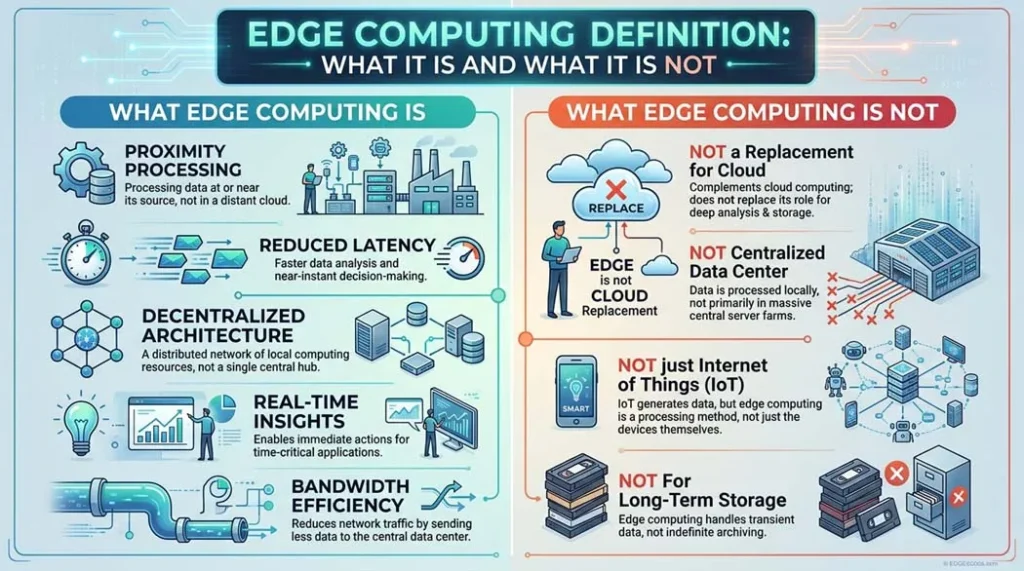
Typical break-even: 500+ IoT devices, OR any real-time control application, OR any offline-critical system
| What Edge Computing IS | What Edge Computing IS NOT |
|---|---|
| Processing data at or near the source of generation | Just moving a server out of a data centre location alone does not make it “edge” |
| A specific architectural pattern with latency, bandwidth, and availability goals | A replacement for cloud edge and cloud are complementary, not competing |
| A spectrum from device-level MCU to regional edge server | Only for IoT edge computing serves every latency-sensitive application including AR/VR, gaming, CDN |
| Enabled by containerisation, 5G, and purpose-built AI silicon | New CDNs, industrial control systems, and branch office computing are all historical forms of edge computing |
| Governed by ETSI MEC standards (GS MEC 001–033) | The same as fog computing fog is a specific intermediate layer within the broader edge hierarchy |
Edge computing is the practice of processing data at or near where it is generated on devices, local gateways, or edge servers to reduce latency below 10ms, cut bandwidth costs by up to 90%, and enable continuous operation without internet connectivity. It complements cloud computing by handling real-time, latency-sensitive, or bandwidth-intensive workloads locally, while sending only aggregated insights to the cloud for long-term analysis and model training.
Edge Computing Architecture: Device, Gateway, Regional & Cloud Tiers
| Tier | Hardware Examples | Compute | Latency | Power | Primary Function |
|---|---|---|---|---|---|
| Device Edge | STM32, ESP32, Arduino Nicla, Raspberry Pi Pico W | μW–100mW FLOPS | <1ms | μW–mW | Sensor acquisition, basic filtering, TinyML inference, actuator control |
| Gateway Edge | NVIDIA Jetson Nano, Intel NUC, Cisco IR1101, Advantech ADAM, Raspberry Pi 5 | 1–10 TOPS | 1–10ms | 5–100W | Protocol translation, data aggregation, local storage, containerised apps, ML inference |
| Regional Edge (MEC) | Dell PowerEdge XR, HPE Edgeline, NVIDIA EGX, AWS Outposts Rack | 10–1000 TOPS | 5–20ms | 1–10kW | Complex ML inference, video analytics, 5G MEC applications, CDN origin |
| Cloud | AWS EC2, Azure VM, GCP Compute Engine (in hyperscale DCs) | Unlimited | 50–500ms | MW (DC level) | Model training, historical analytics, global orchestration, long-term storage |
Mobile Edge Computing (MEC): ETSI Standard & 5G Integration
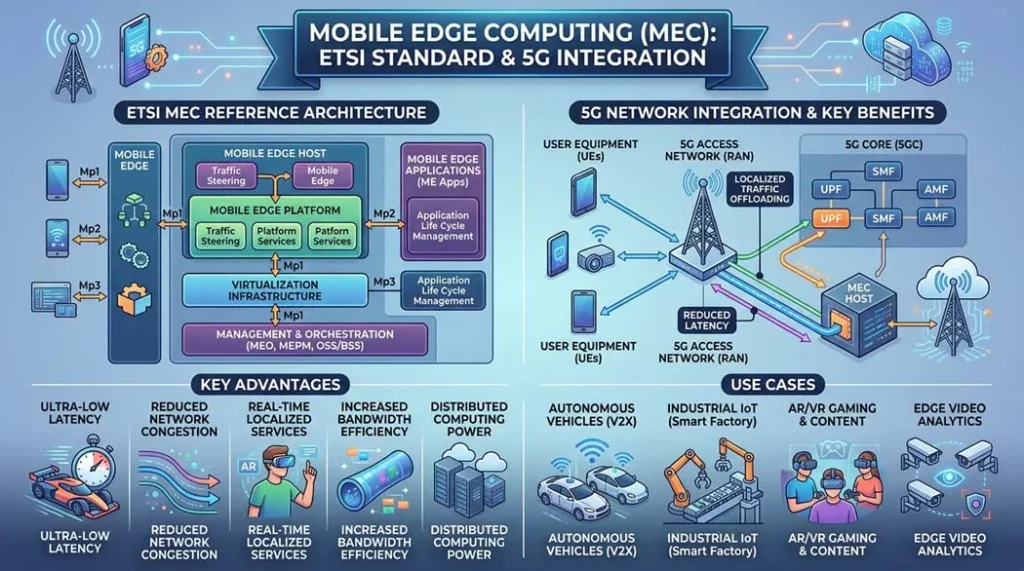
Multi-access Edge Computing (MEC) is formally standardised by the European Telecommunications Standards Institute (ETSI) through its MEC Industry Specification Group. The ETSI MEC framework (GS MEC 001–003) defines the reference architecture, application programming model, and APIs for deploying compute at the network edge specifically inside or adjacent to cellular base stations.
| ETSI MEC Standard | Scope | Link |
|---|---|---|
| GS MEC 001 | Terminology definition for Multi-access Edge Computing | ETSI GS MEC 001 ↗ |
| GS MEC 002 | Technical requirements for MEC framework and reference architecture | ETSI GS MEC 002 ↗ |
| GS MEC 003 | Framework and reference architecture (normative specification) | ETSI GS MEC 003 ↗ |
| GS MEC 010 | Mobile Edge Management Part 1: System, host and platform management | ETSI GS MEC 010 ↗ |
| GS MEC 016 | UE application interface how mobile apps request MEC services | ETSI GS MEC 016 ↗ |
Fog Computing: Origin, Architecture & Relationship to Edge
The term “fog computing” was coined by Flavio Bonomi at Cisco in 2012 computing infrastructure dense near the ground, like fog, as opposed to cloud computing high in the sky. The OpenFog Consortium (now merged with the Industrial Internet Consortium) formalised the definition and published the OpenFog Reference Architecture in 2017.
| Characteristic | Cloud Computing | Fog Computing | Edge Computing |
|---|---|---|---|
| Location | Centralised data centre | Metro/LAN intermediate nodes | On or near the device/sensor |
| Latency | 50–500ms | 10–50ms | <1–10ms |
| Compute scale | Unlimited (elastically scalable) | Medium (gateway to small server) | Small to medium |
| Connectivity requirement | WAN / internet | LAN / metro network | Local / no connectivity needed |
| Data visibility | All aggregated data | Aggregated from multiple edge nodes | Raw local sensor data |
| Industry term status | Dominant | Declining (absorbed into “edge”) | Dominant and growing |
| Standard body | NIST SP 800-145 | OpenFog RA (IEEE 1934) | ETSI MEC, Linux Foundation Edge |
The OpenFog Consortium merged with the Industrial Internet Consortium (IIC) in 2019, and the term “fog computing” largely fell out of industry use. However, the fog architecture layer intermediate processing nodes aggregating multiple edge devices before forwarding to cloud is more prevalent than ever. Today it is called the “gateway tier” or “regional edge tier.” The concept Cisco invented in 2012 is implemented by every major IoT platform: AWS Greengrass Core (fog node), Azure IoT Hub with downstream IoT Edge devices (fog pattern), and NVIDIA EGX platform serving multiple Jetson edge devices.
IoT Edge Computing: Sensors, Gateways & Industrial Protocols
IoT and edge computing are not separate technologies they are two halves of the same problem. IoT generates data at massive scale and geographic distribution; edge computing provides the processing infrastructure to make that data actionable without routing everything to the cloud.
Annual cost saving at $0.09/GB AWS: (4MB/s × 0.99 reduction) × 31.5M seconds × $0.000000090 ≈ $11,300/year per factory
Industrial IoT Protocols That Edge Gateways Must Support
| Protocol | Type | Used In | Edge Gateway Role | Cloud Translation |
|---|---|---|---|---|
| Modbus RTU/TCP | Serial / Ethernet | PLCs, sensors, meters (legacy dominant) | Poll registers, buffer data, detect change | → MQTT / REST to cloud |
| OPC-UA | Ethernet (TCP) | Modern industrial automation, SCADA | Subscribe to nodes, filter, aggregate | → MQTT / AMQP to cloud |
| MQTT | Ethernet / 4G/5G | IoT devices, gateways, telemetry | Broker locally; bridge to cloud broker | → AWS IoT Core / Azure IoT Hub |
| CANbus | Serial | Automotive, robotics, industrial | Translate CAN frames to structured messages | → MQTT / HTTP |
| Profibus / Profinet | Serial / Ethernet | Siemens industrial automation | Via OPC-UA server on gateway | → Azure IoT Edge modules |
| BACnet | Ethernet / IP | Building management systems (HVAC, lighting) | BACnet/IP to gateway, local control logic | → Cloud BMS analytics |
| DNP3 / IEC 61850 | Serial / Ethernet | Power grid SCADA, substations | Substation gateway; local protection logic | → SCADA head-end / cloud |
| LoRaWAN | LPWAN radio | Wide-area IoT: agriculture, smart city, meters | LoRa gateway concentrator → network server | → Cloud via The Things Network / AWS |
| Zigbee / Z-Wave | 2.4GHz mesh radio | Smart home, commercial building automation | Hub/coordinator → LAN/WiFi bridge | → Cloud via Matter/Home Assistant |
The Edge-First IoT Design Rule
Always design IoT systems to operate fully at the edge first define every control action, every alert, every decision that must happen within the local network without cloud connectivity. Then layer cloud features on top: historical trending, cross-site analytics, model training, remote dashboard. Systems designed cloud-first and retrofitted with edge capabilities are consistently more complex, more expensive, and less reliable than systems designed edge-first. The cloud is an enhancement to edge IoT, not the foundation of it.
AI on Edge: Edge AI Devices, NPUs & Inference Platforms
Edge AI running machine learning inference on edge devices without cloud connectivity has been transformed by purpose-built AI accelerators. Neural Processing Units (NPUs), Tensor Processing Units (TPUs), and dedicated AI silicon now enable models previously requiring data centre GPU clusters to run at single-digit watts on palm-sized modules.
| Platform | AI Performance | Power | CPU / GPU | Key Use Case | Price (approx.) | Datasheet / Docs |
|---|---|---|---|---|---|---|
| NVIDIA Jetson Orin NX 16GB Best Performance | 100 TOPS | 10–25W | 8-core ARM + 1024-core Ampere GPU | Autonomous robotics, industrial vision, edge LLM inference | ~$699 | NVIDIA Jetson Orin NX ↗ |
| NVIDIA Jetson Orin AGX 64GB | 275 TOPS | 15–60W | 12-core ARM + 2048-core Ampere GPU + 2 DLAs | Autonomous vehicles, complex multi-sensor fusion, medical imaging | ~$1,999 | Jetson AGX Orin ↗ |
| Intel Core Ultra (Meteor Lake) with NPU | 34 TOPS (NPU) | 15–45W (full SoC) | P+E cores + Intel Arc GPU + NPU | Edge AI PCs, industrial PCs, Windows AI workloads, OpenVINO | varies (SoC) | Intel Core Ultra ↗ |
| Google Coral Edge TPU | 4 TOPS (TPU only) | 2W | NXP i.MX 8M host + Edge TPU co-processor | Low-power vision inference, smart cameras, embedded AI | ~$30–150 | Google Coral Docs ↗ |
| Apple M4 Neural Engine | 38 TOPS | ~3W (Neural Engine) | 10-core CPU + 10-core GPU + Neural Engine | On-device LLM, image generation, voice AI consumer and enterprise Mac/iPad | Integrated (Mac/iPad) | Apple M4 Newsroom ↗ |
| Hailo-8 AI Processor | 26 TOPS | 2.5W | Dedicated AI accelerator (no CPU/GPU) | Smart cameras, traffic monitoring, retail analytics ultra-low-power vision | ~$70–200 (module) | Hailo-8 Specs ↗ |
| Qualcomm QCS8550 (Snapdragon 8 Gen 2) | 45 TOPS (Hexagon NPU) | 5–12W | Kryo CPU + Adreno GPU + Hexagon NPU | Edge AI cameras, mobile robots, AR headsets, premium smartphones | varies (SoC) | Qualcomm QCS8550 ↗ |
TOPS (Tera Operations Per Second) is a peak theoretical figure, often measured with INT8 operations on specific model types. Real inference throughput depends on: model architecture (transformers are harder than CNNs), memory bandwidth (not just compute), framework optimisation (TensorRT, OpenVINO, CoreML all differ), batch size, and thermal throttling. A Jetson Orin AGX rated at 275 TOPS running a real ResNet-50 in TensorRT INT8 achieves ~9,000 images/second approximately 2.5ms per image. Always benchmark with your actual model and framework, not vendor TOPS numbers alone.
Edge to Cloud Computing: Hybrid Architecture Design
Edge and cloud computing are not competing paradigms they are complementary tiers of a single architecture. The design question is not “edge or cloud?” but “which workloads belong at which tier?” The answer is determined by latency requirements, data volume, connectivity reliability, and regulatory constraints.
Edge Computing Platforms: AWS, Azure, Google, Microsoft Compared
| Platform | Product | Edge Model | Protocol Support | AI/ML at Edge | Offline Operation | Pricing Model | Docs |
|---|---|---|---|---|---|---|---|
| AWS IoT Greengrass v2 Most Mature | AWS IoT Greengrass | Lambda + containerised components at edge | MQTT, HTTP, OPC-UA (via connectors) | SageMaker Edge Manager; Neo compiler; DLR runtime | ✅ Full offline with local MQTT broker | Per-device monthly fee + cloud messaging | AWS Greengrass Docs ↗ |
| Microsoft Azure IoT Edge Best Enterprise Integration | Azure IoT Edge + Azure Stack Edge | Docker containers on edge device; IoT Hub parent-child hierarchy | MQTT, AMQP, HTTPS, OPC-UA (publisher module) | Azure Machine Learning edge deployment; ONNX Runtime; Custom Vision | ✅ Offline with local storage module + sync on reconnect | IoT Hub tier + Azure Stack Edge hardware | Azure IoT Edge Docs ↗ |
| Google Distributed Cloud Edge | GDC Edge + Anthos on bare metal | GKE (Kubernetes) extended to edge hardware | MQTT, HTTP, gRPC | Vertex AI Edge deployments; TFLite; Coral Edge TPU support | ✅ GKE cluster operates independently; syncs when connected | Anthos subscription + hardware | Google Distributed Cloud Docs ↗ |
| AWS Wavelength | AWS Wavelength Zones | AWS compute embedded inside carrier 5G networks (Verizon, Vodafone) | Standard AWS APIs; carrier network routing | Full EC2 GPU instances at MEC location | ❌ Requires carrier 5G connectivity | EC2 pricing (at MEC location premium) | AWS Wavelength ↗ |
| Azure Private MEC | Azure Private MEC + Azure Edge Zones | Azure cloud services on carrier-deployed hardware | Standard Azure APIs; 5G network integration | Full Azure AI/ML stack at MEC location | ⚠️ Depends on private 5G network uptime | Azure consumption + MEC infrastructure | Azure Private MEC ↗ |
| NVIDIA EGX Platform | NVIDIA EGX + Fleet Command | GPU-accelerated edge servers managed from cloud console | Protocol-agnostic; app-defined | CUDA, TensorRT, TAO Toolkit; Triton Inference Server | ✅ Local GPU inference operates independently | Hardware + Fleet Command subscription | NVIDIA EGX ↗ |
| Eclipse Mosquitto + EdgeX Foundry Open Source | Linux Foundation EdgeX Foundry | Open-source microservices framework for IoT edge | Modbus, OPC-UA, BACnet, MQTT, REST via device services | Model-agnostic; integrates with any inference runtime | ✅ Fully offline no cloud dependency by default | Free (open source); support contracts available | EdgeX Foundry Docs ↗ |
Real Hardware Comparison: Edge Servers & Edge AI Devices
| Hardware | Category | CPU | AI Perf. | Storage | Operating Temp | Power | Price | Best For |
|---|---|---|---|---|---|---|---|---|
| Dell PowerEdge XR8000 | Ruggedised Edge Server | 2× Intel Xeon Scalable (up to 60 cores) | Optional NVIDIA A30 GPU (165W) | Up to 8TB NVMe | 0°C to +55°C | Up to 3kW | ~$8,000–$30,000 | Regional edge DC, 5G MEC hosting, complex AI inference |
| HPE Edgeline EL8000 | Converged Edge System | 2× Intel Xeon D | Up to 2× NVIDIA T4 GPU | Up to 16TB | 0°C to +55°C | Up to 2kW | ~$15,000–$40,000 | Manufacturing, energy, smart city edge DC |
| NVIDIA Jetson Orin AGX 64GB Edge AI Leader | Edge AI Module | 12-core ARM Cortex-A78AE | 275 TOPS (GPU+DLA) | 64GB eMMC + NVMe via carrier | −40°C to +85°C (industrial) | 15–60W | ~$1,999 (module) | Autonomous robots, industrial vision, edge LLM inference |
| Intel NUC 13 Pro | Mini Edge PC | Intel Core i7-1360P | Intel Arc GPU + NPU (~11 TOPS) | Up to 2TB M.2 NVMe | 0°C to +60°C | 28–64W | ~$500–$900 | Light industrial edge, digital signage, retail AI, lab edge |
| Cisco IR1101 Industrial Router | Edge IoT Gateway / Router | ARM Cortex-A72 (compute module) | None (compute focused) | 8GB Flash + SD card | −40°C to +70°C | 12–18W | ~$1,500–$3,000 | Industrial IoT protocol translation, ruggedised field gateway |
| Advantech MIC-730AI | AI Edge Inference Server | Intel Core i7/i9 (10th gen) | NVIDIA RTX 4090 (optional) / Quadro | Up to 4TB NVMe RAID | 0°C to +50°C | 300–600W | ~$3,000–$10,000 | Factory AI inference, medical imaging, intelligent transport |
| Raspberry Pi 5 (8GB) Developer/Light Edge | SBC / Lightweight Edge | Quad-core Cortex-A76 @ 2.4GHz | None (CPU only; ~0.5 TOPS estimated) | MicroSD / NVMe HAT | 0°C to +85°C (PCB) | 5–10W | ~$80 | Prototyping, low-load edge gateway, educational, smart home hub |
Edge IoT Gateway: Design, Protocol Translation & Selection Guide
The edge IoT gateway is the most critical component in an industrial IoT architecture it bridges the world of legacy field devices (PLCs, sensors, meters running Modbus, OPC-UA, CANbus) and the modern cloud/edge software stack (MQTT, containers, REST APIs). Getting gateway selection wrong is the #1 cause of costly IoT project rework.
Audit All Field Protocols
Before selecting a gateway, physically survey all field devices. Document each device’s communication protocol (Modbus RTU/TCP, OPC-UA, BACnet, CANbus, Profibus, DNP3), data rate, polling frequency, and physical interface (RS-485, RS-232, RJ-45, USB). A gateway that cannot natively support your dominant protocol requires custom development budget accordingly.
Define Local Storage and Buffering Requirements
Calculate worst-case connectivity loss duration × data rate = required local storage. Example: 4-hour connectivity SLA × 40KB/s post-filtering = 576MB minimum buffer. Add 3× margin for unexpected outages → 1.75GB. Choose gateway with at least 8GB flash + an SD or NVMe slot for field-replaceable storage expansion. Ensure the edge software (Greengrass, IoT Edge, or custom) implements store-and-forward with guaranteed delivery semantics.
Match Environmental Specifications
Factory floors, outdoor installations, and process plants require gateways rated for industrial environments: −40°C to +70°C operating temperature, IP30–IP67 ingress protection, DIN-rail mounting, wide-input DC power (9–48VDC), IEC 61000-4 EMC immunity. Using a consumer-grade mini-PC (Raspberry Pi, Intel NUC) in a process plant is a guarantee of field failures within 12 months.
Verify OTA Update Infrastructure
A gateway that cannot be updated remotely creates a permanent security liability. Every gateway must support: secure boot, signed firmware/container images, over-the-air delta updates, rollback on failed update, and remote console access. Without OTA, patching a CVE on 500 gateways requires 500 site visits typically $500–$1,500 per visit. OTA infrastructure is not optional for production deployments.
Design Security from Day One
Each gateway must have: a unique X.509 device certificate provisioned at manufacture (not generic username/password), TLS 1.3 for all outbound communications, firewall rules denying all unsolicited inbound connections, read-only root filesystem with signed container workloads, and hardware security module (TPM 2.0 or equivalent) for cryptographic key storage. Retrofitting security to a deployed gateway fleet is 3–5× more expensive than building it in from the start.
Edge Computing Security: Threats, Controls & Zero Trust
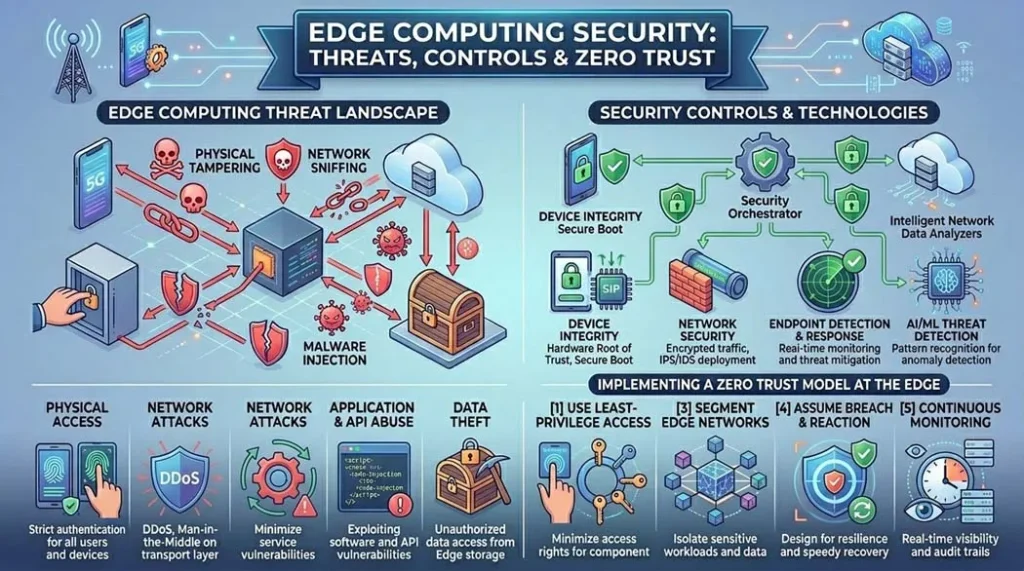
| Threat | Edge-Specific Risk | Control | Standard / Framework |
|---|---|---|---|
| Physical access / device tampering | Edge devices in factories, street cabinets, remote sites physically accessible by anyone nearby | Tamper-evident enclosures; TPM 2.0 for key storage; encrypted storage; remote wipe capability | NIST SP 800-207 Zero Trust |
| Unencrypted legacy protocols | Modbus, BACnet, DNP3 have no native encryption edge gateway is protocol bridge point | Terminate legacy protocols at gateway; never forward unencrypted to WAN; gateway → cloud TLS 1.3 only | IEC 62443 Industrial Security |
| Firmware supply chain attack | Compromised gateway firmware at scale (10,000 devices) = massive botnet or industrial sabotage | Signed firmware with hardware root of trust; secure boot; vendor SBOM (Software Bill of Materials) | NIST SP 800-161 Supply Chain |
| Unpatched CVEs at scale | Manual patching of thousands of field devices is infeasible devices stay unpatched for years | OTA update infrastructure; automated CVE scanning; SBOM tracking; immutable container OS | IEC 62443-2-3 |
| Weak/shared device credentials | Default passwords, shared certificates, or API keys hardcoded in firmware common in low-cost IoT | Unique X.509 certificate per device provisioned at manufacture; certificate rotation; no shared secrets | ETSI EN 303 645 (IoT Security) |
| Man-in-the-middle on edge network | Local network segments at edge often less monitored than cloud lateral movement risk | Network segmentation (OT/IT separation); mutual TLS; certificate pinning; micro-segmentation (Cisco ISE) | NIST SP 800-207 |
| Data exfiltration from edge | Edge devices with local storage of sensitive data (health, financial, PII) as regulatory risk | Encryption at rest (LUKS, VeraCrypt); data minimisation at edge; audit logging; GDPR data residency compliance | GDPR, HIPAA, ISO 27001 |
Traditional perimeter security (“trust everything inside the firewall”) is fundamentally broken for edge computing edge devices are outside any traditional perimeter, often in hostile physical environments, and access resources across multiple networks. NIST SP 800-207 Zero Trust Architecture ↗ mandates: never trust, always verify. Every device, every user, every workload must authenticate and be authorised for every resource access regardless of network location. For edge: this means device certificates (not VPNs), ZTNA agents on edge devices, and policy enforcement at the application layer, not the network perimeter.
Case Studies: Factory Floor AI, Smart City MEC & Autonomous Vehicle Edge
Problem: Cloud-based vision inspection causing 2.5% defect escape rate on robotic welding line
Background: A Tier 1 automotive supplier ran 18 robotic welding cells, each producing 240 welds/hour. Vision inspection used AWS Rekognition Custom Labels weld images uploaded to cloud, result returned to PLC. Average round-trip: 180ms. PLC control loop: 100ms. Cloud latency regularly exceeded PLC timeout.
Root cause: Cloud-only architecture for a real-time control application. Physics of light-speed propagation to AWS eu-west-1 (Dublin, ~800km from plant) guaranteed minimum 4ms round-trip, with software overhead taking actual latency to 180ms average and 800ms at 95th percentile.
Edge solution deployed: NVIDIA Jetson AGX Xavier per 3 welding cells (6 units total), running a fine-tuned YOLOv8 weld defect model compiled to TensorRT INT8. Inference latency: 8ms per weld image. Model updates pushed weekly from AWS SageMaker via signed OTA. Fleet managed via NVIDIA Fleet Command.
Results after 12 months: Defect escape rate: 2.5% → 0.04%. Cloud data transfer costs: −87%. Capital payback: 8 months (avoided warranty claims). Plant manager quote: “We stopped arguing about cloud vs edge the day we saw the first defect caught in real time.”
Problem: Traffic light adaptive control latency too high with cloud-based AI processing
Background: A municipal transport authority deployed 200 AI-enabled traffic cameras for adaptive signal control. Camera streams (4K, H.264) sent to AWS for vehicle counting and queue estimation. Results returned to traffic controllers. Cloud round-trip: 220ms average. Adaptive control algorithm required <50ms response to be effective.
Edge solution: AWS Wavelength Zones deployed within Vodafone 5G network nodes (2 MEC locations covering the city). Traffic camera streams now routed to Wavelength compute (EC2 g4dn.xlarge with NVIDIA T4 GPU) via 5G user plane local breakout never leaving the carrier network to reach AWS eu-west-1. End-to-end latency: 12ms average.
Results: Average intersection wait time reduced 31%. Emergency vehicle clearance time: −45% (priority routing activates in <15ms). City-wide carbon emission from idling: estimated −8%. This project would have been architecturally impossible without 5G MEC it required both the radio performance of 5G and the compute co-location of MEC.
Problem: Drilling equipment health monitoring with intermittent VSAT connectivity
Background: An offshore drilling platform operated 340 rotating equipment assets (pumps, compressors, motors) with vibration, temperature, and pressure sensors. VSAT connectivity: 99.2% uptime (30–60 hours of downtime per year in storms). Cloud-only predictive maintenance system caused 8 missed anomaly alerts during connectivity outages contributing to 2 unplanned maintenance events costing $800K each.
Edge solution: Azure IoT Edge deployed on 4 ruggedised industrial PCs (IEC 61850 rated, −40°C capable). Local MQTT broker (Eclipse Mosquitto). Azure Stream Analytics edge module running anomaly detection on all 340 assets at 100Hz no cloud connectivity required. Results stored locally (4TB NVMe RAID, 90-day rolling). On VSAT reconnection: synchronisation of compressed anomaly records and model updates only (not raw sensor data). Monthly cloud data transfer: 8GB vs previous 4TB.
Results: Zero anomaly misses in 18 months post-deployment (including 3 VSAT outage events). Maintenance cost reduction: $1.2M/year (2 prevented failures × $600K average cost). Cloud data costs: −99.8%. ROI achieved in 3 months.
Common Edge Computing Mistakes Engineers Make (And How to Fix Them)
“Our cloud solution has 50ms average latency well within our 100ms requirement”
What happened: A robotics company designed a cloud-based collision avoidance system with 50ms average cloud latency. During production, 99th percentile latency hit 380ms during AWS region congestion events 4× above the safety threshold. Three near-miss incidents occurred before the architecture was redesigned.
The rule: For safety-critical or real-time control applications, design for the 99th or 99.9th percentile latency, not the average. Cloud latency has heavy tails averages are misleading. The only way to guarantee deterministic <10ms latency is compute at the edge, on the same local network as the actuator. Physics is the guarantee, not the SLA.
“Our edge system keeps the production line running until the internet goes down”
What happened: An edge IoT platform was deployed at a food processing plant. Edge devices sent data to AWS IoT Core; control decisions were computed in a Lambda function and returned via MQTT. When the plant’s fiber connection was cut by a contractor (2-hour outage), all edge devices stopped responding the local IoT gateway was stateless and had no local decision capability. $180,000 in lost production in one afternoon.
Fix: Every production edge architecture must define its degraded mode operation: what runs locally during connectivity loss, what data is buffered and for how long, and how conflict resolution works on reconnection. AWS Greengrass, Azure IoT Edge, and EdgeX Foundry all support offline-first patterns but the developer must explicitly design and test the offline scenario. Connectivity loss is not an edge case. It is a planned operating mode.
“We deployed edge computing for our weekly sales report dashboard”
Over-engineering: A retail company deployed NVIDIA Jetson edge servers in each of 200 stores to compute weekly sales dashboards. Latency requirement: 24 hours (data aggregated weekly). Result: $400,000 in edge hardware serving a use case that required zero edge compute cloud batch processing costs: $80/month. Edge computing was the wrong tool for a non-latency-sensitive workload.
Under-engineering (more common): A different company used cloud-only architecture for CNC machine tool compensation a control loop requiring 1ms response. Cloud latency: 180ms. Result: tool compensation was applied after the toolpath had already moved 2mm beyond the correction point. Scrap rate: 12%. Correct solution: on-machine edge compute with direct integration to the CNC controller, no network hop at all. The lesson: choose the tier by latency requirement, not by technology preference.
“We bought the highest TOPS device but our model won’t run on it”
What happened: An engineering team selected the Google Coral Edge TPU (4 TOPS, $35) for a computer vision pipeline running a custom Transformer-based model. The Edge TPU only supports TensorFlow Lite models compiled for the Edge TPU and does not support attention mechanisms (the core of Transformers). The model literally could not run on the hardware despite 4 TOPS being theoretically sufficient compute.
Fix: Before selecting edge AI hardware, verify: (1) which ML frameworks are supported (TFLite, ONNX, TensorRT, OpenVINO); (2) which model architectures are supported (CNNs, Transformers, RNNs); (3) what the memory bandwidth limitation is (often the real bottleneck, not TOPS); (4) actual measured throughput with your specific model on that specific hardware. Always run a proof-of-concept with your actual model before committing to a hardware platform for production at scale.
- Shared device certificates: using one certificate for all devices means one compromised device compromises all. Always provision unique identity per device X.509 individual certificates, not shared API keys.
- Unencrypted MQTT on local networks: “it’s just the internal network” is not a security argument industrial espionage, insider threat, and supply chain attacks all operate on internal networks. Always TLS 1.3, even locally.
- No OTA update path: deploying edge devices without update infrastructure means every future security patch requires a physical site visit. Budget this cost before deployment, not after the first CVE.
- Default credentials on IoT gateways: the Mirai botnet of 2016 (which took down Dyn DNS and large portions of the internet) was built entirely from IoT devices with default passwords. This attack vector has not gone away in 2026 it has grown.
Real-World Applications Across Industries
| Application | Edge Tier Used | Latency Required | Platform | Industry |
|---|---|---|---|---|
| Autonomous vehicle perception | Device-edge (onboard SoC) | <10ms | NVIDIA Drive Orin / Qualcomm Snapdragon Ride | Automotive |
| 5G V2X (vehicle-to-everything) | MEC (5G base station) | <5ms | AWS Wavelength / Ericsson MEC | Smart transport |
| Robotic surgery assistance | Regional edge + MEC | <1ms haptic, <10ms video | Custom + 5G MEC | Medical |
| Predictive maintenance (vibration AI) | Gateway edge | <100ms | NVIDIA Jetson / Azure IoT Edge | Manufacturing |
| Real-time video analytics (retail) | Gateway edge | <200ms | Intel OpenVINO / Hailo-8 | Retail |
| Smart grid substation protection | Device edge | <4ms (IEC 61850 GOOSE) | Ruggedised RTU + IEC 61850 | Energy |
| AR remote assistance | MEC (5G network edge) | <20ms | Azure Private MEC / AWS Wavelength | Field service / Industrial |
| Precision agriculture (drone AI) | Device-edge (onboard) | Real-time (no connectivity) | Qualcomm Flight RB5 / Jetson Nano | Agriculture |
| Port container tracking (edge AI + IoT) | Gateway + regional edge | <500ms | NVIDIA EGX + AWS Greengrass | Logistics |
| Content delivery (CDN) | Regional edge PoP | <20ms to user | Akamai / Cloudflare / Fastly | Media / Internet |
| Online gaming low-latency | MEC (carrier edge) | <15ms | AWS Wavelength / Google Stadia tech | Gaming |
| Building energy management (BMS) | Gateway edge | <2s (BACnet polling) | EdgeX Foundry + MQTT + cloud dashboard | Smart building |
Edge Deployment Troubleshooting: Field Diagnostics
| Symptom | Likely Cause | Quick Diagnostic | Fix |
|---|---|---|---|
| Edge device sends data but cloud never receives it | TLS certificate expired; IoT Hub connection string wrong; firewall blocking port 8883 (MQTT over TLS) | Run openssl s_client -connect iot-hub.azure-devices.net:8883 from device. Check certificate expiry. Check firewall rules for outbound 8883/443. | Rotate certificate; update connection string; open firewall port. Implement certificate expiry monitoring with alert 30 days before expiry. |
| Edge AI inference latency much higher than benchmarks | Model not compiled for target hardware; thermal throttling; memory bandwidth bottleneck; wrong batch size | Check GPU/NPU utilisation (tegrastats on Jetson, intel_gpu_top on Intel). Check temperature. Verify TensorRT/OpenVINO compilation was used, not raw PyTorch. | Compile model with TensorRT (Jetson) or OpenVINO (Intel). Reduce thermal throttling with heatsink/fan. Set batch size to 1 for real-time single-frame inference. |
| Gateway stops forwarding data after connectivity loss | Missing store-and-forward; MQTT client does not implement persistent session; buffer full | Check local storage for buffered messages. Verify MQTT clean_session = false and QoS ≥ 1 in client config. Check disk space (df -h). | Implement store-and-forward at gateway. Set MQTT persistent session. Add disk space monitoring alert at 80% full. Implement circular buffer policy to discard oldest data when full. |
| IoT sensors showing stale data gateway polls but values never update | Modbus timeout mismatch; wrong register address; RS-485 bus contention; half-duplex timing issue | Use Modbus diagnostic tool (ModScan, QModMaster) to poll device directly from laptop on same RS-485 bus. Verify baud rate, parity, stop bits, and slave ID match device manual. | Correct Modbus parameters. Check RS-485 termination resistors (120Ω at each end of bus). Verify one master only on the bus. Increase timeout from default 500ms to 2000ms for slow devices. |
| Edge device reboots unexpectedly in field | Thermal overtemperature; power supply brownout; watchdog timer trigger; kernel panic | Check system logs after reboot: journalctl -b -1 (previous boot). Check thermal logs. Measure supply voltage under load should not drop >5%. | Add heatsink or fan. Upgrade power supply capacity (2× peak current rating). Fix application causing watchdog timeout. Use UPS for power brown-out protection. |
| OTA update fails on subset of fleet devices | Insufficient disk space for update staging; incompatible hardware variant in fleet; network timeout during download | Check disk space on failing devices. Verify hardware variant (SoC version, RAM) matches update target. Check update server logs for download failure reasons. | Add disk cleanup pre-update step. Tag hardware variants in fleet management. Implement chunked downloads with resume capability. Set update retry with exponential backoff. |
The 3-Check Edge Diagnostic (First 5 Minutes on Any Call)
When an edge deployment misbehaves, always check these three things before touching any configuration: (1) Is the device online? ping the device IP, check IoT Hub/Greengrass connection status, verify network interface is up. (2) Is the device healthy? CPU load (should be <80%), memory (should be <90%), disk space (>20% free), temperature (within spec). (3) When did it last send data? check the last telemetry timestamp in IoT Hub/AWS IoT Core. These three checks resolve 60% of edge support calls without deeper investigation.
Future Trends: 6G Edge, Neuromorphic Computing & Satellite Edge
6G and Sub-Millisecond Edge Computing (2030+)
6G research (IMT-2030), led by bodies including ITU-R Working Party 5D ↗, targets 10–100× higher data rates than 5G and sub-millisecond air interface latency. 6G introduces “network as a sensor” the radio environment itself becomes a sensing medium. Combined with integrated MEC, 6G will enable applications currently impossible: holographic telepresence, truly tactile internet (remote surgery with force feedback), and real-time digital twins synchronised at microsecond precision. Commercial deployment: 2030–2033.
Neuromorphic Edge Computing
Neuromorphic chips (Intel Loihi 2, IBM NorthPole) process information as sparse spikes like biological neurons consuming 100–1,000× less power than equivalent TOPS on conventional silicon. Intel’s Loihi 2 achieves complex gesture recognition at 23μJ per inference (millijoules vs milliwatts on conventional AI chips). For extreme-constraint edge deployments implantable medical devices, wildlife trackers, deep-space sensors neuromorphic computing will be the only viable AI platform. Intel Neuromorphic Research ↗ currently hosts the world’s largest neuromorphic research programme.
Satellite Edge Computing
Low Earth Orbit (LEO) satellite constellations (SpaceX Starlink, Amazon Kuiper, OneWeb) provide global connectivity with 20–40ms latency far below the 600ms of geostationary satellites. The next step, already in prototype phase: compute payloads on satellites themselves processing earth observation imagery, IoT aggregation, and edge analytics in orbit. AWS Ground Station ↗ and Microsoft Azure Orbital are building the cloud-satellite integration layer. Processing in orbit true edge computing with no terrestrial infrastructure needed is projected to reach commercial viability by 2028–2030.
Microsoft Edge Computing: The Continuum Vision
Microsoft’s edge computing strategy, described in their Hybrid Cloud documentation ↗, spans from Azure Sphere (μW-class IoT MCU with built-in cloud security) through Azure IoT Edge (containerised workloads on industrial gateways), Azure Stack HCI (hyperconverged edge data centre infrastructure), to Azure Arc (unified management plane extending Azure to any location on-premises, edge, or competitor cloud). The vision: Azure as the operating system for the entire compute continuum from silicon to cloud with “Microsoft Edge Computing” as the brand umbrella for this end-to-end stack.
Frequently Asked Questions
Edge computing is a distributed computing paradigm that processes data at or near the source of generation on devices, local gateways, or edge servers rather than sending it to a centralised cloud data centre. This reduces latency from 100–500ms (cloud round-trip) to under 10ms, cuts bandwidth costs by 60–90% by filtering data locally, and enables real-time decision-making for applications where cloud latency is unacceptable. Examples: autonomous vehicles, industrial robot control, real-time video analytics, and remote surgical robotics.
Mobile Edge Computing (MEC), standardised by ETSI as Multi-access Edge Computing, places cloud-computing capabilities and an IT service environment at the edge of the mobile network inside or adjacent to cellular base stations (eNodeB/gNodeB in 4G/5G). MEC enables ultra-low-latency (<10ms), high-bandwidth computing for mobile devices without backhaul to a central cloud. Use cases include 5G vehicle-to-everything (V2X) communication, augmented reality, real-time video processing, and autonomous vehicle coordination. Key ETSI MEC standards: GS MEC 001 (terminology), GS MEC 002 (requirements), GS MEC 003 (architecture).
Cloud computing centralises processing in large data centres (AWS, Azure, GCP) accessible over the internet, with latencies of 50–500ms, unlimited scalability, but high bandwidth cost and internet dependency. Edge computing distributes processing to the point of data origin on devices or local servers with latencies of 1–10ms, lower bandwidth cost, and local operation without internet dependency. The optimal architecture is hybrid: edge handles real-time low-latency decisions; cloud handles historical analysis, model training, and long-term storage. Neither can fully replace the other for general-purpose use.
Fog computing, coined by Cisco’s Flavio Bonomi in 2012 and formalised by the OpenFog Consortium (IEEE 1934 standard), is a layer of distributed computing infrastructure between edge devices and the cloud typically in local area networks or metro-area hubs. Edge computing processes data on or very near the device; fog computing processes at an intermediate aggregation layer. The term “fog computing” is now largely absorbed into “edge computing” following the OpenFog/IIC merger in 2019, but the architectural layer it describes gateway tier between sensors and cloud is more prevalent than ever in AWS Greengrass Core, Azure IoT Hub, and EdgeX Foundry implementations.
IoT edge computing combines Internet of Things sensor networks with edge processing capability. Instead of streaming all IoT data to the cloud (often terabytes per day), edge nodes pre-process, filter, aggregate, and act on data locally sending only anomalies, summaries, or insights to the cloud. A factory with 500 vibration sensors at 10kHz would require 4MB/s continuous cloud bandwidth; edge processing reduces this to under 40KB/s of event-driven alerts a 99% reduction. IoT edge gateways bridge the protocol gap between legacy industrial sensors (Modbus, OPC-UA, BACnet) and cloud platforms (AWS IoT Core, Azure IoT Hub).
Edge AI runs machine learning inference executing trained AI models directly on edge devices or edge servers, without sending data to the cloud. Benefits: ultra-low latency (<5ms inference), data privacy (sensitive data never leaves the device), offline capability, and reduced cloud compute costs. Key platforms: NVIDIA Jetson Orin (275 TOPS, robotics and industrial), Intel OpenVINO on Core Ultra (34 TOPS NPU, industrial PCs), Apple Neural Engine (38 TOPS, consumer/enterprise Mac), Google Coral Edge TPU (4 TOPS, low-power cameras), Hailo-8 (26 TOPS, 2.5W). Training remains in the cloud; only inference runs at edge.
Microsoft Azure Edge Computing spans: Azure IoT Edge (containerised cloud workloads on edge devices, offline operation, Docker-compatible modules); Azure Stack Edge (GPU-accelerated hardware appliance running Azure services on-premises); Azure Sphere (secure MCU for IoT end devices with built-in cloud security); Azure Arc (manage edge, on-premises, and multi-cloud servers using Azure control plane); and Azure Private MEC (Azure services deployed inside carrier 5G networks). Azure IoT Edge supports TensorFlow, ONNX, and PyTorch models via Azure Machine Learning edge deployment, integrating with Azure IoT Hub for device management at scale.
An edge IoT gateway is a hardware device that sits between field-level IoT sensors and the network/cloud, performing: protocol translation (Modbus → MQTT, OPC-UA → AMQP), data aggregation, local storage, edge processing, and security functions. Key capabilities: legacy industrial protocol support, containerised edge application runtime, local data buffering during connectivity loss, VPN/TLS security, and cloud synchronisation on reconnect. Examples: Cisco IR1101 (ruggedised, −40°C to +70°C, IOS-based), Advantech ADAM-3600 (DIN-rail, Modbus/OPC-UA), Dell EMC Edge Gateway 3200 (x86, full IoT Edge runtime). Selection must be driven by protocol requirements, environmental rating, and OTA update capability not price alone.
Edge-to-cloud computing is the complete tiered architecture connecting edge devices through processing layers to cloud data centres. Data flows: sensors → device-edge (raw signal processing) → gateway edge (protocol translation, aggregation, filtering) → regional edge/MEC (ML inference, complex analytics) → cloud (training, long-term storage, cross-site analytics). Models trained in cloud are deployed back to edge for local inference a bidirectional architecture. Major implementations: AWS Outposts (cloud infrastructure on-premises), Azure Arc (cloud control plane for edge), Google Distributed Cloud (GKE extended to edge), AWS Wavelength (EC2 inside 5G carrier networks).
Yes this is one of edge computing’s primary advantages over pure cloud architectures. Edge devices and gateways operate fully autonomously: local sensor processing continues, actuator control operates, and data is stored locally. When connectivity is restored, data synchronises to the cloud in order. AWS IoT Greengrass, Azure IoT Edge, Eclipse Mosquitto (MQTT broker), and EdgeX Foundry all support offline-first operation. This is critical for remote industrial deployments (mines, offshore platforms, agricultural equipment) and applications requiring regulatory data residency. Offline-first must be explicitly designed it is not automatic.
Edge devices in IoT are hardware endpoints that generate, process, or act on data at the network edge. They span a wide spectrum: constrained end-nodes (microcontrollers like STM32, ESP32 μW to mW power, simple sensing and TinyML inference), smart sensors (Raspberry Pi class SBCs with onboard processing), industrial IoT gateways (Cisco IR, Advantech ADAM protocol translation, industrial rated), and edge AI modules (NVIDIA Jetson series GPU-accelerated inference). The unifying characteristic: they operate in or near the physical environment where data is generated, rather than in a data centre. By 2025, IDC estimates 41.6 billion connected IoT devices globally the majority are edge devices.
An edge server is a compute server deployed at the network edge near end users or data sources rather than in a centralised cloud data centre. Edge servers provide significantly more compute power than end devices or gateways, supporting complex ML inference, video analytics, multiple simultaneous applications, and local storage at scale. Examples: Dell PowerEdge XR8000 (ruggedised, up to 2× Xeon processors), HPE Edgeline EL8000 (industrial edge server), NVIDIA EGX servers (GPU-accelerated), and AWS Outposts Rack (cloud infrastructure in an on-premises rack). Edge servers are used as MEC compute nodes, CDN origin servers, regional IoT data aggregation points, and local AI inference platforms.
An edge network is the networking infrastructure at the periphery of the internet CDN nodes, internet exchange points, last-mile connectivity (base stations, DSL, cable head-ends). Edge computing is the compute and processing capability placed within or near that edge network. Edge computing requires edge networking but edge networking can exist without edge computing (simple packet forwarding). Modern deployments combine both: compute-capable network nodes that process traffic rather than merely routing it as in ETSI MEC at 5G base stations or CDN nodes with edge compute capability (Cloudflare Workers, Fastly Compute@Edge).
An edge data centre (micro data centre or edge colocation facility) is a small-scale data processing facility located within 30–100km of end users as opposed to hyperscale cloud data centres thousands of kilometres away. Edge data centres range from 5–100 server racks (vs thousands in hyperscale), are prefabricated and rapidly deployable, and connect to the nearest internet exchange point or carrier hotel. Used for: CDN edge PoP (content delivery), 5G MEC hosting, regional IoT data aggregation, and latency-sensitive applications for specific metro areas. Major operators: Equinix (xScale edge), Iron Mountain, EdgeConneX, and carrier-hosted facilities (Verizon, AT&T, Vodafone).
“Computing at the edge” and “computing on the edge” are used interchangeably across industry and academia referring to the same paradigm of processing data near where it is generated rather than in a centralised data centre. ETSI, IEEE, the Linux Foundation Edge group, AWS, Azure, and Google all use both phrases synonymously. Some practitioners distinguish “on the edge” (directly on end devices) from “at the edge” (on nearby servers), but this is not a formalised distinction in any standards body. The meaningful technical distinctions are latency tier, compute capability, and power budget not the preposition. If a vendor uses one phrase vs the other, it is marketing language, not technical taxonomy.
🎯 The Bottom Line
Edge computing is not a trend it is a physical reality. Light has a finite speed. Bandwidth has a finite cost. Industrial systems cannot stop when the internet goes down. These are not engineering opinions; they are physics constraints that cloud-only architectures cannot solve regardless of how fast or cheap cloud compute becomes.
Three rules that resolve most edge architecture decisions: (1) If latency requirement is under 50ms or offline operation is required edge is mandatory, not optional. (2) If data generation rate × cost-per-GB exceeds edge hardware cost in less than 18 months edge processing is economically justified. (3) Design offline-first, layer cloud features second systems designed cloud-first and retrofitted for edge operation consistently cost 3–5× more to operate reliably in the field.
From Akamai’s first CDN edge server in 1998 to NVIDIA Jetson Orin delivering 275 TOPS of AI inference at 60W in 2023, the trajectory is clear: intelligence is moving to the edge of the network, to the factory floor, to the base station, and ultimately onto the device itself. The engineers who understand how to design, deploy, and operate systems across this compute continuum will define the next decade of infrastructure.
⚠️ Important Disclaimer
Platform capabilities, pricing, and specifications in this guide reflect information available as of March 2026. Cloud and edge computing platforms evolve rapidly always verify current specifications, pricing, and feature availability directly from vendor documentation before making architectural or procurement decisions.
Hardware specifications are sourced from manufacturer datasheets and may vary by configuration. Real-world performance will differ from benchmark figures depending on workload, thermal environment, and software optimisation. Always conduct proof-of-concept testing with representative workloads on your target hardware before committing to production scale.
📚 Related Guides on Procirel
📎 References, External Authority Sources & Standards
- 1 ETSI GS MEC 003 V3.1.1 (2022). Multi-access Edge Computing (MEC); Framework and Reference Architecture. European Telecommunications Standards Institute. ETSI GS MEC 003 ↗ Normative MEC architecture specification. [International Standard Primary Authority]
- 2 Satyanarayanan, M., Bahl, P., Cáceres, R., & Davies, N. (2009). The Case for VM-Based Cloudlets in Mobile Computing. IEEE Pervasive Computing, 8(4), 14–23. doi.org/10.1109/MPRV.2009.82 ↗ Original academic paper defining “cloudlets” the first formal edge computing definition. [IEEE Journal Primary Historical Source]
- 3 Bonomi, F., Milito, R., Zhu, J., & Addepalli, S. (2012). Fog Computing and Its Role in the Internet of Things. MCC Workshop, ACM. doi.org/10.1145/2342509.2342513 ↗ Original paper coining “fog computing” by Cisco’s Flavio Bonomi. [ACM Primary Historical Source]
- 4 NIST SP 800-207 (2020). Zero Trust Architecture. National Institute of Standards and Technology. NIST SP 800-207 ↗ Authoritative ZTA framework for edge security architecture. [US Government Standard External Authority]
- 5 AWS. (2024). AWS IoT Greengrass v2 Developer Guide. Amazon Web Services. AWS Greengrass Docs ↗ Official documentation for AWS IoT Greengrass edge platform. [Manufacturer Documentation]
- 6 Microsoft. (2024). Azure IoT Edge Documentation. Microsoft Azure. Azure IoT Edge Docs ↗ Official documentation for Azure IoT Edge and Azure Stack Edge. [Manufacturer Documentation]
- 7 NVIDIA. (2024). Jetson AGX Orin Technical Brief. NVIDIA Corporation. NVIDIA Jetson AGX Orin ↗ 275 TOPS specification and use case documentation. [Manufacturer Datasheet]
- 8 Linux Foundation Edge. (2024). EdgeX Foundry Documentation. EdgeX Foundry Docs ↗ Open-source IoT edge framework with full protocol support documentation. [Open Source Foundation External Authority]
- 9 Google Cloud. (2024). Google Distributed Cloud Edge Documentation. Google Distributed Cloud Docs ↗ GKE at edge architecture and deployment documentation. [Manufacturer Documentation]
- 10 IEC 62443-2-3:2015. Security for Industrial Automation and Control Systems Part 2-3: Patch Management in the IACS Environment. International Electrotechnical Commission. IEC 62443 ↗ OTA update and patch management standards for industrial edge deployments. [International Standard]
- 11 Grand View Research. (2024). Edge Computing Market Size, Share & Trends Analysis Report 2024–2030. grandviewresearch.com ↗ $232B market size projection and growth analysis. [Market Research External Data Source]
- 12 Intel Research. (2023). Intel Loihi 2 Neuromorphic Processor. Intel Corporation. Intel Neuromorphic Research ↗ Loihi 2 specifications and neuromorphic edge computing research. [Manufacturer Research External Authority]