Why Your LiPo Battery Dies So Fast (Even When Fully Charged)
9 hidden killers draining your pack and field-tested fixes the datasheets won’t tell you.
⚡ Key Takeaways
- A “fully charged” LiPo can show 4.2V at rest but sag below cutoff under load if internal resistance has increased your charger can’t detect this.
- Cell imbalance is the #1 silent killer. One weak cell triggers low-voltage cutoff while the others still have 60%+ capacity remaining.
- WiFi-capable boards like ESP32 draw 300–500mA peak spikes that small or aged LiPos simply can’t sustain without voltage collapse.
- Storing LiPos at full charge (4.2V) accelerates permanent capacity loss by 20%+ per year compared to storage voltage (3.8V).
- A 470µF–1000µF bulk capacitor at your load’s power input is the cheapest fix for transient voltage sag costs $0.15, saves hours of debugging.
- Temperature below 10°C can cut usable capacity by 20–40% your battery literally can’t deliver its rated energy when cold.
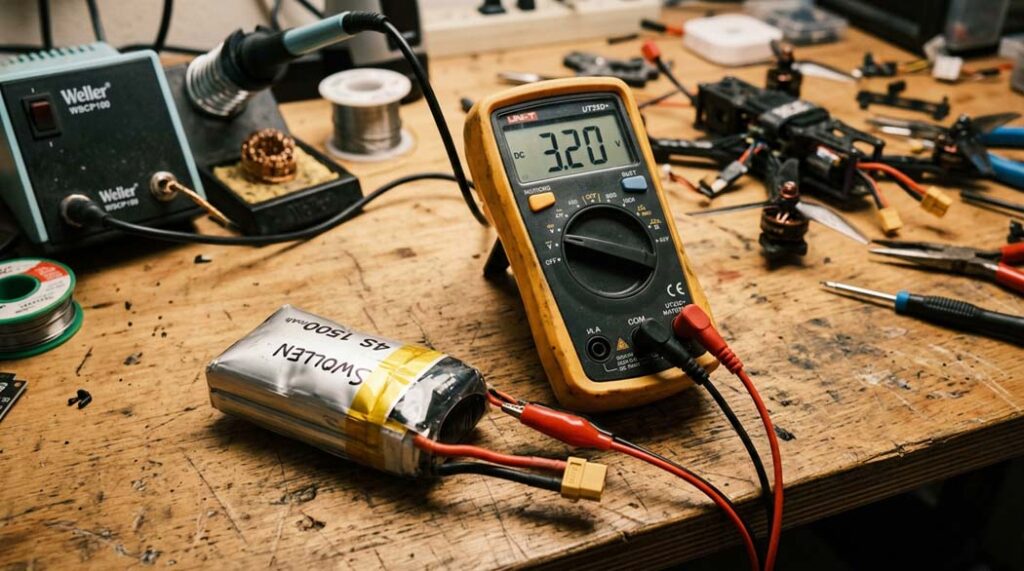
- If your LiPo is puffed even slightly, it’s not “a little worn.” It’s actively failing retire it immediately.
You’re Not Imagining It Something IS Wrong
You charged your LiPo to a solid 4.2V per cell. The charger LED turned green. You connected it to your drone, robot, ESP32 project, or RC car and within minutes, the voltage tanked. Maybe your flight controller threw a low-battery warning 30 seconds in. Maybe your ESP32 hit a brownout reset loop. Maybe your RC car barely crawled out of the driveway.
So you did what anyone would do: you Googled it. And you found the same recycled advice everywhere “use a good charger,” “don’t over-discharge,” “buy quality packs.”
Thanks. Super helpful. 🙄
Here’s what those generic guides won’t tell you: the problem almost never has a single cause. After 6+ years of building battery-powered hardware from FPV racing quads to solar-powered IoT nodes I’ve learned that a LiPo dying fast is usually a combination of 2–3 overlapping issues. And most of them are invisible unless you know exactly where to look.
This guide isn’t going to repeat beginner advice. We’re going deep into the electrochemistry, the circuit-level reality, and the field-tested fixes that actually solve this problem.
1 Internal Resistance: The Silent Capacity Thief
Every LiPo cell has internal resistance (IR). It’s a physical property of the cell the resistance of the electrolyte, the electrode interfaces, the current collectors. You can’t eliminate it. And here’s the thing: it increases with every charge cycle, every high-current discharge, and every day the cell ages.
Why This Kills Your Runtime
- A new premium cell might have 3–8 mΩ internal resistance. After 200+ cycles or abuse, that climbs to 30, 50, even 100+ mΩ.
- Your charger reads terminal voltage at near-zero current. It sees 4.20V and says “full.” It has no way to know that under a 10A load, voltage will sag to 3.2V instantly.
- The math is simple: Voltage Drop = Current × Internal Resistance. A cell at 60 mΩ pulling 15A loses 0.9V to IR alone. Your 4.2V cell delivers 3.3V the instant you hit the throttle.
- The battery IS fully charged. It just can’t deliver that energy without massive voltage sag.
How to Diagnose
- Use a charger with IR readout (iSDT Q6 Pro, ToolkitRC M8S, HOTA D6 Pro).
- Compare readings to when the pack was new (if you recorded them you should start).
- Rule of thumb for standard hobby LiPos: above 15–20 mΩ per cell = aging. Above 40 mΩ = retirement candidate.
Real-World Insight
I’ve had packs that read 4.20V/cell on the bench and couldn’t sustain a 2-minute hover. IR was 55 mΩ across all cells. The charger said “full.” The charger was technically correct and completely useless for predicting actual performance. Voltage alone is not a health indicator.
2 Cell Imbalance Is Eating Your Runtime
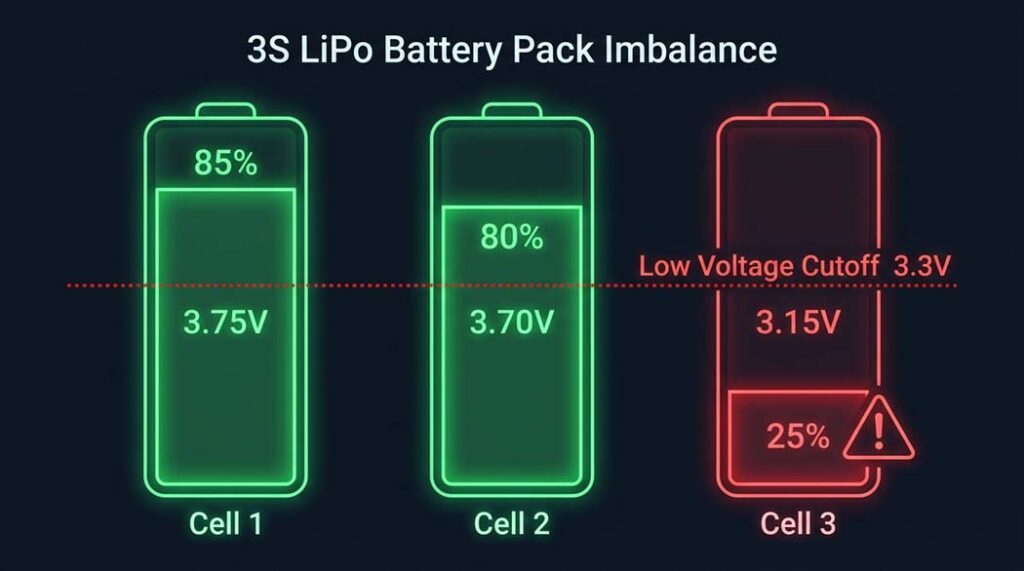
A 3S LiPo is not one battery. It’s three separate cells wired in series. A 6S pack is six. They’re manufactured individually and then assembled. They are never perfectly matched and they diverge further with use.
The Deadly Chain Reaction
- Your charger balance-charges all cells to 4.20V. Looks perfect on screen.
- Under load, the weakest cell (higher IR, lower capacity, slight manufacturing variance) drops voltage faster than the others.
- Your ESC / BMS hits its per-cell low-voltage cutoff (typically 3.3–3.5V) based on the weakest cell even if the other cells are comfortably at 3.7V.
- Result: your device shuts down with 60–70% of total pack energy still unused.
- You check total pack voltage it reads 10.8V on a 3S. That’s 3.6V average per cell. Seems fine. But Cell 3 was at 3.1V. That’s what triggered the cutoff.
How to Diagnose
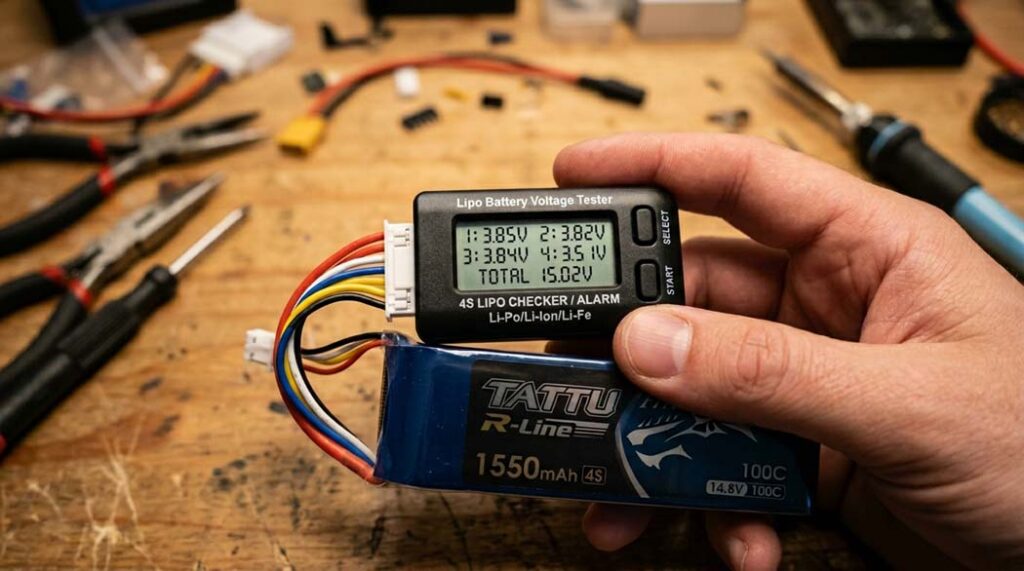
- Use a per-cell voltage checker (those cheap $4 LiPo buzzers actually work for this).
- Check cell voltages immediately after the device cuts off. If cells differ by more than 0.05V, you have imbalance. More than 0.15V? That pack needs attention.
- Log per-cell voltage over multiple cycles. A consistently weak cell means it’s physically degraded balance charging can’t fix a bad cell, it can only mask it temporarily.
3 Current Spikes You Never Measured
This one catches smart builders off guard because the problem is invisible to a basic multimeter.
Where the Hidden Spikes Come From
- ESP32 WiFi TX bursts: Average draw might be 80–150mA. But during WiFi transmission, it spikes to 300–500mA for milliseconds. On a small 500mAh LiPo, that’s a 0.6–1C burst that sags voltage below brownout threshold.
- Motor inrush: A brushless motor rated at 15A continuous can spike to 40–60A during rapid throttle changes. Your battery sees a momentary short circuit.
- Servo stalls: A servo drawing 200mA normally can pull 1–2A when mechanically stalled.
- Relay/solenoid coils: Inrush current is 5–10× steady-state for the first 10–50ms.
- LED strips: A “12W” WS2812B strip at full white can pull 3–4A. Multiply by strand count.
Why This Makes Your Battery “Die Fast”
The voltage sag from these spikes triggers low-voltage protection or brownout resets. Your device shuts off, reboots, or enters a restart loop. You see a “dead battery” but the battery is actually fine it just can’t supply the peak current your circuit demands.
4 Self-Discharge & Parasitic Drain
You charge your LiPo on Sunday. You come back on Thursday. It’s already noticeably lower. What happened?
Two Separate Issues
- Natural self-discharge: Healthy LiPo cells self-discharge ~1–3% per month at room temperature. This is normal and not why your battery dies fast in a day or two.
- Parasitic drain from your circuit: THIS is the one people miss. Components that stay “on” even when your project is “off” continuously sip current:
- Voltage regulators with quiescent current (AMS1117: 5mA idle, even with no load)
- Status LEDs (typical: 10–20mA each)
- MCU in light sleep instead of deep sleep
- Pull-up resistors on I2C lines (two 4.7kΩ pull-ups = ~1.4mA at 3.3V)
- SD card modules (10–30mA idle on cheap breakouts)
The Math That Matters
A 1000mAh LiPo with 5mA parasitic drain dies in 200 hours (8.3 days). With 15mA drain? 66 hours (2.7 days). That’s a “fully charged battery that doesn’t last” and the battery is completely innocent.
How I Find Parasitic Drains
Put a multimeter in series with the battery (mA range) and measure current with your device “off.” If it reads anything above 10–20µA on a supposedly sleeping circuit, start pulling components until you find the culprit. Nine times out of ten, it’s a voltage regulator or a sensor module that doesn’t have a true shutdown mode.
5 Your Charger Is Lying to You
I don’t say this to be dramatic. Cheap chargers especially TP4056-based modules and bundled no-name chargers have measurable accuracy problems.
How Chargers Deceive You
- Early termination: Charging terminates when current drops below a threshold (typically 1/10C). But cheap chargers use an aggressive threshold, stopping at 4.12–4.15V instead of 4.20V. You get 85–90% capacity and think you’re at 100%.
- No real balancing: Some “balance chargers” only monitor cell voltage. They don’t actively drain high cells to equalize. The LED says “balanced” when cells are still 30–50mV apart.
- Inaccurate voltage reference: A charger with ±50mV accuracy on voltage measurement can undercharge or overcharge cells. Over hundreds of cycles, this adds up.
- Wrong charge rate: Charging a 1000mAh cell at 2A (2C) accelerates degradation. Some cheap chargers don’t let you set charge rate they just blast the maximum current.
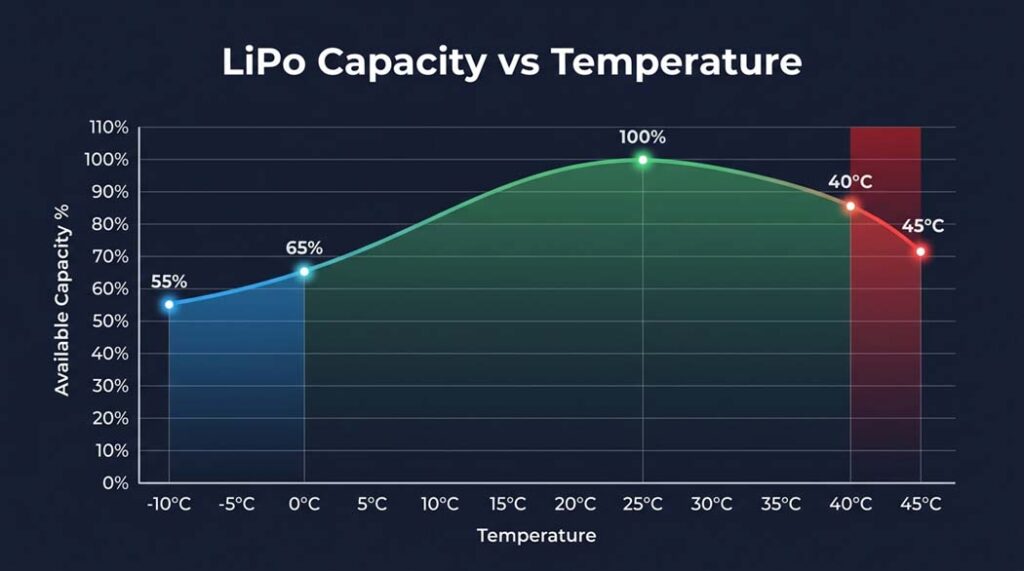
6 Temperature Killed Your Capacity
LiPo batteries are shockingly sensitive to temperature. This isn’t a minor factor it can halve your runtime overnight.
The Numbers
- Below 10°C (50°F): Usable capacity drops 10–20%. Ion mobility in the electrolyte slows down, internal resistance rises sharply.
- Below 0°C (32°F): Capacity drops 30–40%. Voltage sag under load becomes severe. Many packs can’t deliver rated current.
- Above 45°C (113°F): Electrolyte decomposition accelerates. Each month at high temperature is equivalent to multiple charge cycles of degradation.
- Charging below 0°C: Causes lithium metal plating on the anode. This is permanent, irreversible, and creates internal short circuit risks. Most consumer chargers don’t check temperature.
The Scenario People Miss
You charge your battery indoors (25°C). Walk outside to fly in 5°C weather. Your battery effectively lost 15–20% of usable capacity between your desk and the flying field. It’s not broken. It’s cold. And nobody told you this matters.
7 Wrong C-Rating for Your Application
C-rating is one of the most misunderstood and most exaggerated specs in the LiPo world.
What C-Rating Actually Means
- A 1000mAh battery rated at 25C can theoretically deliver 25A continuously.
- In reality, most budget brands inflate C-ratings by 2–5×. That “25C” pack might only sustain 10–12C before voltage sag makes it useless.
- If your application draws 20A peaks and your 1000mAh pack is actually capable of 12C (12A), you’re over-stressing the cells every single time. Voltage sags. Protection triggers. Runtime plummets.
How to Choose Correctly
Calculate your actual peak current draw (not average peak). Divide by battery capacity in Ah. That’s the C-rate you need. Then add a 50% safety margin because the label is probably lying. Buy from brands that publish independent third-party discharge test data (Tattu, CNHL, and GNB are more honest than most).
8 Storage Abuse & Calendar Aging
This is the slow, invisible killer. It doesn’t cause a dramatic failure. It just quietly steals 5–10% of your capacity year after year until one day you realize your 1500mAh pack now behaves like a 900mAh pack.
The Science
- At full charge (4.2V), the anode is under maximum electrochemical stress. A solid electrolyte interface (SEI) layer grows faster, consuming lithium ions permanently.
- Research shows storing at 4.2V at 25°C causes ~20% capacity loss per year. At storage voltage (3.8V), this drops to ~4% per year.
- At elevated temperatures (40°C), the degradation at full charge is even worse up to 35% per year.
- This damage is irreversible. No amount of cycling, conditioning, or “reconditioning” will recover lost lithium inventory.
9 Physical Damage You Can’t See
LiPo pouch cells are fragile. The internal layers anode, cathode, separator are microns thin. Damage doesn’t always show externally.
Hidden Damage Sources
- Hard landings / crashes: Internal tabs can partially disconnect, increasing resistance. Separator layers can develop micro-tears that cause slow internal shorts.
- Overtightened straps: Excessive pressure on a pouch cell deforms internal layers and can cause localized hotspots.
- Lead wire stress: Repeatedly bending wire connections at the cell tab can fracture the joint, creating intermittent high-resistance connections.
- Previous over-discharge: Discharging below 3.0V per cell causes copper dissolution from the anode current collector. When you recharge, this copper plates out in random locations, creating internal micro-shorts. The cell looks fine. It charges fine. But it self-discharges 10–100× faster than normal.
LiPo Voltage State Reference Chart (Per Cell)
Use this visual to quickly assess where your cell stands. All values per single LiPo cell:
Comparison: LiPo Battery Diagnostic Tools
Not sure what tool to buy? Here’s a real-world comparison based on what actually helps you diagnose “dies too fast” problems:
| Tool | Price Range | IR Readout | Per-Cell Voltage | Load Testing | Ease of Use | Best For |
|---|---|---|---|---|---|---|
| Basic Multimeter | $10–20 | ❌ No | ⚠️ Manual per lead | ❌ No | Easy | Quick voltage checks |
| Cell Checker / Alarm | $4–10 | ❌ No | ✅ Yes | ❌ No | Easy | Field per-cell monitoring |
| iSDT Q6 Pro Charger | $50–65 | ✅ Yes | ✅ Yes | ⚠️ Discharge mode only | Moderate | IR tracking + smart charging |
| ToolkitRC M8S | $45–55 | ✅ Yes | ✅ Yes | ⚠️ Discharge mode only | Moderate | Multi-chemistry + compact |
| CBA Battery Analyzer | $120–200 | ✅ Calculated | ⚠️ Total only | ✅ Full discharge curves | Moderate | True capacity testing, discharge curves |
| Smart BMS (JBD/Daly) | $15–50 | ⚠️ Some models | ✅ Yes (via app) | ❌ No | Easy | Long-term monitoring, IoT/EV packs |
| Oscilloscope | $60–400+ | ❌ No | ✅ Yes | ✅ Transient capture | Advanced | Catching spike/sag events, parasitic drain |
Comparison: Quick Fix Methods Ranked by Effectiveness
If your LiPo dies fast, here’s how to prioritize your troubleshooting ranked by how often each fix actually solves the problem in my experience:
| Fix / Action | Cost | Time to Implement | Success Rate | Difficulty | When to Try |
|---|---|---|---|---|---|
| Add bulk capacitor (470µF+) | $0.15 | 5 minutes | Very High | Easy | ESP32/MCU brownout resets |
| Check per-cell voltage under load | $4 (cell checker) | 2 minutes | Very High | Easy | Always first diagnostic step |
| Measure & eliminate parasitic drain | $0 (if you have a multimeter) | 15–30 minutes | High | Moderate | Battery drains overnight/idle |
| Use thicker/shorter power wires | $2–5 | 10 minutes | Medium-High | Easy | Long wires, thin gauge, breadboards |
| Upgrade charger to smart charger | $45–65 | N/A | Medium | Easy | Using cheap/bundled charger |
| Switch to higher C-rate battery | $15–50 | N/A | Medium | Easy | High-current applications |
| Use larger capacity battery | $10–40 | N/A | High | Easy | When current draw exceeds cell capability |
| Retire and replace the pack | $10–50 | N/A | Definitive | Easy | High IR, puffing, failed 24hr self-discharge test |
🔧 Pro-Tips from the Field: What 6+ Years of LiPo Failures Taught Me
These aren’t in any datasheet. They come from wrecked drones, dead IoT nodes deployed in the field, and hundreds of hours on the bench.
Tip #1: The Storage Voltage Rule Is Non-Negotiable
If you’re not using a LiPo within 48 hours, bring it to storage voltage (3.80–3.85V/cell). I’ve watched identical packs diverge dramatically over one season the ones stored at full charge lost 18% capacity. The ones stored at 3.8V lost less than 3%. Same brand, same batch, same use pattern. Only difference was storage discipline.
Tip #2: Log IR on Every Pack from Day One
Write the initial IR readings on the pack with a Sharpie. Check every 20–30 cycles. When IR doubles from its initial value, that pack has reached middle age. When it triples, start shopping for a replacement. This one habit has saved me from surprise failures mid-flight more times than I can count.
Tip #3: Never Trust a Breadboard for Power
Breadboard contact resistance can add 0.5–2Ω in the power path. At 500mA, that’s 0.25–1V of drop before your circuit even sees the power. I’ve seen ESP32 projects that “can’t run on battery” work perfectly the moment you solder the power wires directly. Breadboards are for signal prototyping, not power delivery.
Tip #4: The “One Flight” Rule for Puffed Packs
The moment a pack shows any visible swelling, it gets zero more flights. Not “one last flight.” Zero. I’ve seen packs go from “slightly puffy” to “actively venting flames” in a single high-current discharge. The gas inside is flammable electrolyte vapor. The structural integrity of the separator is compromised. No project, no flight, no test is worth a fire.
Tip #5: Use an XT60 or XT30 Not JST-PH for High Current
JST-PH connectors are rated for 2A. People routinely pull 5–10A through them on DIY drone builds. The connector heats up, resistance increases, contact degrades over time. Then they blame the battery for voltage sag. Use appropriately rated connectors: XT30 for up to 30A, XT60 for up to 60A. The connector is part of the power system.
Tip #6: Cycle New Packs Before Trusting Them
Fresh-from-factory LiPos especially budget brands often take 3–5 gentle charge/discharge cycles to reach rated capacity. The first charge cycle on a new pack often delivers 80–90% of rated mAh. Don’t judge a new pack by its maiden run. Give it a few cycles at moderate C-rates first.
Tip #7: Your Voltage Regulator Choice Matters More Than You Think
The AMS1117 (LDO) has a dropout voltage of ~1.1V and wastes everything above 3.3V as heat. A buck converter (like MP1584 or TPS63000 buck-boost) is 85–95% efficient. On battery power, switching from an LDO to a buck converter can extend runtime by 30–50% on the same cell. The LiPo isn’t dying fast your regulator is wasting the energy.
❓ FAQ People Also Ask
Answers to the 10 most common questions from people dealing with LiPo batteries that die too fast.
Most quality LiPo cells are rated for 300–500 cycles to 80% of original capacity. But this assumes ideal conditions: charging to 4.2V, discharging to ~3.5V, moderate C-rates, and room temperature. In practice, aggressive use (high C-rate discharge, hot environments, deep discharge) can cut this to 100–200 cycles. Conversely, charging to only 4.1V and discharging to 3.6V can double or even triple the rated cycle life. Battery University research confirms that partial charge/discharge cycles significantly extend LiPo longevity.
A healthy LiPo should not lose meaningful voltage overnight if nothing is connected. If it drops more than 0.02–0.03V per cell in 24 hours with no load, something is wrong. The most likely causes are: (1) a developing internal micro-short from previous over-discharge or physical damage, (2) a parasitic drain from a circuit that’s still connected, or (3) end-of-life cell degradation. Check per-cell voltages if one cell drops significantly faster than the others, that specific cell is failing and the pack should be retired.
The ESP32’s brownout detector triggers at approximately 2.43V by default. WiFi transmission bursts draw 300–500mA peaks. If your LiPo has high internal resistance, is undersized (below 500mAh for WiFi-heavy apps), or your power path has resistance (thin wires, JST connectors, breadboard contacts), voltage sags below the brownout threshold during TX bursts. Fixes: (1) add a 470µF–1000µF capacitor at the ESP32 VIN pin, (2) use a larger capacity LiPo (1000mAh+), (3) solder power connections directly instead of using breadboard, (4) use shorter/thicker wires, and (5) switch from LDO to buck-boost regulator if using one.
No. Absolutely not. Puffing indicates internal gas generation from electrolyte decomposition. The cell’s internal structure is compromised separator integrity may be reduced, and internal shorts are more likely. Continued use especially at high discharge rates risks thermal runaway, fire, or venting of toxic gases. Discharge it to 0V using a controlled method (discharge through a resistor, salt water bath, or charger discharge mode), then dispose at a battery recycling facility. Never puncture, crush, or throw puffy LiPos in household trash.
3.80V–3.85V per cell (approximately 40–50% state of charge). At this voltage, electrochemical stress on both the anode and cathode is minimized. Studies show LiPos stored at this voltage retain 96–97% capacity per year, compared to 80% when stored at full charge (4.2V). Every quality smart charger has a “Storage” mode that automatically charges or discharges to this level. Use it. This single habit extends LiPo lifespan more than almost any other practice.
Yes, dramatically. At 0°C (32°F), usable capacity drops 20–40% compared to room temperature. Lithium ion mobility in the electrolyte decreases, internal resistance spikes, and voltage sag under load becomes severe. At -10°C, many LiPo packs simply can’t deliver rated current. Keep batteries warm until the moment of use (jacket pocket, insulated case). And critically: never charge a LiPo below 0°C. It causes lithium metal plating on the anode permanent damage that creates internal short circuit risk.
Rapid voltage drop under load points to one of three things: (1) High internal resistance the cell can’t deliver current without massive voltage sag. Check IR with a smart charger. (2) Undersized battery for the application if you’re pulling more current than the cell can reasonably supply (exceeding its true C-rating), voltage will collapse. (3) Wiring/connector resistance thin wires, oxidized connectors, or breadboard contact resistance add to the effective IR of the system. Measure voltage at the battery terminals AND at the load terminals under operation. If they differ by more than 0.2V, you have wiring losses.
Check the resting voltage per cell. If cells read above 3.0V, the battery is likely recoverable with a normal charge cycle. If cells read 2.5–3.0V, the pack is deeply discharged some chargers refuse to charge at this level but a “NiMH” trickle charge at very low current (0.1–0.2A) can often recover it to a safe level, then switch back to LiPo mode. If any cell reads below 2.0V, that cell is almost certainly damaged beyond recovery. Copper dissolution has likely occurred and the cell is a safety risk. Retire the pack. Also, any pack that puffs, smells unusual, or gets hot during charging is dead don’t try to save it.
For cycle life and longevity, 18650 Li-ion cells (e.g., Samsung 30Q, Sony VTC6, LG HG2) typically last 500–1000+ cycles vs. 300–500 for LiPo pouches. They’re also more resistant to abuse, have built-in protection (in protected variants), and are less prone to puffing. However, LiPo pouches offer higher discharge rates (better for drones, RC), lighter weight, and more flexible form factors. For IoT projects, sensor nodes, and portable devices where longevity matters more than burst power, 18650s are often the better choice. For FPV drones and RC, LiPo still dominates.
No. Despite what some YouTube videos claim, capacity loss in LiPo cells is caused by irreversible chemical changes lithium inventory loss, SEI layer growth, electrode structural degradation. There is no “reconditioning” procedure that reverses these changes. Cycling the pack at moderate rates can sometimes recover temporary capacity dips caused by extended storage (the cell “wakes up”), but this recovers maybe 3–5% not the 20–30% you’ve lost to aging. If a pack has genuinely lost capacity, the lithium is gone. Replace the pack and take better care of the next one.
⚠️ Safety & Evidence Disclaimer
LiPo batteries store significant energy and can cause fire, burns, chemical exposure, or toxic fume inhalation if damaged, misused, short-circuited, or improperly charged. Always observe the following:
- Use a charger specifically designed for LiPo/Li-ion chemistry with proper voltage and current settings.
- Charge only on fireproof surfaces or inside LiPo-safe charging bags.
- Never leave charging batteries unattended.
- Immediately discontinue use of any battery that puffs, emits odor, or generates abnormal heat.
- Store batteries away from flammable materials at storage voltage (3.8V/cell).
- Dispose of damaged or end-of-life LiPo batteries at designated battery recycling facilities never in household waste.
- Never charge a LiPo below 0°C or above 45°C.
The information in this guide is based on real-world field experience, published electrochemistry research, and manufacturer technical documentation. It is provided for educational purposes and is not a substitute for manufacturer-specific safety instructions for your particular battery or device. When in doubt, consult the battery manufacturer directly.
⚡ The Bottom Line
A LiPo battery that “dies fast even when fully charged” is almost never a mystery once you know the 9 places to look. In my experience, the real cause is a combination of 2–3 overlapping factors: elevated internal resistance, cell imbalance, unmeasured current spikes, parasitic drains, charger inaccuracy, temperature effects, wrong C-rating, storage abuse, or hidden physical damage.
Stop blaming the battery brand. Start measuring under load. Start tracking per-cell voltages. Start storing at 3.8V. These three habits alone will double the useful life of your packs and eliminate most “dies too fast” complaints.
And if a pack is puffed even slightly let it go. No flight, no project, no test is worth a house fire.
Stay safe. Build smart. And treat your batteries like the volatile energy stores they are. 🔋
This guide is regularly updated with new field insights and reader feedback.
Last reviewed: July 2025 | Next scheduled review: October 2025