 Procirel
Class D vs. Class AB Amplifier: Which is Best for Your Home Audio?
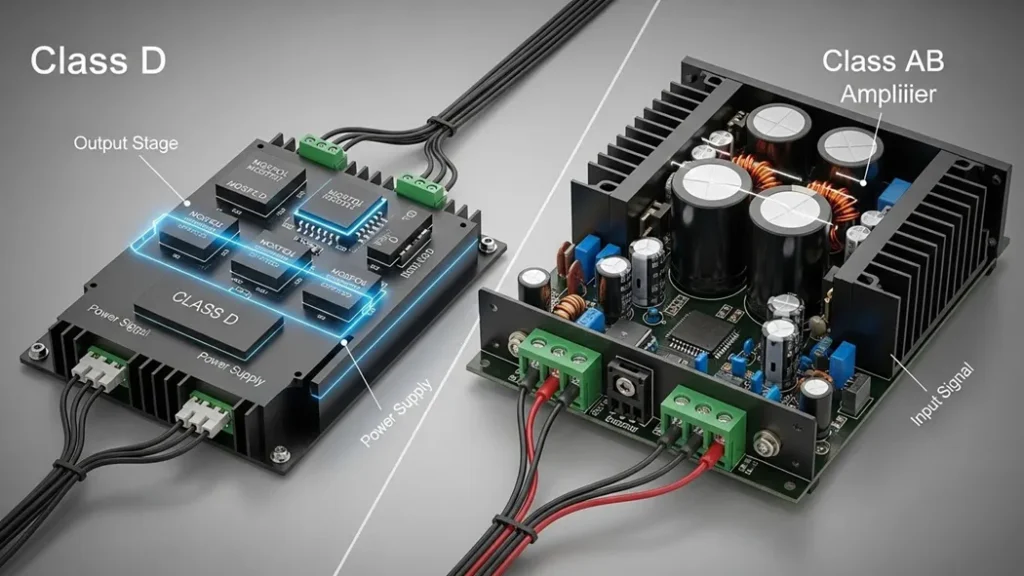
While both serve the same purpose, their internal magic, efficiency, and sound signatures differ significantly. This guide will break down the technicalities of Class D and Class AB amplifiers to help you decide which is the perfect fit for your ears and your home. For efficiency, compact size, and subwoofer power, Class D is usually the better choice.
## 1. Understanding the Fundamentals: How Do They Work?
To appreciate the difference, we must look at how these devices handle the “Active Device” (the transistor) inside the circuit.
[Class D vs. Class AB Amplifier-2](/api/media/class-d-vs-class-ab/Class-D-vs. -Class-AB-Amplifier-2-1024×576.
### Class AB: The Audiophile’s Balanced Choice
Class AB is a “hybrid” design. It was created to solve the problems of its predecessors. The power-hungry Class A and the distortion-prone Class B.
1. In a Class B amplifier, the circuit conducts only half the signal cycle. Introduces “crossover distortion” where the two halves of the sound wave meet.
2. Class AB fixes this by allowing both transistors to stay “on” slightly during the crossover point.
3. This results in a happy medium that combines the high sound quality of Class A with the better efficiency of Class B.
### Class D: The High-Efficiency Powerhouse
Contrary to popular belief, the “D” in Class D does not stand for “Digital. ” It stands for the next letter in the sequence of amplifier classifications.
1. Instead of acting like a variable valve (linear), Class D transistors operate as switches.
2. They are either fully “on” or fully “off”.
3. By using Pulse Width Modulation (PWM), they turn the audio signal into a series of pulses.
4. Because the transistors spend very little time in the “in-between” state where heat is generated, they are incredibly efficient.
## 2. The Efficiency Battle: Power vs. Heat
In the world of[electronics](/tutorial/electronics), efficiency (Eta)
is the ratio of useful AC power delivere …
d to the speakers versus the DC power drawn from the wall.Why it matters for your home: A Class AB amplifier is essentially a heater that plays music. Because nearly half the energy is wasted as heat, these units require massive metal heat sinks and plenty of ventilation. On the other hand, Class D amplifiers can produce massive amounts of power in tiny, lightweight enclosures because they lose very little energy to heat.
| Metric | Class AB | Class D |
| — | — | — |
| Typical Efficiency | 50–70% | 90–95%+ (up to near 100% theoretical) |
| Heat Dissipation | High (large heatsinks required) | Very low (compact designs possible) |
| Power Consumption | Moderate to high | Minimal |
| Physical Size/Weight | Larger and heavier | Compact and lightweight |
## 3. Sound Quality and Linearity
For many audiophiles, “Linearity” is the gold standard. It means the output is a perfect, larger-scale copy of the input. The Warmth of Class AB Class AB is renowned for itshigh linearity and “warm” sound. Because the transistors are always active (never fully switching off), there is no high-frequency switching noise to filter out. This makes Class AB the standard for high-end home theaters and professional studio equipment where audio purity is the only thing that matters.
### The Precision of Class D
Early Class D amplifiers were criticized for sounding “cold” or “harsh” due to the high-frequency switching noise. However, modern technology has changed the game. To make the sound usable, Class D amps use a low-pass filter at the output to smooth the pulses back into a smooth audio wave. High-end modern Class D units (like those using GaN transistors) now rival Class AB in clarity. They are often preferred for their “punchy” and “fast” bass response, making them the kings of subwoofers.
## 4. Practical Applications: Which One Should You Buy?
### When to Choose Class AB
– Critical Listening: If you have a dedicated listening room and high-end floor-standing speakers.
– Legacy Quality: If you prefer the heavy, robust build of traditional Hi-Fi gear.
– Home Theater Main Channels: For the front left, right, and center speakers where vocal clarity is paramount.
### When to Choose Class D
– Portable and Small Spaces: If you need an amp for a bookshelf, a desktop, or a smartphone.
– Powering Subwoofers: Because subwoofers require massive current and power, the high efficiency of Class D is ideal.
– Hidden Audio: If you are installing speakers in a ceiling or a cabinet where there is no airflow for cooling.
ScenarioRecommended ClassWhyCritical two-channel listening with efficient speakersClass ABTraditional warmth and proven linearityMulti-channel home theater or high-power needsClass DEfficiency, cool operation, compact sizeSubwoofer amplificationClass DHandles high current demands effortlesslyDesktop, bookshelf, or space-constrained setupsClass DSmall footprint, low heatPortable or battery-powered audioClass DExtended battery life
## 5. Technical Performance Metrics
– To truly compare these two, engineers look at specific formulas to determine performance. Power Gain (Ap). Both classes aim to maximize the ratio of output power to input power (Ap=PoutPin)..
– To truly compare these two, engineers look at specific formulas to determine performance.
– Power Gain (Ap). Both classes aim to maximize the ratio of output power to input power (Ap=PoutPin)..
– Total Harmonic Distortion (THD): Class AB generally maintains a lower THD across high frequencies. Class D distortion can increase if the output filter is not high-quality.
– Thermal Management: In Class AB, designers must use JEDEC standards to prevent “thermal runaway,” where the heat causes the amplifier to destroy itself
### 6. Real-World User Experiences
– The community feedback on these classes is quite telling. A user on a popular audio forum noted that switching to a dedicated high-power amplifier provided a “punch unlike anything I’d heard before”. Interestingly, while many still swear by the “warmth” of Class AB, modern Class D users frequently report that they cannot tell the difference in a blind test except that their room stays much cooler!.
### Conclusion: No Universal Winner
The Class AB vs. Class D debate has evolved significantly by 2026. Class AB remains beloved for its timeless, organic sound signature and robust build. Class D, however, represents the future offering superior efficiency, power density. (in top implementations) transparent audio quality that challenges traditional perceptions.
Ultimately, the best amplifier is the one whose implementation aligns with your priorities. Timeless musicality and heft (Class AB) or modern efficiency and versatility (Class D). Many audiophiles now mix both Class AB for mains and Class D for surrounds or subs for optimal performance. Learn more about different[Amplifier Classes](/tutorial/what-is-an-amplifier)in our main guide.
#### FAQ:
Is Class D digital?
No, it uses Pulse Width Modulation, which is an analog process.
Which is more efficient?
Class D is the clear winner, often excee …
ding 90% efficiency.Can Class AB be portable?
It is difficult because Class AB requires large batteries and heavy heat sinks.
Are differences audible in blind tests?
Often not, when comparing high-quality examples.
## Related guides in this track
– New to Amplifiers & Audio? Start with the [complete amplifiers & audio guide](/tutorial/amplifiers-complete-guide) it indexes every tutorial in this track.
– [Inverting Op-Amp: Gain, Virtual Ground and Design](/tutorial/inverting-op-amp-configuration)
– [Non-Inverting Op-Amp: High-Impedance Gain Stage](/tutorial/non-inverting-op-amp-configuration)
– [The Op-Amp Voltage Follower: Small Circuit, Big Leverage](/tutorial/op-amp-voltage-follower)
– Calculate the numbers: [op-amp gain calculator](/tools/opamp-gain) · [power calculator](/tools/electrical-power)
### Practical example
Take the first measured row from the table above. Typical Efficiency corresponds to 50–70% under 90–95%+ (up to near 100% theoretical). Reproduce that configuration at the bench, record your own value beside it. Any meaningful gap tells you which tolerance or assumption deserves a closer look. Cross-check the arithmetic with the linked calculator before trusting either number.
## Keep going with this track
– The complete amplifiers & audio guide: [Amplifiers & Audio complete guide](/tutorial/amplifiers-complete-guide)
– Read next: [inverting op-amp: gain, virtual ground and design](/tutorial/inverting-op-amp-configuration)
– Also in this track: [non-inverting op-amp: high-impedance gain stage](/tutorial/non-inverting-op-amp-configuration)
– Continue with: [the op-amp voltage follower: small circuit, big leverage](/tutorial/op-amp-voltage-follower)
– Calculate as you go: [op-amp gain calculator](/tools/op-amp-gain) · [power dissipation tool](/tools/electrical-power) · [gain to dB converter](/tools/opamp-gain)
– Bookmark this page against the day a measurement surprises you. Most readers return to the table and the mistake list first, and that is the correct order.
## Frequently asked questions
Technical Performance Metrics?
– To truly compare these two, engineers look at specific formulas to determine performance. Power Gain (Ap). Both classes aim to maximize the ratio of output power to input power (Ap=PoutPin)..
– To truly compare these two, engineers look at specific formulas to determine performance.
– Power Gain (Ap). Both classes aim to maximize the ratio of output power to input power (Ap=PoutPin)..
– Total Harmonic Distortion (THD): Class AB generally maintains a lower THD across high frequencies. Class D distortion can increase if the output filter is not high-quality.
– Thermal Management: In Class AB, designers must use JEDEC standards to prevent “thermal runaway,” where the heat causes the amplifier to destroy itself
6.
Understanding the Fundamentals: How Do They Work??
To appreciate the difference, we must look at how these devices handle the “Active Device” (the transistor) inside the circuit.
[Class D vs. It was created to solve the problems of its predecessors. The power-hungry Class A and the distortion-prone Class B.
1.
Sound Quality and Linearity?
The Warmth of Class AB Class AB is renowned for its high linearity and “warm” sound. Because the transistors are always active (never fully switching off), there is no high-frequency switching noise to filter out.