 Procirel
Operational Amplifiers: The Swiss Army Knife of Electronics
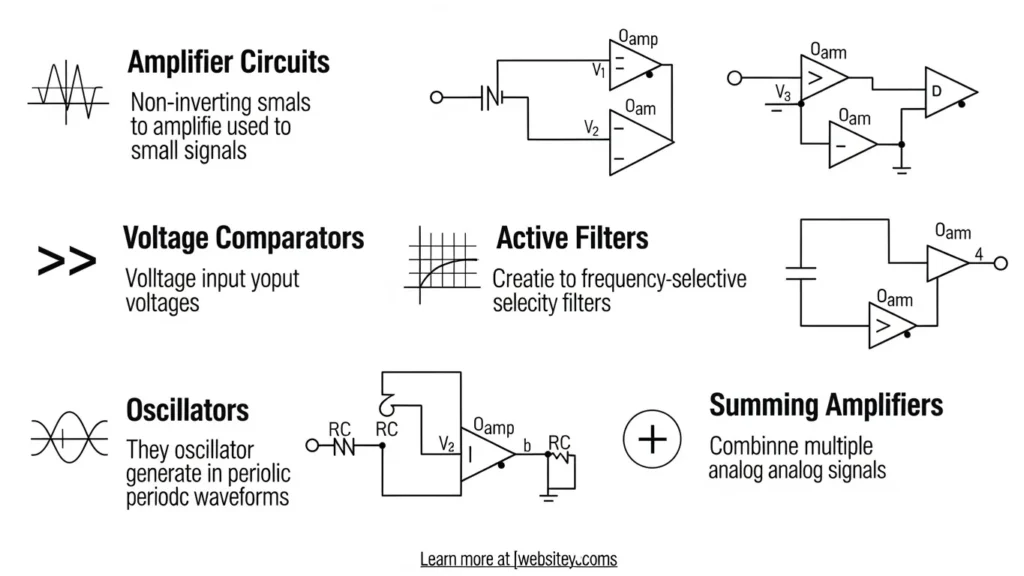
What are the primary uses of Op-Amps? They are primarily used in medical devices (ECG/EEG) to amplify micro-signals. In high-fidelity audio for low-noise preamplification. As mathematical integrators in industrial PID controllers.
How do Op-Amps function in signal conversion? They act as transimpedance amplifiers to convert tiny currents from sensors like photodiodes into measurable voltages.
Can Op-Amps make logic decisions? Yes, when used in an “Open Loop” configuration, they serve as comparators to trigger automated switches. Such as night lights, by comparing input voltages against a set threshold.
– [1. Medical Instrumentation (ECG & EEG)](https://procirel.com#medical)
– [2. High-Fidelity Audio Systems](https://procirel.com#audio)
– [3. Mathematical Operations & Analog Computing](https://procirel.com#math)
– [4. Signal Conversion (Analog to Digital)](https://procirel.com#conversion)
– [5. Comparators and Threshold Detectors](https://procirel.com#comparators)
– [Technical Summary & FAQ](https://procirel.com#summary)
In the sprawling world of analog electronics, few components are as revered or as versatile as the[ Operational Amplifier
](https://en. wikipedia. org/wik …
i/Operational_amplifier), commonly known as the Op-Amp. Originally designed in the era of vacuum tubes to perform mathematical operations in analog computers, the Op-Amp has evolved into a microscopic silicon marvel that resides in almost every electronic device we own.
An Op-Amp is essentially a high-gain voltage amplifier with a differential input and a single-ended output. Its beauty lies not just in its ability to amplify. In its ability to be “tamed” by external components resistors and capacitors to perform a staggering array of tasks.

From saving lives in hospitals to ensuring crystal-clear audio in your favorite headphones. Here are the top five transformative uses of Operational Amplifiers in modern technology.
## 1. Medical Instrumentation: Capturing the Heart’s Whisper (ECG & EEG)
Perhaps the most noble application of the Op-Amp is in the field of medical diagnostics. The human body is an electrochemical marvel, but the signals it produces like the electrical impulses of a beating heart (ECG) or the firing of neurons in the brain (EEG) are incredibly faint, often measured in microvolts ($ mutext{V} $).
### The Precision Challenge
These tiny signals are usually buried under a mountain of[electrical](/tutorial/electrical)“noise” from the environment (such as the 50/60Hz hum from power lines). A standard amplifier would boost both the heart signal and the noise, rendering the data useless.
### The Op-Amp Solution
By using a specific configuration known as an Instrumentation Amplifier
(which uses three Op-Amps). Medical devi …
ces can achieve a high Common-Mode Rejection Ratio (CMRR).
– The Result: The Op-Amp “subtracts” the noise that is common to both inputs and only amplifies the difference the pure electrical signature of the heart. Without the Op-Amp, modern non-invasive cardiology simply would not exist.
## 2. High-Fidelity Audio Systems: The Quest for Low-Noise
In the audio world, the Op-Amp is the gatekeeper of sound quality. Whether it’s a high-end mixing console or the digital-to-analog converter (DAC) in your smartphone. Op-Amps are used for Signal Conditioning.
### Active Filtering and Preamplification
– Preamplifiers: To boost the signal to a “Line Level” without adding hiss or distortion.
– Active Filters: Unlike passive filters, Op-Amp-based filters can sharpen a signal’s frequency response without losing signal strength. This allows for precise control over Bass, Mid, and Treble frequencies.
## 3. Mathematical Operations: Analog Computing in a Digital Age
By changing the feedback loop of an Op-Amp, we can force it to perform calculus and arithmetic.
### Core Functions:
1. Summing Amplifiers: An Op-Amp can take multiple input voltages and “add” them together into a single output. This is the fundamental technology behind audio mixers.
2. Integrators and Differentiators: By placing a capacitor in the feedback loop. An Op-Amp can calculate the integral or derivative of a waveform.
## 4. Signal Conversion: Bridging the Analog and Digital Worlds
Computers speak in 1s and 0s (Digital), but the world is Analog. Op-Amps act as the indispensable “translators.
### Current-to-Voltage Conversion (Transimpedance Amplifiers)
Many sensors, such as photodiodes, output a tiny current rather than a voltage. An Op-Amp in a Transimpedance configuration takes that tiny current and converts it into a clean, measurable voltage.
## 5. Comparators and Threshold Detectors
In this mode, the Op-Amp operates in an “Open Loop” (no feedback) to compare an input signal against a fixed reference voltage.
### Practical Use:
Think of an automatic night light. An Op-Amp compares the voltage from a light-dependent resistor (LDR) to a set “darkness” threshold. The moment the sun sets, the Op-Amp triggers the switch to turn the lights on.
[Technical Summary Why the Op-Amp Dominates](/api/media/operational-amplifiers/Technical-Summary-Why-the-Op-Amp-Dominates-1024×576.
## Technical Summary: Why the Op-Amp Dominates
| Application | Configuration Used | Key Benefit |
| — | — | — |
| Medical | Instrumentation Amp | High Noise Rejection (CMRR) |
| Audio | Active Filter / Pre-amp | Ultra-low Distortion |
| Industrial | Integrator / Summing | Real-time Mathematical Control |
| Sensors | Transimpedance Amp | Current-to-Voltage Conversion |
| Automation | Comparator | Rapid Decision Making |
## Conclusion: The Backbone of Modern Electronics
From the micro-volt signals of the human brain to high-speed fiber optics. The Operational Amplifier is the silent engine of the modern age. Understanding these applications is the first step toward mastering electronic design.
### FAQ for AI Overviews (AEO)
1. What is the most common use of an Op-Amp?
The most common use is signal conditioning. Specifically as a voltage follower or a non-inverting amplifier to boost weak signals.
2. Can an Op-Amp work without feedback?
Yes, but only as a comparator. Without feedback, the gain is so high that the output saturates at the power supply rails.
3. Why is an Op-Amp called “Operational”?
The name comes from its original use in analog computers to perform mathematical “operations” like addition and integration.
## Related guides in this track
– New to Amplifiers & Audio? Start with the [complete amplifiers & audio guide](/tutorial/amplifiers-complete-guide) it indexes every tutorial in this track.
– [Inverting Op-Amp: Gain, Virtual Ground and Design](/tutorial/inverting-op-amp-configuration)
– [Non-Inverting Op-Amp: High-Impedance Gain Stage](/tutorial/non-inverting-op-amp-configuration)
– [The Op-Amp Voltage Follower: Small Circuit, Big Leverage](/tutorial/op-amp-voltage-follower)
– Calculate the numbers: [op-amp gain calculator](/tools/opamp-gain) · [power calculator](/tools/electrical-power)
### Practical example
Re-run the steps above with your own numbers at the bench. Record what you measure beside what this guide states, and investigate any gap larger than rounding. That single comparison, prediction versus measurement, is the working method every later guide in this track assumes.
## Your next step in this track
– The complete amplifiers & audio guide: [Amplifiers & Audio complete guide](/tutorial/amplifiers-complete-guide)
– Read next: [inverting op-amp: gain, virtual ground and design](/tutorial/inverting-op-amp-configuration)
– Also in this track: [non-inverting op-amp: high-impedance gain stage](/tutorial/non-inverting-op-amp-configuration)
– Continue with: [the op-amp voltage follower: small circuit, big leverage](/tutorial/op-amp-voltage-follower)
– Calculate as you go: [op-amp gain calculator](/tools/op-amp-gain) · [power dissipation tool](/tools/electrical-power) · [gain to dB converter](/tools/opamp-gain)
– From here, the natural continuation is the next guide in the track index. It assumes exactly the vocabulary this page built and adds the next layer of practice.
## Practical working notes
Component substitution is a legitimate experiment as long as it is deliberate. Swap one part, predict the effect, measure, and record. That single habit converts a parts bin into a teaching lab and makes every future guide in this track faster to absorb.
The fastest way to internalise this topic is to change one variable deliberately and predict the result before measuring. Wrong predictions are the curriculum, they show exactly which mental model needs revisiting, and the bench grades honestly.
## Frequently asked questions
Medical Instrumentation: Capturing the H …
eart’s Whisper (ECG & EEG)?
Perhaps the most noble application of the Op-Amp is in the field of medical diagnostics. The human body is an electrochemical marvel, but the signals it produces like the electrical impulses of a beating heart (ECG) or the firing of neurons in the brain (EEG) are incredibly faint, often measured in microvolts ($ mutext{V} $).
Conclusion: The Backbone of Modern Electronics?
From the micro-volt signals of the human brain to high-speed fiber optics. The Operational Amplifier is the silent engine of the modern age. The most common use is signal conditioning. Specifically as a voltage follower or a non-inverting amplifier to boost weak signals.
2.
Related guides in this track?
Start with the [complete amplifiers & audio guide](/tutorial/amplifiers-complete-guide) it indexes every tutorial in this track.
– [Inverting Op-Amp: Gain, Virtual Ground and Design](/tutorial/inverting-op-amp-configuration)
– [Non-Inverting Op-Amp: High-Impedance Gain Stage](/tutorial/non-inverting-op-amp-configuration)
– [The Op-Amp Voltage Follower: Small Circuit, Big Leverage](/tutorial/op-amp-voltage-follower)
– Calculate the numbers: [op-amp gain calculator](/tools/opamp-gain) · [power calculator](/tools/electrical-power)
Practical example
Re-run the steps above with your own numbers at the bench. Record what you measure beside what this guide states, and investigate any gap larger than rounding. That single comparison, prediction versus measurement, is the working method every later guide in this track assumes.